You have done everything the Amazon PPC guides tell you. Adjusted bids, restructured campaigns, tested match types, segmented ad groups. Yet your ACoS stubbornly refuses to drop below 40%. Your competitor sells an almost identical product at a similar price, spends less on ads, and somehow maintains a 22% ACoS.
The difference is not their bidding strategy. It is their listing.
After analysing thousands of Amazon advertising campaigns across food, beverage, health, and household categories, one pattern emerges repeatedly: the sellers with the lowest ACoS are not the best advertisers – they are the best listing builders. Their listings convert at 18-25% while the category average languishes at 8-12%. That conversion rate gap is the single largest determinant of advertising profitability.
This guide takes a different approach to Amazon PPC strategy. Instead of focusing on campaign structure and bid optimisation (topics covered exhaustively elsewhere), we focus on the variable that actually determines whether your ads make money: your listing quality.
Table of Contents
- The Dirty Secret of Amazon PPC
- Why ACoS Is a Listing Problem, Not a Bidding Problem
- The PPC-Listing Quality Feedback Loop
- What Amazon’s Algorithm Considers for Ad Relevance
- Campaign Types: A Brief Overview
- The Conversion Rate Multiplier Effect
- Which Listing Elements Affect PPC Performance Most
- How to Diagnose Your PPC Problems
- The Optimise Before You Advertise Framework
- Budget Allocation: When to Spend More
- When PPC Cannot Fix a Listing Problem
- Case Study: Same Product, Same Budget, Different Listing
- The Organic Rank Flywheel
- Frequently Asked Questions
The Dirty Secret of Amazon PPC: Bad Listings Waste Ad Spend
Here is a truth that Amazon PPC management agencies rarely emphasise: no amount of campaign optimisation can overcome a listing that does not convert. If your product page fails to convince shoppers who land on it, every click you pay for is money down the drain.
The economics are straightforward. You pay per click regardless of whether that click converts. If your listing converts at 8% (below category average), you need 12.5 clicks to generate one sale. If a competitor’s listing converts at 20%, they need only 5 clicks per sale. At the same cost-per-click, your cost of acquiring a customer is 2.5x higher than theirs.
This is not a bidding problem. This is not a targeting problem. This is a listing problem masquerading as an advertising problem.
According to Amazon’s own advertising documentation, the average CPC across categories ranges from $0.50 to $3.00. At $1.20 CPC (common in grocery and health categories), the difference between an 8% and 20% conversion rate is the difference between a $15 customer acquisition cost and a $6 one. That $9 gap, multiplied across hundreds or thousands of clicks per month, is where most Amazon advertising budgets go to die.
The sellers who succeed with Amazon PPC understand something fundamental: Amazon listing optimisation is not a separate activity from advertising. It IS your advertising strategy. The listing is the ad’s landing page, and landing page quality determines advertising ROI in every channel – Amazon included.
Why ACoS Is a Listing Problem, Not a Bidding Problem
Advertising Cost of Sale (ACoS) is calculated as: Ad Spend divided by Ad Revenue, expressed as a percentage. Most sellers try to reduce ACoS by lowering their bids or narrowing their targeting. These actions reduce spend, but they also reduce reach – fewer impressions, fewer clicks, fewer sales.
The alternative approach: increase the revenue generated per click by improving your conversion rate. This is the only lever that reduces ACoS without reducing volume.
Let us work through the maths with a concrete example:
| Metric | Seller A (Poor Listing) | Seller B (Optimised Listing) |
|---|---|---|
| Monthly ad spend | $3,000 | $3,000 |
| Average CPC | $1.20 | $1.20 |
| Clicks | 2,500 | 2,500 |
| Conversion rate | 8% | 18% |
| Sales from ads | 200 | 450 |
| Average order value | $25 | $25 |
| Ad revenue | $5,000 | $11,250 |
| ACoS | 60% | 26.7% |
Same spend. Same CPC. Same product price. The only difference is that Seller B’s listing converts more than twice as well. Seller A is haemorrhaging money. Seller B is profitable. And Seller B did not touch their campaign settings to achieve this – they focused on their listing.
This is why experienced Amazon sellers treat ACoS as a diagnostic metric for listing quality rather than advertising efficiency. When ACoS is high, the first question should not be “how do I bid differently?” but “why is my listing not converting the traffic I am already paying for?”
Same product. Better listing. More sales.
The PPC-Listing Quality Feedback Loop
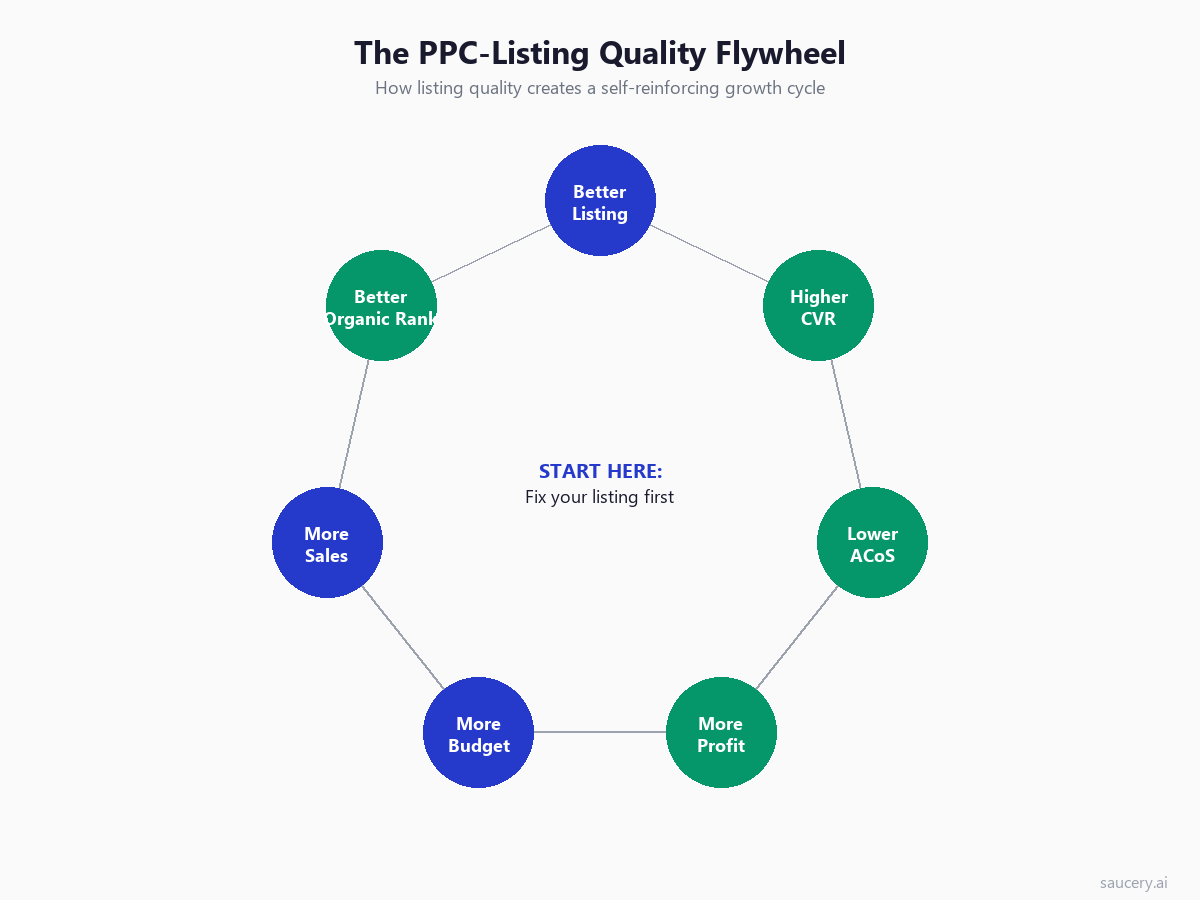
The relationship between listing quality and PPC performance is not linear – it is a flywheel. Once you improve your listing to the point where ads become profitable, a self-reinforcing cycle begins:
- Better listing – optimised images, compelling title, persuasive bullet points
- Higher conversion rate – more of your paid clicks become customers
- Lower ACoS – same spend generates more revenue
- More profit – campaigns become cash-flow positive
- More budget available – you can reinvest profits into ads
- More sales volume – higher budget drives more total orders
- Better organic rank – sales velocity improves search position
Step 7 feeds back into step 1 because better organic rank means more total sales (organic plus paid), which generates more reviews, which improves conversion rate further. This is the flywheel that successful Amazon brands build, and listing quality is the entry point.
A Jungle Scout survey of Amazon sellers found that 65% of profitable sellers cite listing quality as more important than PPC strategy for overall success. Conversely, a poor listing creates a death spiral. Low conversion means high ACoS, which means reduced budget, which means fewer sales, which means declining rank, which means even less visibility. Many sellers who conclude that “Amazon PPC does not work” are actually observing the consequences of a listing problem, not an advertising problem.
What Amazon’s Algorithm Considers for Ad Relevance
Amazon’s advertising algorithm does not operate in isolation from its organic search algorithm. Your listing content directly influences where your ads appear, how often they show, and how much you pay per click.
According to Amazon Advertising’s optimisation guides, the ad relevance score considers:
- Keyword relevance – how well your listing content matches the search term
- Historical click-through rate – how often shoppers click your ad when shown
- Historical conversion rate – how often clicks become purchases
- Listing completeness – whether all listing fields are populated
- Product category and attributes – correct categorisation and item specifics
This means your listing quality affects PPC performance in two distinct ways. First, it determines whether your ads are shown at all (relevance score). Second, it determines whether those impressions are profitable (conversion rate). A listing that is not optimised for relevant keywords may not even qualify for impressions on high-value search terms, regardless of bid amount.
Amazon rewards listings that generate sales from ads with lower CPCs over time. This is their equivalent of Google’s Quality Score – if your listing consistently converts ad traffic well, Amazon reduces your effective cost because showing your ad is profitable for them too. This creates yet another advantage for sellers with optimised listings: they literally pay less per click than competitors with the same bid.
Campaign Types: A Brief Overview
Before diving deeper into the listing-PPC connection, a brief overview of Amazon’s campaign types for context:
Sponsored Products appear in search results and on product detail pages. They look like organic listings with a small “Sponsored” label. These are the workhorse of Amazon PPC – keyword-targeted, performance-driven, and directly affected by listing quality because the ad IS your listing (main image, title, price, rating).
Sponsored Brands appear at the top of search results with your brand logo, a custom headline, and multiple products. These drive brand awareness and store traffic. Listing quality matters here because shoppers who click through land on your product pages.
Sponsored Display targets shoppers based on interests, viewing behaviour, or specific product pages. These ads appear on and off Amazon. Again, the conversion happens on your listing – so listing quality determines ROAS.
According to Amazon Sponsored Products documentation, these ads account for approximately 78% of all Amazon advertising spend. Across all three types, the same principle applies: the ad gets the click, but the listing gets the sale. Campaign type selection and bid strategy matter, but they are second-order variables compared to listing quality. Research from Jungle Scout’s 2024 advertising report indicates that top-performing sellers achieve 3-5x better ROAS than bottom performers in the same category – a gap too large to explain by bid strategy alone.
The Conversion Rate Multiplier Effect
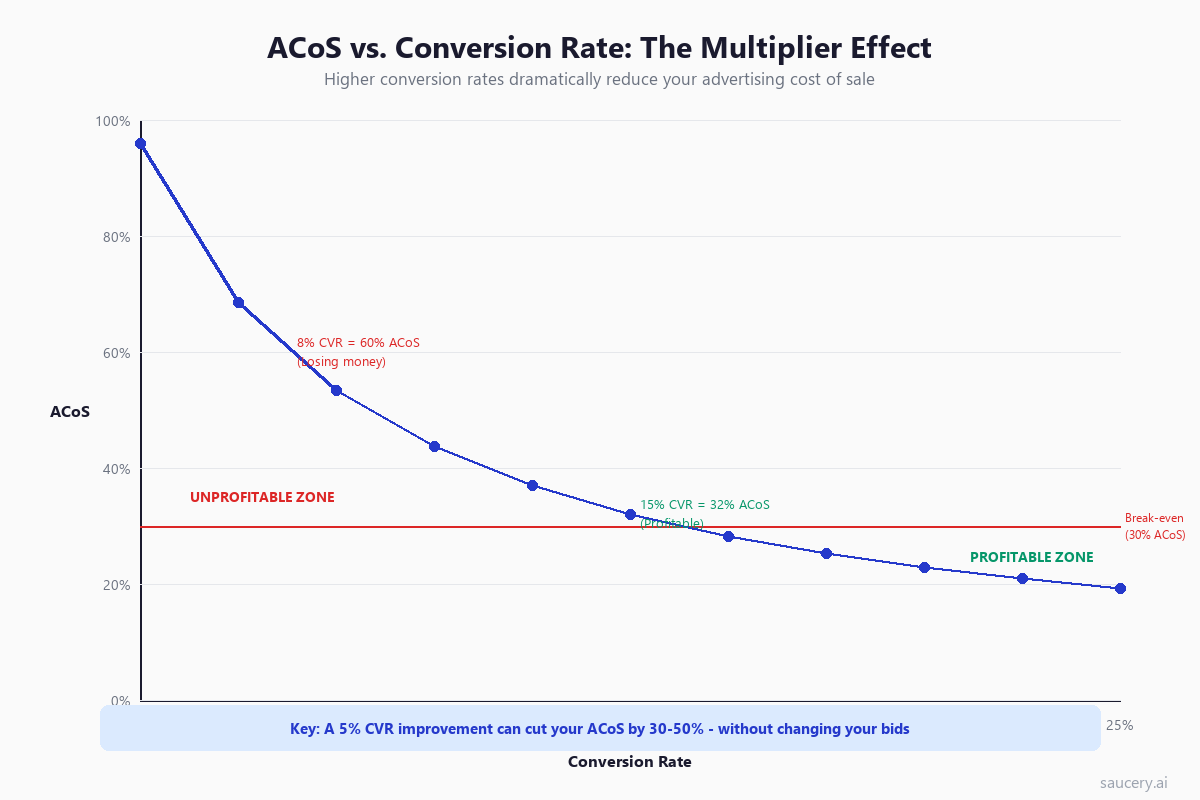
The relationship between conversion rate and ACoS is not linear – it is exponential. Small improvements in conversion rate produce outsized improvements in advertising efficiency. This is the multiplier effect, and understanding it changes how you think about PPC optimisation entirely.
Here is how the maths works. ACoS = CPC / (CVR x ASP), where ASP is average selling price. Since CPC and ASP are relatively fixed in the short term, ACoS is essentially an inverse function of CVR.
The practical implications (assuming $1.20 CPC and $25 ASP):
| Conversion Rate | ACoS | Status |
|---|---|---|
| 5% | 96% | Catastrophic loss |
| 8% | 60% | Significant loss |
| 10% | 48% | Losing money |
| 12% | 40% | Breaking even (maybe) |
| 15% | 32% | Marginal profit |
| 18% | 26.7% | Profitable |
| 20% | 24% | Strong profit |
| 25% | 19.2% | Excellent performance |
Notice the pattern: improving from 8% to 12% CVR (a 4-point improvement) reduces ACoS by 20 points. Improving from 12% to 16% (same 4-point improvement) reduces ACoS by only 10 points. This means the biggest gains come from fixing fundamentally broken listings. If your conversion rate is below category average, the return on listing optimisation dramatically outweighs the return on campaign optimisation.
Research published by Helium 10 shows that the median Amazon conversion rate sits around 10-15% depending on category, with top performers reaching 20-30%. If you are below the median, every dollar spent on listing improvement generates more ROI than every dollar spent on PPC management.
Same product. Better listing. More sales.
Which Listing Elements Affect PPC Performance Most
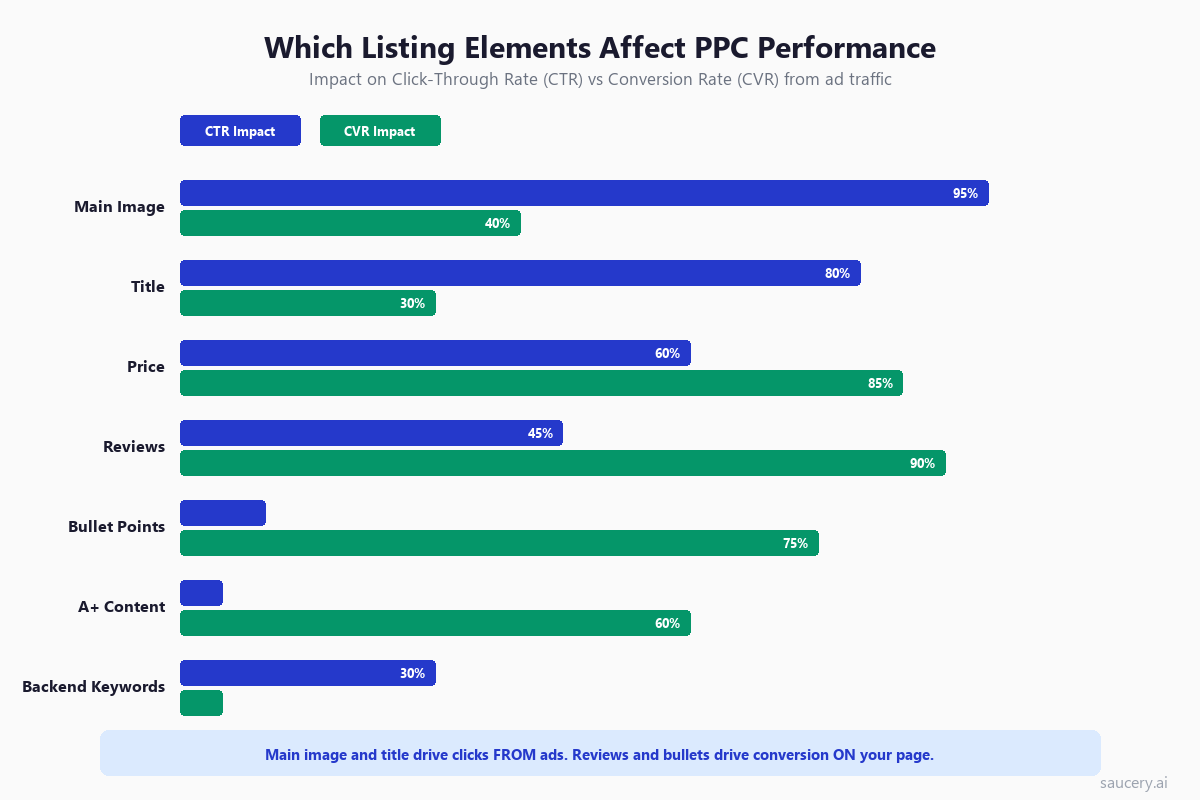
Not all listing elements affect PPC performance equally, and they affect different metrics at different stages of the purchase funnel. Understanding which elements drive click-through rate versus conversion rate lets you prioritise optimisation efforts for maximum advertising ROI.
Main Image: The Click Generator
Your main image is the single most important element for Sponsored Products performance because it IS what shoppers see in the ad. Before any shopper reads your title or checks your price, they see your image in the search results grid alongside 15-20 competing products.
A compelling main image increases CTR from ad impressions. Higher CTR means more clicks at the same spend, more data for Amazon’s algorithm, and a better relevance score over time. According to Amazon’s product photography guidelines, images that fill 85%+ of the frame, show the product clearly against a white background, and communicate scale outperform those that do not.
For food and beverage products specifically, packaging clarity is paramount. Shoppers scrolling search results make split-second decisions – your image needs to communicate what the product is, what flavour or variant it is, and roughly how much they are getting, all within a thumbnail-sized frame.
Title: Relevance Score and CTR
Your product title serves dual duty in PPC. First, it influences Amazon’s relevance matching – determining whether your ad qualifies to show for a given search term. Second, it affects CTR because shoppers scan titles to confirm the result matches their intent.
For PPC purposes, front-load your title with the most important keywords and product identifiers. Amazon truncates titles in ad placements (particularly on mobile), so the first 60-80 characters carry disproportionate weight. A title that reads “Organic Green Tea – 100 Bags – Japanese Sencha…” performs better for PPC than “Premium Quality Handpicked Authentic Japanese…” because the searchable terms appear first.
Price: The Conversion Gate
Price affects PPC in two ways. First, it influences CTR from search results (shoppers see price before clicking). Second, and more significantly, it is the primary conversion gate after clicking. A shopper who clicks your ad has already seen your price, so if they do not convert, price is rarely the sole issue – but if your price is significantly above competitors for a comparable product, pricing strategy becomes the dominant conversion variable.
For PPC efficiency, ensure your price is competitive within your positioning tier. You do not need to be the cheapest, but you need to justify any premium through visible quality signals (packaging, brand reputation, certifications).
Reviews: Social Proof for Conversion
Star rating and review count appear in Sponsored Products ads alongside your image, title, and price. They function as a trust signal that directly impacts both CTR and conversion rate. Products with fewer than 15 reviews or a rating below 4.0 stars face a significant conversion penalty when advertising against established competitors.
Data from Perpetua’s advertising benchmarks shows that products with 100+ reviews convert 2-3x better from ad traffic than products with fewer than 10 reviews, even with identical listing quality otherwise. This is why many experienced sellers delay aggressive PPC spending until they have accumulated a baseline of social proof.
Bullet Points: The Conversion Closer
Bullet points do not affect CTR from ad impressions (shoppers cannot see them until they click through). However, they are a primary conversion driver on the product page. Research on what shoppers actually read on product listings shows that bullets receive significant attention, particularly the first three.
For PPC-driven traffic specifically, bullets need to address the intent behind the search term that triggered the ad. If a shopper searched “organic protein powder for smoothies” and clicked your ad, your bullets should confirm organic certification, protein content, and smoothie suitability within the first two points. Misalignment between search intent and bullet content is a common conversion killer for ad traffic.
Backend Keywords: The Hidden Relevance Driver
Backend search terms are invisible to shoppers but critical for ad relevance. Amazon uses these fields to understand what your product is and which search queries it should match. Incomplete or irrelevant backend keywords can prevent your ads from showing on valuable search terms, regardless of your bid. Ensure your keyword research feeds into both visible listing content and backend fields.
How to Diagnose Your PPC Problems
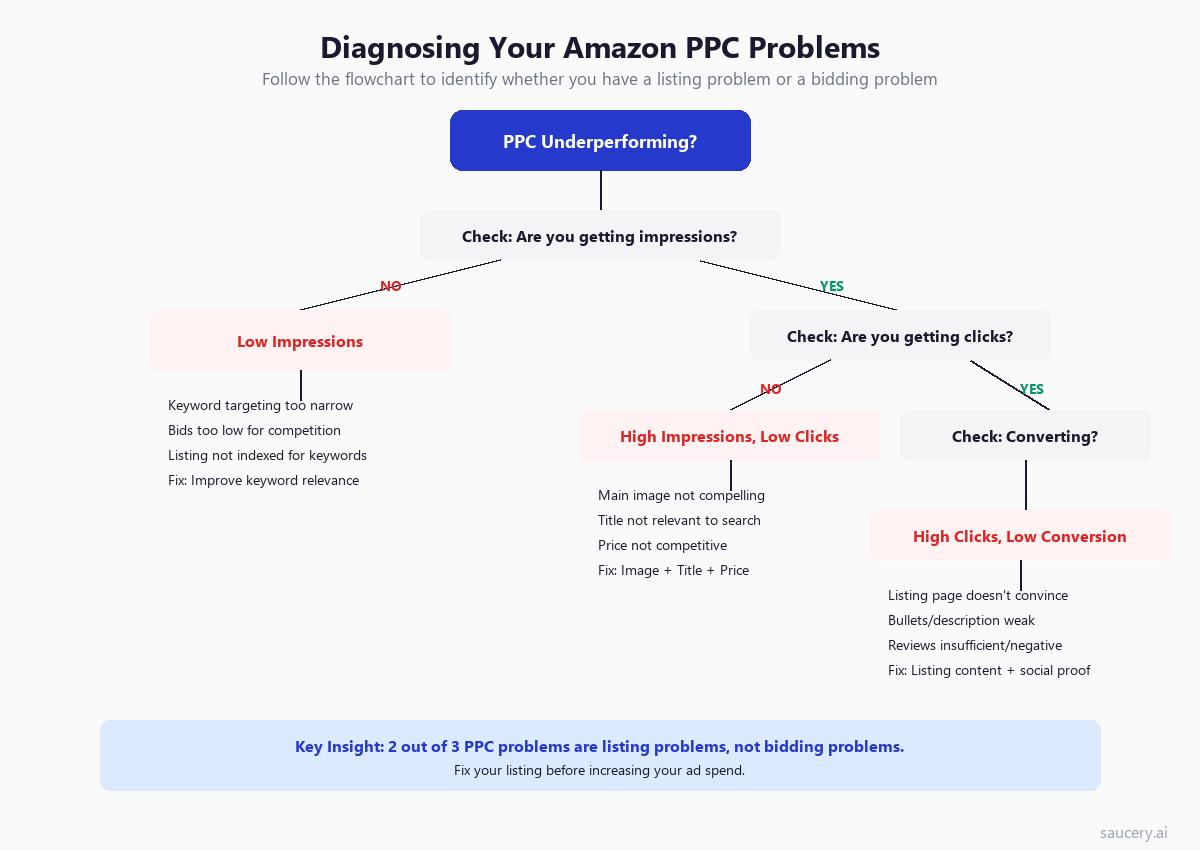
The diagnostic framework is simple once you understand that PPC performance breaks down at three distinct stages, each pointing to different listing issues:
High Impressions, Low Clicks (CTR Problem)
If your ads are getting shown but shoppers are not clicking, the issue is your search result presentation. This means one or more of:
- Main image does not stand out or communicate the product clearly
- Title does not match the search intent (shoppers do not think your product is what they want)
- Price is visibly non-competitive in the search results grid
- Star rating or review count is significantly below competitors
Fix: Focus on main image quality, title relevance and CTR optimisation, and competitive pricing positioning. These are the only elements visible before the click.
High Clicks, Low Conversions (Listing Page Problem)
If shoppers are clicking your ads but not buying, the search result presentation is working – shoppers are interested enough to click. The problem is on your product page. This indicates:
- Bullet points do not address the shopper’s needs or search intent
- Secondary images do not build confidence or demonstrate the product
- A+ Content is missing or does not support the purchase decision
- Reviews contain concerning themes that create doubt
- Product description does not answer remaining questions
Fix: Focus on on-page content quality – bullets, images, A+ Content, and review management. The shopper is already interested (they clicked); you need to close the sale.
Low Impressions (Relevance Problem)
If your ads are barely showing despite reasonable bids, Amazon’s algorithm does not consider your listing relevant to the keywords you are targeting. This is a listing SEO problem – your listing content does not contain or contextually match the search terms you are bidding on.
Fix: Ensure your target keywords appear naturally in your title, bullets, and backend search terms. Amazon must understand what your product is before it will show your ads to relevant shoppers.
The Optimise Before You Advertise Framework
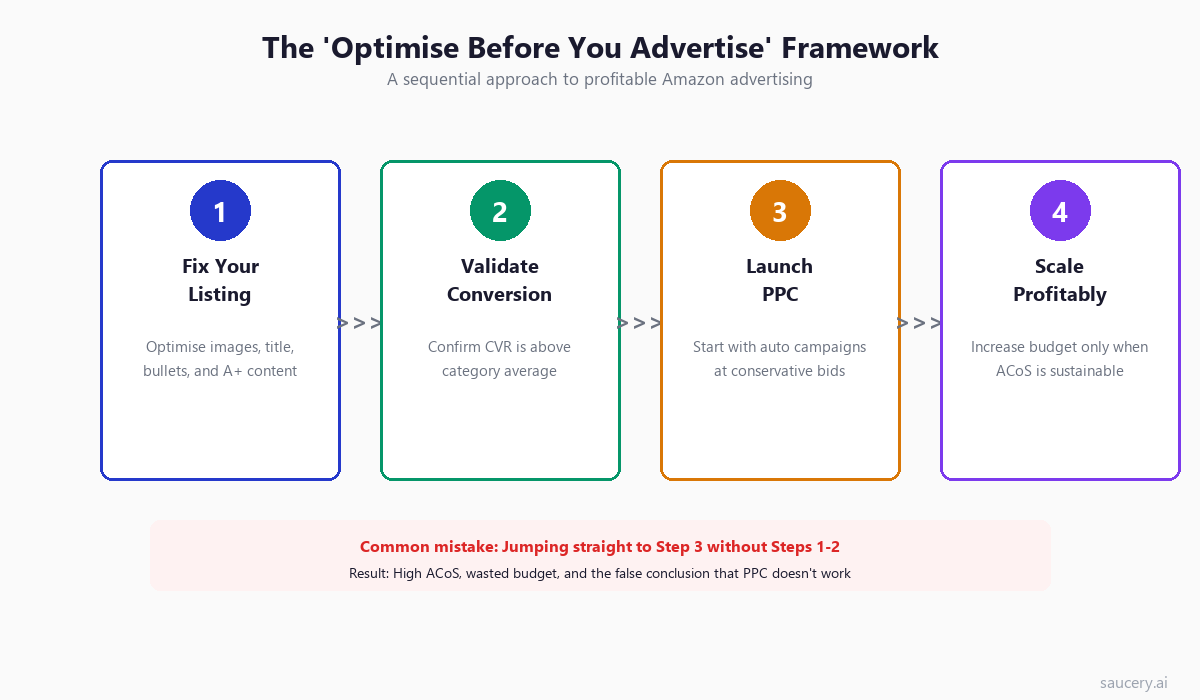
Based on the principles above, here is a sequential framework for building profitable Amazon PPC campaigns. The key insight: steps 1 and 2 happen before you spend a single dollar on ads.
Step 1: Fix Your Listing
Before spending on ads, ensure your listing is conversion-ready:
- Professional main image that fills the frame and clearly shows the product
- 6-7 secondary images including lifestyle, infographic, and scale shots
- Title front-loaded with primary keywords and key product attributes
- 5 bullet points addressing benefits, features, and common objections
- A+ Content with comparison charts and brand story
- Backend search terms filled with relevant keywords not in visible content
- Competitive pricing relative to your positioning tier
This is not optional preparation – it is the foundation that determines whether your advertising investment pays off or gets wasted. An optimised listing is not just better for PPC – it converts organic traffic better too, creating value across all channels.
Step 2: Validate Conversion
Before scaling ad spend, confirm that your listing converts at or above category average. Use Amazon Brand Analytics and your unit session percentage to benchmark. If your conversion rate is below the category median, return to Step 1.
A useful rule of thumb: if your unit session percentage is below 10%, your listing has fundamental issues. Between 10-15%, you are average. Above 15%, you are ready to scale profitably. Above 20%, you are in excellent position to drive aggressive growth through PPC.
Step 3: Launch PPC Conservatively
With a validated listing, begin with automatic campaigns at conservative bids to gather keyword data. Let Amazon’s algorithm find converting search terms for 2-3 weeks, then harvest those terms into manual campaigns with exact and phrase match targeting.
Start with daily budgets that allow meaningful data collection without excessive risk. For most products, $30-50/day gives enough clicks to identify patterns within two weeks.
Step 4: Scale Profitably
Only increase budget when your ACoS is sustainable. Sustainable means your total advertising cost (including agency fees if applicable) leaves acceptable profit margin after COGS and Amazon fees. For most products, this means ACoS below 25-30%.
Scale by increasing budgets on proven campaigns first, then expanding to new keyword targets and campaign types (Sponsored Brands, Sponsored Display). Each expansion should be validated before further scaling.
Same product. Better listing. More sales.
Budget Allocation: Do Not Increase Spend Until Your Listing Converts
One of the most expensive mistakes in Amazon advertising is increasing budget on a listing that does not convert. It feels productive – more impressions, more clicks, more data. But more clicks on a low-converting listing just means more money wasted.
A better framework for budget allocation decisions:
- CVR below category average: Spend $0 on PPC. Invest in listing improvement instead.
- CVR at category average: Conservative PPC for data collection only. Learn which keywords convert.
- CVR above category average: Scale PPC aggressively on proven keywords.
- CVR significantly above average (top 20%): Maximum PPC investment. You have a conversion advantage – exploit it.
This framework prevents the common scenario where sellers throw increasing amounts of money at advertising without first solving the conversion problem underneath. According to analysis from Pacvue’s quarterly benchmark reports, average CPCs on Amazon have increased 15-20% year-over-year for the past three years. Marketplace Pulse tracking data confirms this trend across all major categories. In a rising CPC environment, listing quality becomes MORE important, not less, because each click costs more and therefore each click wasted hurts more.
Think of it this way: spending $3,000/month on PPC with a 10% conversion rate is equivalent to spending $1,500/month with a 20% conversion rate in terms of sales generated. The difference is $1,500/month in profit – or $18,000 per year. That $18,000 could fund significant listing improvement, professional photography, A/B testing, and still leave money over.
When PPC Cannot Fix a Listing Problem
There are scenarios where no amount of advertising spend will generate acceptable returns because the underlying listing (or product) has fundamental issues that PPC cannot overcome:
No product-market fit. If the product does not solve a real problem or meet a genuine need, advertising will drive clicks but not conversions. PPC can accelerate demand but cannot create it. A product nobody wants will not sell regardless of ad spend.
Uncompetitive pricing with no differentiation. If your product is functionally identical to competitors but priced 30% higher with no visible quality signals to justify the premium, advertising will drive clicks that immediately bounce when shoppers compare options.
Poor reviews with valid complaints. If your product has persistent 3-star reviews citing real quality issues (not the occasional unreasonable customer), advertising will amplify awareness of those problems. More traffic to a listing with bad reviews means more people reading those reviews and choosing a competitor.
Category suppression or compliance issues. If your listing triggers Amazon’s content filters, has restricted keywords, or operates in a category with advertising restrictions, campaign optimisation cannot help. These are listing and compliance problems.
Insufficient listing content. A listing with one image, a minimal title, no bullets, and no A+ Content will convert poorly from ad traffic regardless of how well-targeted those ads are. Shoppers need information to make purchase decisions, and a bare listing does not provide it.
In each of these cases, the correct response is to fix the underlying issue before spending on advertising. PPC is an amplifier – it amplifies what already works, and it amplifies what does not work just as readily.
Case Study: Same Product, Same Budget, Different Listing Quality
Consider two sellers in the premium coffee category, both selling a single-origin Ethiopian bean in 1kg bags at $34.99. Both allocate $2,500/month to Sponsored Products. Both target identical keyword sets. Here is how listing quality creates divergent outcomes:
Seller A: Unoptimised Listing
- Main image: product on white background, bag fills 60% of frame, text hard to read
- Title: “Ethiopian Coffee Beans 1kg Whole Bean Premium Quality Arabica Fresh Roasted”
- Bullets: Generic features (100% Arabica, fresh roasted, whole bean, resealable bag, satisfaction guaranteed)
- Images: 3 total (main + 2 lifestyle shots)
- A+ Content: None
- Reviews: 47 reviews, 4.2 stars
Seller B: Optimised Listing
- Main image: product fills 90% of frame, packaging sharp and legible, roast colour visible
- Title: “Single Origin Ethiopian Yirgacheffe Coffee Beans 1kg – Light Roast, Notes of Blueberry and Jasmine – Freshly Roasted”
- Bullets: Specific flavour profile, elevation and farm details, roast date guarantee, brewing recommendations, comparison to alternatives
- Images: 7 total (main + infographic + lifestyle + brewing guide + origin story + comparison + packaging detail)
- A+ Content: Full brand story with comparison chart against other single-origins
- Reviews: 47 reviews, 4.2 stars (identical to Seller A)
The Results After 30 Days
| Metric | Seller A | Seller B |
|---|---|---|
| Impressions | 180,000 | 195,000 |
| CTR | 0.35% | 0.55% |
| Clicks | 630 | 1,073 |
| CPC (average) | $1.35 | $1.18 |
| Spend | $850 | $1,266 |
| Conversion rate | 9% | 19% |
| Orders from ads | 57 | 204 |
| Revenue from ads | $1,994 | $7,134 |
| ACoS | 42.6% | 17.7% |
| Profit from ads (est.) | -$120 | +$2,410 |
Same product. Same price. Same reviews. Same keywords. Seller B’s listing quality advantage produced:
- 57% higher CTR (better image and title)
- 111% higher conversion rate (better page content)
- 12.5% lower CPC (Amazon rewards high-converting listings)
- 258% more revenue
- ACoS 25 points lower
Seller A concludes “PPC is too expensive in my category.” Seller B concludes “PPC is my primary growth channel.” They are selling the same product in the same category. The difference is entirely listing quality.
This example illustrates why testing listing elements before scaling ad spend is not optional – it is the highest-ROI activity available to Amazon sellers.
The Organic Rank Flywheel: PPC Drives Sales, Sales Drive Rank
The ultimate goal of Amazon PPC is not to run ads forever – it is to build organic ranking that reduces PPC dependency over time. This is the organic rank flywheel, and it only works when your listing converts well enough to make the initial PPC investment profitable.
The mechanism: Amazon’s A10 algorithm heavily weights recent sales velocity when determining organic search position. PPC-driven sales count toward this velocity. So profitable PPC campaigns drive sales that improve your organic position, which generates additional organic sales, which further improves your position.
Over time, as organic rank improves, a growing percentage of your sales come without advertising cost. Your blended ACoS (total ad spend / total revenue including organic) drops as organic sales grow. Research from Sellics annual advertising report shows that the most successful Amazon brands reach a point where PPC represents only 20-30% of total sales, with the remaining 70-80% coming from organic rank built partly through early PPC investment.
But this flywheel has a prerequisite: your listing must convert well enough for the PPC phase to be profitable (or at least break-even). If PPC is unprofitable because your listing does not convert, you cannot sustain the investment long enough to build organic rank. The flywheel never starts spinning.
This is perhaps the most compelling argument for prioritising listing quality over campaign optimisation. A great listing enables the flywheel strategy. A poor listing prevents it entirely, regardless of how sophisticated your PPC management becomes.
For brands launching new products, this flywheel strategy is particularly important. New products start with zero organic rank and must rely entirely on PPC (and external traffic) for initial sales. The faster your listing converts that paid traffic, the faster you build organic rank, and the faster you escape PPC dependency.
Same product. Better listing. More sales.
Frequently Asked Questions
What is a good ACoS for Amazon PPC?
“Good” ACoS depends on your profit margins, but most sellers target 20-30% as sustainable. However, what matters more than absolute ACoS is whether it is above or below your break-even point. Calculate your break-even ACoS by subtracting all non-advertising costs (COGS, Amazon fees, shipping) from your selling price, then dividing the remainder by your selling price. If your product sells for $25 with $12 in costs, your break-even ACoS is 52%. Anything below that is profitable from PPC – but lower is always better. The path to lower ACoS runs through higher conversion rate.
Should I run PPC on a new listing with no reviews?
You can, but expect higher ACoS until you build social proof. Products with zero reviews convert at roughly half the rate of products with 15+ reviews. Consider starting with a small daily budget ($15-20) purely for data collection rather than profitability. Use this phase to identify which keywords drive clicks and which listing elements need improvement based on real traffic data. Scale spending only after accumulating initial reviews and validating your conversion rate.
How long should I wait before optimising my PPC campaigns?
Allow 2-3 weeks minimum before making bid and targeting changes, as Amazon’s attribution window is 7-14 days. However, if your listing conversion rate is below 10% during this period, pause campaigns and fix the listing rather than waiting for PPC data to accumulate. You are paying for traffic that is not converting – that money is better spent on listing improvement.
Can I use PPC data to improve my listing?
Absolutely. PPC search term reports reveal exactly which keywords shoppers use to find products like yours, which ones generate clicks versus conversions, and where intent mismatches exist. High-click, low-conversion keywords often indicate that your listing does not match the shopper’s expectation created by the search term. Use this data to align your listing content with actual search behaviour. Brand Analytics provides additional conversion data by search term to inform listing optimisation priorities.
What is the relationship between organic rank and PPC performance?
They are deeply connected. Products that rank organically for a keyword typically convert better on that keyword in PPC because Amazon’s algorithm has already validated relevance. Conversely, PPC sales on a keyword improve organic rank for that keyword. The optimal strategy uses PPC to build rank on target keywords while the listing converts well enough to make that investment sustainable. Over time, organic sales grow and PPC can be reduced without losing total volume.
How much should I spend on Amazon PPC per month?
Budget should be determined by your conversion rate, not by arbitrary spending targets or competitor benchmarks. A listing converting at 20% can profitably absorb $5,000-10,000/month in ad spend. A listing converting at 8% cannot profitably absorb $500/month. Start with enough budget to collect statistically meaningful data (typically $30-50/day for 2 weeks), validate that your listing converts the traffic, then scale based on profitability. The right budget is the one where your last dollar spent still returns more than a dollar in profit.
Is it worth hiring a PPC agency if my listing is not optimised?
No. An agency can optimise bids, structure campaigns efficiently, and manage budgets – but they cannot overcome a listing that does not convert. Hiring an agency to manage PPC on an unoptimised listing is like hiring a race car driver for a vehicle with flat tyres. Fix the listing first, validate conversion, then bring in PPC expertise to scale what already works. Many agencies will tell you this themselves – the good ones refuse to onboard clients with fundamentally broken listings because they know the campaigns will underperform regardless of management quality.
How do I know if my listing quality is the problem versus my PPC strategy?
Check your unit session percentage (conversion rate) in Business Reports. If it is below category average, your listing is the primary issue – no PPC strategy will compensate. If your conversion rate is above average but ACoS is still high, then campaign structure, keyword targeting, or bid strategy may be the issue. The diagnostic flowchart above provides a systematic approach: high impressions with low clicks suggests image and title problems, high clicks with low conversion suggests on-page content problems, and low impressions suggests keyword relevance problems.
Does listing quality affect Sponsored Brands and Sponsored Display differently than Sponsored Products?
The impact is consistent across all ad types, but manifests differently. Sponsored Products are most directly affected because the ad creative IS your listing (image, title, price, rating). Sponsored Brands allow custom headlines and creative, so CTR depends partly on your brand creative rather than listing quality alone – but conversion still happens on the listing page. Sponsored Display retargets shoppers who have already viewed your listing or similar products, so listing quality determines whether these second-chance impressions convert. In all cases, the conversion event occurs on your product page.
The Bottom Line
Amazon PPC strategy is, at its core, listing strategy. The sellers with the best advertising performance are not the ones with the most sophisticated campaign structures or the most aggressive bids. They are the ones whose listings convert paid traffic at rates that make any reasonable bid profitable.
If your ACoS is above target, resist the temptation to tinker with bids and budgets as your first response. Instead, ask: “Is my listing converting at or above category average?” If the answer is no, you have found your highest-leverage improvement opportunity. Fix the listing, validate conversion, then scale your PPC.
The formula is not complicated: optimise first, advertise second. But it requires the discipline to invest in listing quality before investing in ad spend – and the patience to validate before scaling. Sellers who follow this sequence build the PPC-listing quality flywheel that compounds over time. Those who skip to advertising without a converting listing waste budget and conclude, incorrectly, that Amazon PPC does not work in their category.
It works. You just need a listing worth advertising.
About the Author
Andrew Mac is the founder of Saucery, where he helps consumer brands optimise product listings using AI-powered shopper models calibrated to real purchase behaviour across seven markets. Before Saucery, he spent over a decade in FMCG and e-commerce, learning that the best advertising strategy is always a product page that converts.
Subscribe for F&B Consumer Insights
Data-driven insights on food & beverage consumer preferences, straight to your inbox.