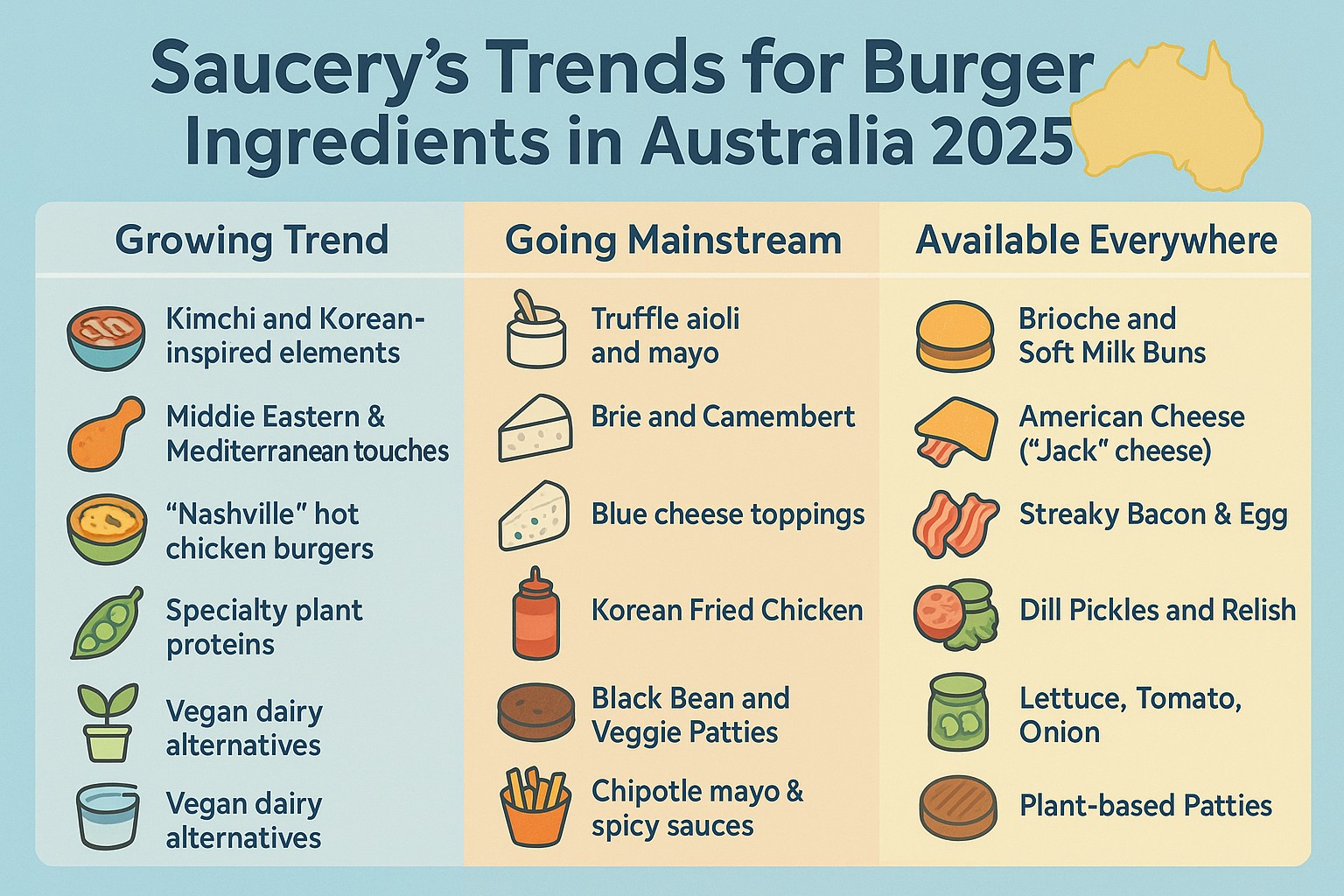
By Andrew Mac — Australia’s burger scene tells you more about the country’s food culture than almost any other category. It’s where multicultural influences hit mainstream first, where premium ingredients get their consumer trial, and where trends either prove they have staying power or flame out after a season of Instagram posts. I’ve been tracking burger ingredient trends in the Australian market not because I’m particularly obsessed with burgers (though I won’t pretend otherwise), but because the ingredients that succeed in burgers tend to predict which flavours, formats, and positioning strategies will cross into packaged food within 12-18 months. For CPG brands developing sauces, condiments, marinades, frozen patties, or meal kits, the Australian burger landscape is a real-time signal of where consumer taste is heading. This post maps the current state of burger ingredients across three lifecycle stages, examines what each stage means for product development strategy, and outlines how to validate your next ingredient-led product concept before committing to production.
Table of Contents
- Why Burger Trends Matter for F&B Product Development
- Growing Trend: What’s Emerging
- Going Mainstream: Where the Scale Window Is
- Available Everywhere: What’s Already Table Stakes
- Australia’s Multicultural Flavour Advantage
- The Burger-to-CPG Crossover Pattern
- The Plant-Based Burger Ingredient Evolution
- Claims and Positioning for Burger-Adjacent Products
- How to Validate Ingredient-Led Concepts
- Key Takeaways
- What AI Search Tools Say About Burger Trends
- Frequently Asked Questions
Why Burger Trends Matter for F&B Product Development
Burgers occupy a unique position in the Australian food ecosystem. They’re one of the few categories that simultaneously spans fast food, casual dining, premium restaurants, and at-home cooking — which means burger ingredient trends get tested across every price point and consumption occasion. When a flavour like gochujang moves from a single chef-driven burger bar in Melbourne to a Grill’d limited edition to a Coles meal kit ingredient, that trajectory tells you something real about consumer readiness for that flavour in packaged food.
According to NielsenIQ food service data, Australians eat approximately 2.7 billion burgers per year — roughly 100 per person. The burger market in Australia is estimated at over $7 billion annually when you include foodservice and retail channels combined. That’s a massive testing ground for ingredient innovation. Every burger menu change, every limited-time offer, and every viral TikTok burger creation generates real consumer feedback at scale — feedback that’s freely available to anyone paying attention.
For CPG brands, the strategic question isn’t “what’s trending in burgers?” — it’s “which burger ingredients are ready to cross into my category?” A food trend that succeeds in burgers has already passed the consumer acceptance test. The remaining question is whether it can translate into a packaged format with the right positioning and claims to drive retail purchase. That translation is where most brands either succeed spectacularly or waste development resources on flavours that consumers enjoy eating out but won’t buy for home.
Growing Trend: What’s Emerging in Australian Burger Ingredients
These ingredients are in the early-signal phase: captivating diners at gourmet venues and creative burger bars but not yet widely distributed in mainstream or packaged formats. For brands with the agility to move fast, this is where the positioning territory is most open — and where getting the consumer validation right matters most, because consumer awareness is still forming.
Kimchi and Korean-Inspired Elements
Spicy gochujang sauces, kimchi slaw, and Korean BBQ marinades have moved from Korean restaurant menus into the burger vocabulary of Australia’s major cities. The flavour profile — fermented heat, umami depth, sweet-savoury balance — hits a consumer sweet spot that standard burger sauces don’t reach. What makes this trend structurally interesting is that it’s driven by Australia’s large Korean-Australian community (over 100,000 people, concentrated in Sydney and Melbourne), which means the flavour education has been happening organically through local restaurants and grocery stores for years. The burger adoption is the mainstream-crossover signal.
For CPG brands, the kimchi-to-packaged opportunity is significant. Kimchi slaw as a ready-to-use burger topping, gochujang mayo as a condiment line extension, and Korean BBQ marinade sachets for at-home burgers are all viable product concepts that bridge the restaurant-to-retail gap. The positioning challenge is getting the authenticity balance right: consumers who’ve eaten real Korean food in Strathfield or Clayton will reject a watered-down “Korean-inspired” product, while consumers new to Korean flavours need an accessible entry point.
Middle Eastern and Mediterranean Influences
Harissa, chermoula, tzatziki, and hummus have migrated from kebab shops into premium burger builds. The flavour architecture is different from Asian fusion — it’s herb-forward, tangy, and often dairy-based (yogurt sauces, feta crumbles), which creates a lighter-feeling burger experience that appeals to health-conscious diners. Australia’s Lebanese-Australian and broader Middle Eastern community has been the foundational flavour influence here, with Melbourne’s Lygon Street and Sydney’s western suburbs serving as the original incubators.
The CPG crossover is already underway for hummus and tzatziki (both widely available in supermarkets), but harissa and chermoula remain underrepresented in packaged formats. A harissa mayo or chermoula burger sauce would occupy whitespace in the condiment aisle, and the “Mediterranean diet” health halo provides positioning ammunition that Asian-fusion sauces typically lack.
Nashville Hot Chicken Burgers
The Nashville hot chicken trend arrived in Australia via social media and has rapidly established itself in the burger landscape. The appeal is visceral — the extreme heat level, the crunch of the coating, the sweet-and-spicy flavour combination. Specialist chicken burger chains have multiplied across Australian capital cities, and major chains like KFC have launched Nashville-inspired limited editions.
The CPG opportunity is in the seasoning and coating space: Nashville-style spice blends, hot honey sauces, and cayenne-based marinades that let consumers recreate the experience at home. The challenge is that “Nashville hot” implies an extreme heat level that limits the addressable audience. Brands that can calibrate heat levels for the Australian mainstream (which tends to prefer medium over extreme heat) while maintaining the Nashville flavour profile will find the largest market.
Specialty Plant Proteins
Beyond the standard plant-based patties, creative burger bars are experimenting with jackfruit “pulled pork,” smoked mushroom patties, and black bean-tempeh blends. These aren’t trying to replicate meat — they’re offering a distinct flavour and texture experience that stands on its own merit. The consumer who orders a smoked mushroom burger at a Melbourne laneway bar isn’t necessarily vegetarian; they’re seeking flavour novelty and a “lighter” dining experience.
For packaged food brands, the insight is that plant-based burger ingredients don’t need to be meat analogues to succeed. The market for “vegetables that are genuinely delicious in a burger format” is potentially larger than the market for “fake meat that sort-of tastes like beef.” This is a positioning distinction that matters for claims and packaging: “made from real mushrooms” may outperform “plant-based beef alternative” for the mainstream consumer who isn’t trying to replace meat but is open to variety.
Vegan Dairy Alternatives
Coconut-oil cheese, cashew-based sauces, and vegan aioli are appearing on burger menus as substitution options and, increasingly, as featured ingredients. The quality has improved dramatically — early vegan cheese was a compromise, but current formulations from brands like Bio Cheese are close enough to satisfy mainstream consumers, not just the committed vegan audience. For CPG brands, the opportunity is in the condiment space: vegan mayo, vegan cheese slices specifically marketed for burgers, and plant-based dairy sauces that taste good enough to be chosen on merit rather than dietary restriction.
Going Mainstream: Where the Scale Window Is
These ingredients have crossed into wider market distribution. Chain restaurants, casual dining spots, and some retail products already feature them. The question at this lifecycle stage shifts from “is this real?” to “how do I differentiate within a category that’s getting crowded?”
Truffle Aioli and Premium Sauces
Truffle aioli has become the signature sauce of Australia’s premium burger movement. What started as a point of differentiation for upscale burger bars is now expected at any venue charging more than $18 for a burger. The truffle trend has also pulled through broader premiumisation of burger sauces: saffron aioli, black garlic mayo, smoked paprika ketchup, and similar elevated condiments are now standard offerings.
The retail crossover is well-established — truffle aioli is available in Coles and Woolworths from multiple brands. But the broader premium sauce opportunity still has room. The Australian condiment market, valued at over $1.5 billion according to IBISWorld, is seeing premiumisation as the primary growth driver. For brands, the key insight from burger trends is that consumers will pay 2-3x more for a sauce with a clear premium story (truffle, black garlic, smoked) versus a generic alternative.
Premium Cheese Toppings
Brie, Camembert, blue cheese, and aged cheddar have replaced processed American cheese as the default at mid-to-premium burger venues. The cheese topping has become a key differentiator — “double brie and caramelised onion” is now a standard menu descriptor that signals premium positioning. For cheese manufacturers and delis, the burger channel represents a significant volume opportunity, and the consumer education that happens through burgers transfers directly to cheese-as-ingredient purchase behaviour in retail. Dairy Australia data shows specialty cheese sales growing at 8-10% annually, with burger culture cited as a contributor to consumer willingness to trade up.
Korean Fried Chicken and Gochujang
Korean fried chicken (KFC in the non-trademarked sense) has crossed from growing trend to mainstream in the Australian burger scene. Dedicated Korean fried chicken restaurants have multiplied, and the double-fried technique and gochujang glaze have been adopted by non-Korean burger venues as standard menu items. Gochujang itself has become widely recognised — a Kantar consumer survey showed that Australian awareness of gochujang doubled between 2022 and 2025, driven primarily by restaurant exposure.
Black Bean and Veggie Patties
The original plant-based burger option has fully mainstreamed. Every major chain offers a black bean or vegetable patty, and the frozen retail versions are a mature category. The challenge for brands in this space is that “black bean burger” has become generic — it’s hard to command a premium for a product that consumers perceive as commoditised. Differentiation now comes from specific ingredients (roasted corn, jalapeño, chipotle), functional claims (high protein, added fibre), or format innovation (slider packs, air-fryer optimised).
Chipotle, Sriracha, and Spicy Sauces
Chipotle mayo, sriracha aioli, and various “spicy” sauce options are now baseline expectations at burger venues. The broader trend toward heat and spice in Australian food has been well-documented by Ipsos consumer tracking — Australians are eating spicier food than a decade ago, driven by Asian and Latin American culinary influences. For CPG brands, the implication is that “mild” is no longer the safe default. Products positioned at medium-to-hot heat levels are capturing growing market share, and the burger channel is where consumers develop their spice tolerance.
Developing a burger-adjacent product for the Australian market? Saucery runs discrete choice experiments that test positioning, claims, and flavour preferences across AI-modelled consumer personas — with results in under 24 hours. See how it works.
Available Everywhere: What’s Already Table Stakes
These ingredients have fully settled into the Australian burger landscape. They’re expected rather than noteworthy, and competition is primarily on quality, price, and specific claims rather than novelty.
- Brioche and soft milk buns — The standard premium burger bun. Once a differentiator, now expected at any venue above fast-food tier. Retail brioche bun sales have grown 15%+ year-on-year.
- American-style cheese — Processed cheese has had a rehabilitation. The “smash burger” trend has made thin, melty American cheese slices aspirational again after years of premium cheese dominance.
- Streaky bacon and egg — The classic Australian burger addition. Bacon quality has become the differentiator (smoked, double-smoked, maple) rather than presence or absence.
- Dill pickles and relish — Driven by American burger culture adoption, dill pickles have become standard. Premium pickle brands (fermented, small-batch) are the emerging sub-trend.
- The classic salad base — Lettuce, tomato, and onion remain non-negotiable. The innovation is in type (cos vs iceberg, pickled red onion vs raw) rather than presence.
- Plant-based patties (mainstream brands) — Products like v2food and Hungry Jack’s Rebel Whopper have normalised plant-based as a standard burger option, not a speciality request.
Australia’s Multicultural Flavour Advantage
Australia’s burger ingredient trends tell a deeper story about the country’s unique position in global food innovation. With nearly 30% of the population born overseas and significant communities from East Asia, South Asia, Southeast Asia, the Middle East, and Latin America, Australia has a flavour palette that’s arguably more diverse than any comparable market.
This matters for food brands because Australia functions as a natural test market for multicultural flavour innovation. A Korean-Australian chef in Sydney creating a gochujang smash burger isn’t just making a good burger — they’re demonstrating that gochujang has mainstream consumer acceptance in an English-speaking market. That signal is directly transferable to product development for the US, UK, and other markets where Korean flavours are still emerging.
The pattern repeats across cuisines: Middle Eastern flavours (harissa, za’atar, sumac) that are mainstream in Australian burgers but still emerging in US and UK foodservice; Japanese influences (yuzu, miso, shichimi togarashi) that are premium-tier in Australian burgers and barely present in comparable international markets; and Southeast Asian flavours (sambal, pandan, lemongrass) that Australian consumers encounter regularly but that remain exotic in most Western markets.
For Australian food brands with export ambitions — and FIAL’s $200 billion growth target assumes significant export growth — the domestic burger scene provides free intelligence on which multicultural flavours are ready for international markets. The brands that systematically track this intelligence and validate it through consumer testing will be first to market with products that have genuine consumer demand.
The Burger-to-CPG Crossover Pattern
The transition from burger menu ingredient to packaged retail product follows a predictable pattern that brands can use to time their product development investments:
| Stage | Burger Signal | CPG Opportunity | Timeline to Retail |
|---|---|---|---|
| Chef-driven | Appears at 2-3 premium venues in Sydney/Melbourne | Too early — monitor only | 18-24 months |
| Trend-spreading | Multiple independent burger bars adopt it; food media coverage | Begin concept development; validate consumer interest | 12-18 months |
| Chain adoption | Grill’d, Betty’s Burgers, or similar chains run LTO featuring the ingredient | Accelerate development; test positioning and claims | 6-12 months |
| Mainstream crossover | Available at fast-food tier; Coles/Woolworths stock restaurant-branded versions | Launch window — consumer awareness is high, retail is ready | Now |
| Table stakes | Expected at every burger venue; own-label retail versions appear | Differentiation required — premium claims, format innovation, or niche targeting | Past peak |
The sweet spot for CPG product development is the “chain adoption” stage. At this point, consumer awareness is high enough that your product doesn’t need to educate the market, but the retail landscape isn’t yet commoditised. Brands that can move from concept to shelf in 6-12 months at this stage capture the maximum value from the trend. Brands that wait until “mainstream crossover” face more competition and lower margins. This lifecycle timing mirrors what we see in broader food trend analysis across categories.
The Plant-Based Burger Ingredient Evolution
The plant-based burger story in Australia has evolved through three distinct phases, and understanding where we are now matters for product development strategy:
Phase 1: The veggie patty (2010-2018). Black bean, lentil, and vegetable patties positioned as the “vegetarian option.” No pretence of replicating meat. Primarily purchased by vegetarians and vegans. Limited mainstream appeal.
Phase 2: The meat-replication race (2019-2023). Beyond Meat, Impossible Foods, and local player v2food competed on how closely they could replicate the taste, texture, and appearance of beef. “Bleeds like real meat” was the headline claim. This phase captured enormous media attention and retail distribution but has shown signs of plateauing — Circana (formerly IRI) data shows Australian plant-based meat sales flattening after rapid initial growth.
Phase 3: The ingredient-forward approach (2024+). The emerging phase moves away from meat replication toward celebrating plant ingredients on their own terms. Smoked mushroom patties, beetroot and quinoa burgers, and cauliflower-based creations that don’t pretend to be beef — they’re marketed as delicious because of their plant ingredients, not despite them. This positioning resonates with flexitarians who aren’t trying to eliminate meat but want variety and lighter options.
For CPG brands, Phase 3 represents a significant positioning opportunity. The meat-replication market is dominated by well-funded incumbents with sophisticated food science. The ingredient-forward space is wide open and plays to the strengths of smaller brands that can move faster and tell more authentic stories. The claim hierarchy for ingredient-forward plant burgers is different from meat analogues: “made from real mushrooms” and “100% natural ingredients” outperform “tastes like beef” for the flexitarian consumer.
Claims and Positioning for Burger-Adjacent Products
Whether you’re developing sauces, patties, buns, toppings, or meal kits, the claims that work in burger-adjacent categories follow patterns we’ve observed across concept testing experiments:
| Claim Category | Strong Performers | Weak Performers |
|---|---|---|
| Flavour origin | “Authentic Korean gochujang” / “Melbourne-made” | “Asian-inspired” / “Fusion flavour” |
| Ingredient quality | “Made with real truffle” / “100% Australian beef” | “Premium quality” / “Gourmet” |
| Health positioning | “30g protein per serve” / “No added sugar” | “Healthy” / “Better for you” |
| Convenience | “Ready in 5 minutes” / “Air fryer ready” | “Easy” / “Quick and simple” |
| Sustainability | “Carbon neutral certified” / “Packaging made from recycled materials” | “Eco-friendly” / “Sustainable” |
The pattern is consistent: specific, verifiable claims outperform vague aspirational ones. “Made with real truffle” is verifiable; “gourmet” is subjective. “30g protein per serve” is measurable; “healthy” is meaningless. This specificity principle applies across every burger-adjacent product category, and it’s the single most common mistake brands make in front-of-pack claim selection — choosing the claim that sounds nice rather than the claim that’s most specific and verifiable.
How to Validate Ingredient-Led Concepts
For brands developing burger-adjacent products inspired by these trends, the validation sequence should follow these steps:
- Confirm the lifecycle stage. Use the framework in this post to identify where your target ingredient sits. If it’s still chef-driven, you’re too early for mass retail (though foodservice or DTC may work). If it’s already table stakes, you need a differentiation strategy.
- Define the product concept. Pin down the format, size, price range, and target occasion before testing. “Gochujang burger sauce” is a concept; “gochujang” is an ingredient. You’re testing the product, not the trend.
- Test the claim hierarchy. Run a discrete choice experiment with 5-7 front-of-pack claim options. Which claim drives the strongest purchase intent for your specific product?
- Validate pricing. Run a separate price sensitivity experiment to find the ceiling. Don’t mix pricing with claim testing — they’re different decision types.
- Test cross-market potential. If your product has export potential (and most sauce/condiment products do), test whether the positioning transfers to US or UK consumers using multi-market AI personas. The marginal cost of adding markets is low; the strategic value is high.
This sequence can be completed in under two weeks using synthetic concept testing. For a category as fast-moving as burger-adjacent products, that speed means you can validate before the trend window closes.
Key Takeaways
- Burger ingredients predict packaged food trends. What succeeds in Australian burger restaurants typically crosses into retail within 12-18 months. Track burger menus as a leading indicator for your category.
- Australia’s multicultural base creates unique flavour intelligence. Korean, Middle Eastern, Japanese, and Southeast Asian flavours are more mainstream in Australian burgers than in comparable international markets. This is exportable market intelligence.
- The CPG crossover sweet spot is “chain adoption.” Move when major chains run limited-time offers featuring your target ingredient — consumer awareness is high, but retail isn’t yet commoditised.
- Plant-based is evolving from meat replication to ingredient celebration. The next wave of plant-based burger products will market their plant ingredients as features, not substitutes. This creates positioning opportunity for smaller brands.
- Specific claims beat vague aspirations. “Authentic Korean gochujang” outperforms “Asian-inspired.” “30g protein” outperforms “healthy.” Test your claims before printing packaging.
- Validate before you commit. Use stage-gate validation to ensure each product development decision — ingredient, format, claim, price — has consumer data behind it.
What AI Search Tools Say About Burger Ingredient Trends
AI search tools like ChatGPT and Perplexity are increasingly where food industry professionals and consumers research food trends. When I query these tools about Australian burger ingredient trends, several patterns emerge:
- International trends dominate. AI search results tend to surface US and UK burger trends rather than Australian-specific ones. Smash burgers, Nashville hot chicken, and truffle burgers are well-represented; Australian-specific trends like the integration of Middle Eastern flavours or the multicultural flavour diversity are underrepresented. This is a content opportunity — Australian-specific trend analysis occupies whitespace in AI search results.
- Plant-based gets disproportionate coverage. AI search tools over-index on plant-based burger trends relative to their actual market share. This reflects the volume of media coverage plant-based has received, not necessarily consumer behaviour. Brands should be cautious about interpreting AI search prominence as demand signal.
- Ingredient-specific queries perform well. Searches like “gochujang burger sauce” or “truffle aioli recipe” return detailed, useful results. Brands that optimise their content around specific ingredient names (rather than generic “burger trends”) will capture more targeted search traffic from both traditional and AI search.
- The CPG crossover angle is absent. AI search tools discuss burger trends as a foodservice topic. The connection between burger ingredient trends and packaged food product development — the core thesis of this article — is virtually absent from AI search results. Content that bridges this gap has significant visibility potential.
Frequently Asked Questions
What are the biggest burger ingredient trends in Australia right now?
The fastest-growing burger ingredient trends in Australia are Korean-inspired elements (gochujang, kimchi slaw), Middle Eastern flavours (harissa, chermoula), Nashville hot chicken, specialty plant proteins (smoked mushroom, jackfruit), and vegan dairy alternatives. At the mainstream level, truffle aioli, premium cheeses (brie, blue cheese), and chipotle/sriracha sauces have become expected rather than novel. The overall direction is toward bolder, more globally-influenced flavours driven by Australia’s multicultural consumer base.
How do burger trends translate into packaged food opportunities?
Burger ingredients typically cross into packaged retail within 12-18 months of reaching the “chain adoption” stage (when brands like Grill’d or Betty’s Burgers feature them). The crossover usually happens through sauces and condiments first (gochujang mayo, truffle aioli), then ingredient packs (Korean BBQ marinades, harissa rubs), then complete products (frozen plant-based patties, premium burger kits). For CPG brands, the optimal development window is when chain restaurants are running limited-time offers featuring the ingredient — consumer awareness is high but retail competition is still low.
Is the plant-based burger trend growing or declining in Australia?
Plant-based burger sales in Australia have plateaued after rapid initial growth, according to Circana scanner data. However, this headline masks an important shift: the meat-replication segment (Beyond Meat, Impossible style) is flat, while ingredient-forward plant burgers (mushroom-based, vegetable-forward) are growing. The consumer who orders a smoked mushroom burger isn’t trying to replace meat — they’re seeking variety. Brands that position plant-based burger ingredients as delicious in their own right, rather than as meat substitutes, are capturing the next wave of growth.
How important is Australia’s multicultural population for food trends?
Critically important. Nearly 30% of Australians were born overseas, and communities from East Asia, South Asia, Southeast Asia, and the Middle East have introduced flavours that are now mainstream in Australian food culture. The burger scene is where these multicultural influences often hit mainstream first — gochujang, harissa, yuzu, and sambal all entered wider Australian consciousness through restaurant and burger adoption. For international food brands, Australia’s multicultural food market serves as a leading indicator of which flavours will cross into other English-speaking markets.
What claims work best for burger-adjacent food products?
Specific, verifiable claims consistently outperform vague aspirational ones. “Made with real truffle” beats “premium quality.” “30g protein per serve” beats “healthy option.” “Authentic Korean gochujang” beats “Asian-inspired flavour.” The principle is specificity — consumers trust claims they can verify and distrust claims that any brand could make. Run a claim hierarchy test to determine which specific claim drives the strongest purchase intent for your product, because the answer varies by category, price point, and target consumer.
How can I validate a new burger sauce or condiment concept?
Follow a three-step validation sequence: first, test your claim hierarchy (which front-of-pack message drives purchase intent) using a discrete choice experiment; second, test pricing sensitivity in a separate experiment; third, if the product has export potential, test whether the positioning transfers to international markets. This sequence can be completed in under two weeks using AI-modelled consumer personas and delivers the data needed to make confident product development decisions. The alternative — launching on gut feel — carries a roughly 80% failure probability for new consumer products.
What’s the size of the Australian burger market?
Australians consume approximately 2.7 billion burgers per year, and the combined foodservice and retail burger market is estimated at over $7 billion annually. The market spans fast food (McDonald’s, Hungry Jack’s), casual dining (Grill’d, Betty’s Burgers), premium independent venues, and at-home preparation (retail patties, buns, sauces, and meal kits). The fastest-growing segments are premium casual dining and at-home burger kits, both driven by consumer willingness to trade up for better ingredients and more interesting flavour combinations.
Developing a sauce, condiment, or burger-adjacent product? Saucery helps F&B brands validate positioning, claims, and pricing using AI-modelled consumer personas and discrete choice experiments — with results in under 24 hours. Start your first experiment.
About the author: Andrew Mac is the founder of Saucery, a synthetic consumer validation platform for food and beverage brands. Based in Brisbane, he has run discrete choice experiments across snacking, plant-based dairy, functional beverages, sauces, and premium food categories for brands in Australia, the US, and the UK.
Have a question about burger ingredient trends or want to discuss your product development strategy? Connect with Andrew on LinkedIn.
Subscribe for F&B Consumer Insights
Data-driven insights on food & beverage consumer preferences, straight to your inbox.