Walmart Marketplace went from 50,000 to 150,000+ sellers in two years. The sellers who optimise their listings now are building moats while competition is still thin.
If you sell physical products online, you already know Amazon. But the smartest brands in 2026 are not putting all their eggs in one marketplace basket. They are looking at where the growth is happening, where the competition has not yet caught up, and where early optimisation creates an outsized advantage.
That place is Walmart Marketplace.
This guide covers everything you need to know about Walmart listing optimisation – from how the search algorithm actually works, to the specific title formulas, description strategies, and attribute completeness signals that determine whether your products get found by Walmart’s 240 million weekly shoppers.
Whether you are launching on Walmart for the first time or trying to improve existing listings that are not performing, this is the playbook. No fluff, no generic advice – just the mechanics that drive visibility on a marketplace that rewards precision over volume.
Why Walmart Marketplace Matters in 2026
Let’s start with the numbers that explain why experienced sellers are treating Walmart as a priority channel, not an afterthought.
The Competition Gap Is Still Wide Open
Amazon has approximately 3.1 million active sellers globally. Walmart Marketplace has around 150,000. That is a 20:1 ratio. In practical terms, this means the average Walmart product listing competes against a fraction of the alternatives that the same product faces on Amazon.
According to Marketplace Pulse data, Walmart has been adding 40,000+ new sellers per year consistently. That growth rate is accelerating, but the absolute numbers still leave enormous room for early movers to establish category dominance.
Think about what this means for your specific category. If you sell premium hot sauces on Amazon, you might face 3,000 competing listings. On Walmart, that number could be 200. The visibility math is radically different.
Access to 240M+ Weekly Shoppers
Walmart is the largest retailer in the world by revenue. Their physical stores see over 240 million customer visits per week in the US alone. The marketplace integration means online sellers can reach these shoppers when they search on Walmart.com or through the Walmart app.
This is not a niche audience. These are mainstream shoppers who are price-conscious, value-driven, and purchase across every consumer category. For food and beverage brands especially, Walmart’s customer base aligns perfectly with trial-driven purchasing behaviour.
Two-Day Delivery Changes Everything
Walmart’s internal data shows that products with two-day delivery tags receive approximately 75% more impressions than equivalent products without it. This is not a minor boost. It is a fundamental shift in visibility that turns fulfilment strategy into a search ranking lever.
Through Walmart Fulfilment Services (WFS), third-party sellers can access the same delivery infrastructure that powers Walmart’s own operations. Products stored in Walmart’s fulfilment centres automatically qualify for two-day delivery badges and the associated visibility boost.
The Amazon Expansion Wave
Successful Amazon sellers are diversifying to Walmart in record numbers. They are discovering that their existing product research, photography, and supply chain infrastructure translates directly – but their Amazon listing copy often does not. Sellers who understand the differences between Walmart and Amazon optimisation hold a significant advantage over those who simply copy and paste.
The opportunity window is clear: Walmart Marketplace is growing fast enough to matter but is still small enough that individual listing quality creates meaningful differentiation. This will not last forever. The time to optimise is now.
How Walmart’s Search Algorithm Works
Before diving into specific optimisation tactics, you need to understand how Walmart decides which products to show when a shopper searches. The algorithm differs from Amazon’s A9/A10 in several important ways, and these differences directly inform your strategy.
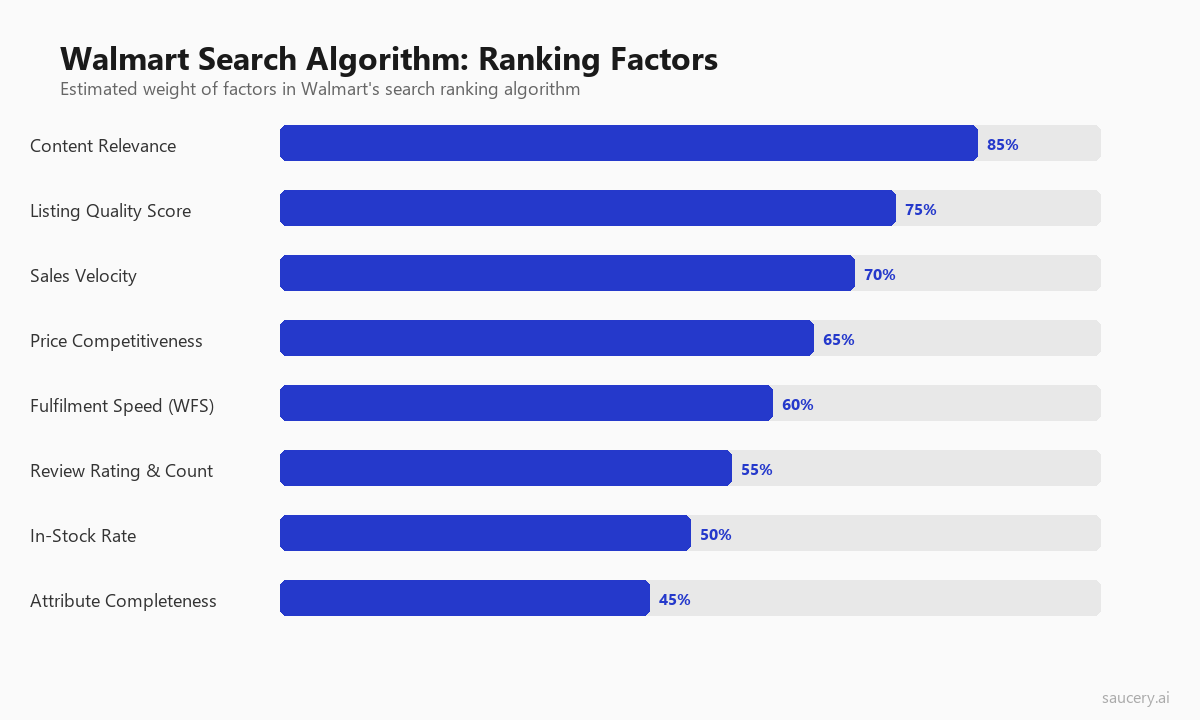
Exact Keyword Matching
Walmart’s search engine relies more heavily on exact keyword matching than Amazon does. Where Amazon’s algorithm has developed sophisticated semantic understanding (recognising that “laptop bag” and “computer carrying case” serve the same intent), Walmart’s system is more literal.
This means the specific words you use in your listing matter more on Walmart. If shoppers search “organic hot sauce” and your listing says “natural chilli sauce,” you are less likely to appear. Walmart’s algorithm rewards precision in keyword usage across all text fields.
The practical implication: you need to be more deliberate about including exact keyword phrases in your titles, descriptions, and attributes. Synonyms and related terms still help, but they are not substitutes for the primary search terms shoppers actually use.
Content Quality Score
Unlike Amazon, Walmart provides sellers with a visible Content Quality Score. This score evaluates how complete and well-optimised your listing content is, and it directly influences search ranking. You can see it in your Walmart Seller Center dashboard.
The score evaluates multiple dimensions: title quality, description completeness, image quantity and quality, attribute fill rate, and product identifier accuracy. Higher scores correlate with better search placement. This transparency is actually a significant advantage – you know exactly what Walmart wants, rather than guessing like on Amazon.
Product Attribute Completeness
Walmart’s algorithm uses product attributes not just for filtering but for matching products to search queries. Every unfilled attribute is a missed opportunity for discovery. Products with complete attribute profiles appear in more filtered searches and category browse sessions.
This is particularly important for food and beverage products where attributes like dietary certifications (organic, gluten-free, vegan), flavour profiles, pack sizes, and nutritional claims all serve as discovery pathways.
Competitive Pricing Signal
Walmart’s customer base is fundamentally value-oriented. The algorithm reflects this by giving preference to competitively priced products. This does not mean you need to be the cheapest – but your pricing needs to be reasonable relative to comparable products in your category.
Walmart also monitors price parity. If your product is significantly more expensive on Walmart than on your own website or other marketplaces, the algorithm may suppress your listing. Consistent, competitive pricing signals trustworthiness to the algorithm.
For brands working through product pricing strategy decisions, understanding how Walmart’s value-first positioning influences algorithmic visibility is essential before setting marketplace prices.
Fulfilment and Delivery Speed
As mentioned, two-day delivery products receive substantial visibility boosts. But even beyond the binary two-day/standard split, faster estimated delivery times correlate with better search placement. Walmart is competing directly with Amazon Prime, and their algorithm prioritises sellers who can match that delivery experience.
Reviews, Ratings, and Sales Velocity
Like every marketplace, Walmart’s algorithm factors in social proof. Products with more reviews, higher ratings, and stronger sales velocity rank better. But because of the lower seller density on Walmart, the review thresholds needed to compete are significantly lower than on Amazon. A product with 50 reviews on Walmart might dominate its category, while on Amazon that same product would be buried.
Conversion rate also matters. Walmart tracks how often shoppers who view your listing actually purchase. Higher conversion rates signal to the algorithm that your listing effectively matches shopper intent, which feeds a positive ranking cycle.
Walmart Title Optimisation: The 50-75 Character Window
Your product title is the single most important ranking factor on Walmart. It is also where the most common mistakes happen – particularly from sellers copying their Amazon titles without adaptation.
Why the First 50 Characters Matter Most
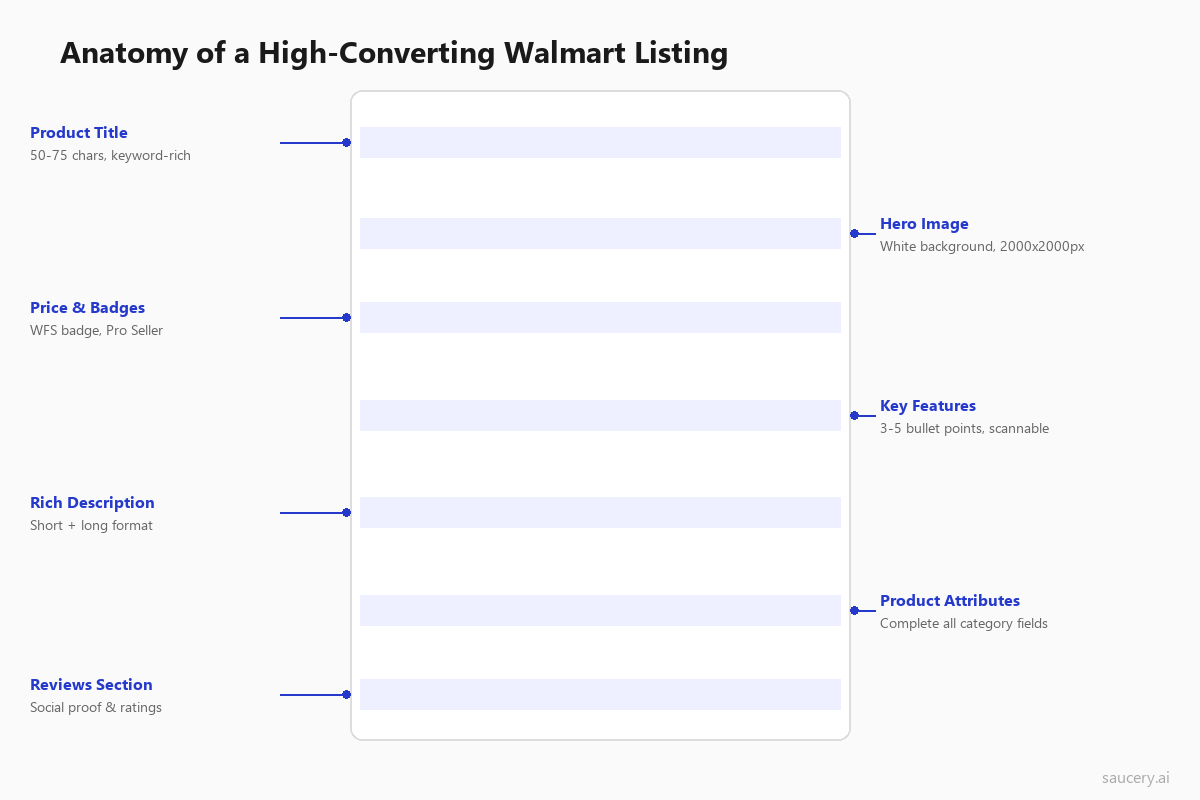
Walmart truncates product titles in search results on both desktop and mobile. The first 50 characters are reliably visible across all display contexts. Characters 51-75 may appear on desktop but are often cut on mobile. Anything beyond 75 characters is essentially invisible to shoppers browsing search results.
This is dramatically different from Amazon, where titles can extend to 200 characters and many sellers use every one. On Walmart, cramming keywords into an overly long title actually hurts you – it looks spammy, reduces click-through rates, and the extra keywords may not even be visible to shoppers.
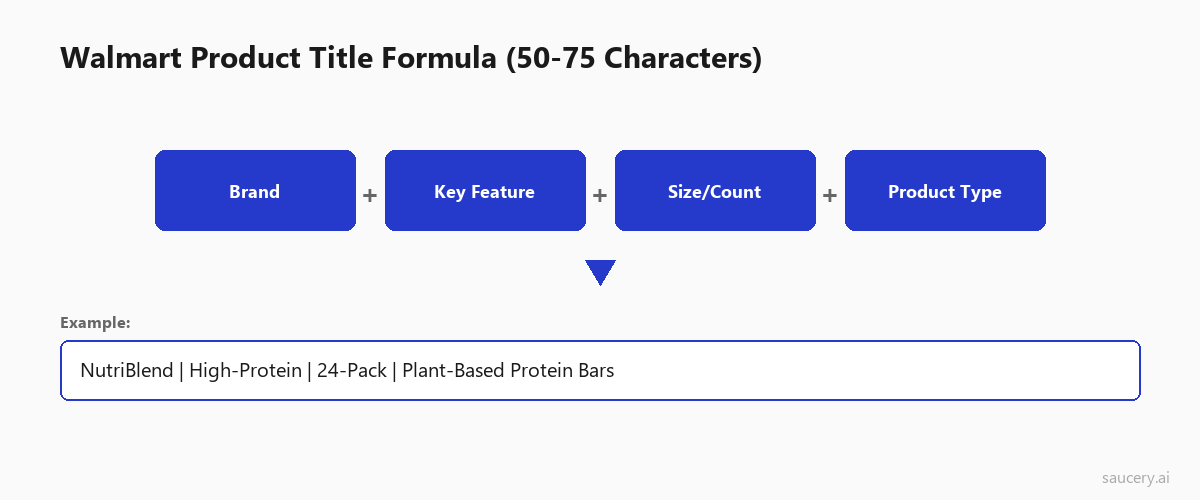
The Walmart Title Formula
Walmart’s own Seller Help documentation recommends this structure:
Brand + Product Line + Defining Quality + Item Name + Pack Count
Each element serves a specific purpose in the ranking and click-through equation:
- Brand – Establishes recognition and trust. Walmart shoppers are brand-aware.
- Product Line – Provides additional context and keyword targeting.
- Defining Quality – The key differentiator (organic, sugar-free, extra-large, etc.)
- Item Name – The generic product category term shoppers search for.
- Pack Count – Critical for value calculation. Shoppers compare price-per-unit.
Good vs Bad Walmart Titles
Bad (Amazon-style, too long):
“Heatwave Artisan Craft Hot Sauce – Carolina Reaper Pepper Sauce for Wings, Tacos, Pizza – All Natural, Gluten Free, No Sugar Added – Made in USA – Premium Gift Set – 3 Pack 5oz Bottles”
This is 196 characters. On Walmart, shoppers would see: “Heatwave Artisan Craft Hot Sauce – Carolina Reape…” Everything else is wasted.
Good (Walmart-optimised):
“Heatwave Carolina Reaper Hot Sauce, All Natural, 3-Pack 5oz”
This is 60 characters. It follows the formula precisely: Brand (Heatwave) + Defining Quality (Carolina Reaper) + Item Name (Hot Sauce) + Quality (All Natural) + Pack Count (3-Pack 5oz). Every element is visible. The most important keyword (“hot sauce”) appears within the first 50 characters.
Another good example:
“NutriFuel Organic Plant Protein Powder, Vanilla, 2lb Tub”
57 characters. Brand + Quality + Item Name + Flavour + Size. Clean, scannable, keyword-rich.
Title Formatting Rules
- Capitalise the first letter of each word (except articles and prepositions like “of,” “the,” “for”)
- No special characters (!, @, #, $, %, &, *)
- No promotional language (“Best Seller,” “Limited Time,” “Free Shipping”)
- No all-caps words
- Use numerals for numbers (3-Pack, not Three-Pack)
- Include the most important keyword as close to the beginning as possible
Violating these rules will not just hurt your ranking – it can trigger Walmart’s automated content review, which may suppress your listing entirely until corrections are made.
The Two-Part Description Strategy
Walmart gives you two distinct description fields, each serving a different purpose and appearing in different contexts. Understanding how to use both is essential for complete Walmart listing optimisation.
Shelf Description (The Hook)
The Shelf Description appears on search result pages and category browse pages. It is your chance to convince shoppers to click through to your full listing. Walmart requires a minimum of 3 bullet points and 750 characters, but you should aim for more.
Key principles for the Shelf Description:
- Lead with the primary benefit – What problem does your product solve? What outcome does it deliver?
- Include your target keywords – The Shelf Description is fully indexed for search. Use your primary and secondary keywords naturally within the content.
- Address the decision-making moment – Shoppers scanning search results need quick reasons to choose you over alternatives. Price-per-unit, quality indicators, and social proof all belong here.
- Keep bullets scannable – Each point should communicate one clear idea. Do not write paragraphs disguised as bullet points.
Example Shelf Description:
- Made with 100% Carolina Reaper peppers sourced from family farms in South Carolina
- All-natural ingredients with no artificial preservatives, added sugar, or high fructose corn syrup
- Versatile heat – perfect on wings, tacos, eggs, and grilled meats
- 3-pack of 5oz glass bottles makes an ideal gift for hot sauce enthusiasts
- Over 10,000 units sold with an average rating of 4.7 stars
Long Description (The Closer)
The Long Description (also called Detailed Description) appears on the full product detail page. Shoppers who reach this point are already interested – they need the detail that moves them from consideration to purchase.
Walmart also requires a minimum of 750 characters here, and this content is indexed for search as well. This is where you can expand on:
- Product story and brand heritage – Why does your product exist? What makes your approach different?
- Detailed specifications – Ingredients, dimensions, compatibility, usage instructions.
- Long-tail keywords – Terms that are too specific for the title but still drive targeted traffic. “Carolina reaper hot sauce for grilling” or “natural hot sauce gift set for dad” can live here.
- Use cases and occasions – Help shoppers visualise your product in their life. Specific scenarios convert better than generic claims.
- Trust signals – Manufacturing standards, certifications, awards, testing protocols.
Both description fields accept basic HTML formatting. Use paragraph breaks, bold text for key phrases, and keep paragraphs short. Walls of unformatted text reduce readability and hurt conversion rates.
Key Features: Your Bullet Point Strategy
Walmart’s Key Features section appears prominently on product detail pages. You can include between 3 and 10 bullet points, and you should use every available slot. Each bullet is a ranking opportunity and a conversion lever.
Structuring Effective Key Features
The most effective Walmart Key Features follow a consistent pattern:
- Lead with the primary product benefit – The single most compelling reason to buy.
- Address common objections – Ingredients concerns, quality doubts, sizing questions.
- Highlight differentiators – What makes you different – your unique selling proposition – from the 5-10 other options in your category?
- Include usage information – How to use, serving suggestions, compatibility details.
- Close with a trust signal – Guarantee, certification, or social proof.
Keyword Integration in Key Features
Each Key Feature bullet is indexed for search. This makes the section a natural place to include secondary and long-tail keywords that do not fit in your title. However, keyword stuffing is obvious and counterproductive. The rule is: every keyword must be part of a sentence that a human would naturally say about the product.
Good keyword integration: “This organic hot sauce pairs perfectly with grilled chicken, fish tacos, and morning scrambled eggs.”
Bad keyword stuffing: “Hot sauce organic hot sauce best hot sauce carolina reaper hot sauce for wings hot sauce gift.”
Walmart’s content quality algorithms can detect keyword stuffing, and it negatively impacts your Content Quality Score.
Formatting Best Practices
- Keep each bullet to 1-2 sentences maximum
- Start each bullet with a different word to aid scanning
- Include specific numbers where possible (percentages, measurements, quantities)
- Do not repeat information from the title
- Do not use all-caps or excessive punctuation
- Avoid subjective claims without substantiation (“best tasting” is weak; “voted #1 by Hot Sauce Monthly” is strong)
Product Attributes: The Hidden Discovery Engine
Product attributes are arguably the most underutilised optimisation lever on Walmart. While most sellers focus on titles and descriptions, the sellers who dominate search results fill every available attribute field – both required and optional.
Why Attributes Drive Discovery
When a Walmart shopper applies filters to narrow their search (dietary preference, price range, brand, size, flavour, certification), the results only include products with those attributes filled in. If your “Organic” certification attribute is empty, your organic product will not appear when shoppers filter for organic products – even if the word “organic” is in your title.
According to Walmart’s listing quality documentation, attribute completeness is one of the largest contributors to the overall Listing Quality Score. Products with 90%+ attribute completion consistently outperform those with only required fields filled.
Required vs Optional Attributes
Walmart categorises attributes into three tiers:
- Required – Must be filled for your listing to be published. These include basic identifiers like brand, product name, and category.
- Recommended – Walmart strongly suggests filling these. They significantly impact your Listing Quality Score and search visibility.
- Optional – Available for your category but not flagged by Walmart. Filling these creates additional discovery pathways that competitors often miss.
The strategy is simple: fill everything. Every optional attribute is a chance to appear in a filtered search that your competitors are missing because they stopped at “required.”
Category-Specific Attribute Strategy
For food and beverage products on Walmart, key attributes include:
- Dietary certifications – Organic, Non-GMO, Gluten-Free, Kosher, Halal, Vegan
- Allergen information – Contains/free-from statements
- Flavour – Primary flavour profile
- Container type – Bottle, jar, pouch, can, box
- Size/weight – In the exact units Walmart expects for your category
- Country of origin – Particularly relevant for premium positioning
- Storage instructions – Refrigerate after opening, shelf-stable, etc.
- Ingredients list – Full ingredient declaration
- Nutritional information – Calories, macros, key micronutrients
For other categories, the attributes differ but the principle remains: more completeness equals more discovery. Check your Seller Center for the full attribute list specific to your product category.
Understanding Your Listing Quality Score
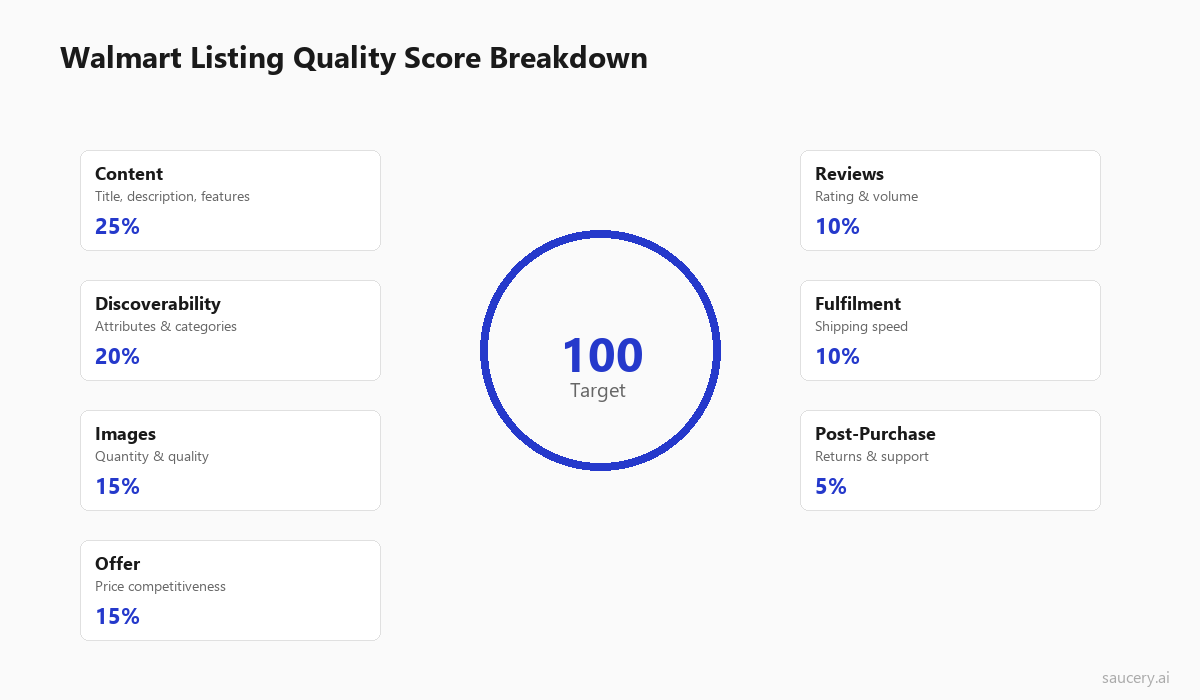
Walmart’s Listing Quality Score is one of the platform’s most valuable features for sellers – and one that Amazon simply does not offer. It is a transparent, actionable metric that tells you exactly how well-optimised your listing is from Walmart’s perspective.
What the Score Measures
The Listing Quality Score evaluates your product listings across multiple dimensions, each weighted by its impact on discoverability and conversion:
- Content Quality – Title format, description length and quality, keyword presence
- Discoverability – Attribute completeness, category accuracy, search term coverage
- Offer Quality – Pricing competitiveness, shipping speed, stock availability
- Ratings and Reviews – Star rating, review count, review recency
Each component contributes to an overall score that you can track over time. Walmart provides specific recommendations for improvement, making this a clear optimisation roadmap.
How to Check Your Score
In Walmart Seller Center, navigate to the Listing Quality section under the Growth Opportunities tab. You will see:
- An overall score for your entire catalogue
- Individual product scores with specific improvement suggestions
- Comparisons to category benchmarks
- Trends showing score changes over time
Walmart flags specific issues like “Missing key attribute: Flavour” or “Title too short – add defining quality” so you know exactly what to fix.
Score Thresholds and Their Impact
While Walmart does not publish exact ranking correlations, seller community data and Walmart’s own documentation suggest these general thresholds:
- Below 60% – Listing may be suppressed in search or receive minimal organic visibility
- 60-80% – Adequate visibility, but losing to competitors with higher scores in the same category
- 80-90% – Strong visibility, appearing in relevant searches consistently
- 90%+ – Maximum algorithmic benefit. Your listing is fully optimised from Walmart’s perspective.
Aim for 90%+ on every listing. Because the score system is transparent, there is no excuse for not knowing what to fix. Every percentage point below 90 represents a specific, addressable gap in your listing content.
Image Optimisation for Walmart Listings
Product images on Walmart follow similar principles to other marketplaces, but the specific requirements and best practices differ in important ways.
Minimum and Recommended Image Count
Walmart requires a minimum of one image but recommends at least four. Top-performing listings typically include 6-7 images. Each additional image increases the information available to shoppers and reduces purchase hesitation.
The image slots should follow this sequence:
- Main image – Product on pure white background, filling 80%+ of the frame
- Alternate angle – Different perspective showing shape, depth, or back label
- Scale/size reference – Product in context showing actual size
- In-use/lifestyle – Product being used in its intended context
- Detail/close-up – Texture, ingredients list, certification logos
- Package contents – Everything included, laid out clearly
- Infographic – Key features, dimensions, or comparison data visualised
Walmart-Specific Image Requirements
- Main image must have a white background – This is strictly enforced. Lifestyle or contextual main images will be rejected.
- Minimum resolution of 1000×1000 pixels – Enables zoom functionality on desktop.
- Professional quality lighting – Brightly and evenly lit. No harsh shadows or colour casts.
- No text overlays or watermarks – Unlike Amazon where infographic images are common, Walmart is stricter about text on product images.
- Swatch images for variants – If your product comes in multiple colours, flavours, or sizes, provide swatch images for each variant.
- JPEG or PNG format – JPEG for photographs, PNG for graphics or images requiring transparency.
Image Quality and Conversion
On Walmart’s platform, where many third-party sellers use manufacturer-provided stock images, professional custom photography creates immediate differentiation. Shoppers unconsciously associate image quality with product quality. Investing in professional product photography for Walmart pays off disproportionately because the baseline quality level is lower than Amazon’s.
For food and beverage brands specifically, showing the actual product (not just the packaging) significantly increases conversion. Shoppers want to see the sauce in a bowl, the protein powder mixed in a shaker, the snack bar broken in half. These images answer unspoken questions about colour, texture, and portion size.
Fulfilment, Pricing, and Their Impact on Ranking
Listing optimisation on Walmart extends beyond content. Your fulfilment method and pricing strategy are algorithmic ranking factors that directly influence visibility.
Walmart Fulfilment Services (WFS)
WFS is Walmart’s equivalent of Amazon FBA. You ship inventory to Walmart’s fulfilment centres, and they handle storage, picking, packing, and shipping. The benefits for search ranking are substantial:
- Two-day delivery badge – The 75% impression boost mentioned earlier
- W+ tag eligibility – Walmart+ members (the equivalent of Prime) see WFS products preferentially
- Free shipping qualification – Products stored in WFS automatically qualify for free shipping thresholds
- Buy Box preference – For products with multiple sellers, WFS listings are preferred for the Buy Box
- Returns handled by Walmart – Reduces seller workload and increases customer confidence
The combined ranking impact of WFS makes it effectively mandatory for sellers who are serious about Walmart search visibility. Self-fulfilled listings can still perform well in low-competition categories, but in any contested space, WFS sellers will generally outrank them.
Pricing Strategy for Walmart’s Value-Conscious Shoppers
Walmart’s customer base has a fundamentally different value orientation than Amazon’s. While Amazon shoppers often prioritise convenience and selection, Walmart shoppers are more price-sensitive and value-driven. Your pricing strategy needs to reflect this.
Key pricing principles for Walmart:
- Price parity or better – Your Walmart price should be equal to or lower than your price on other channels. Walmart actively monitors this and will suppress overpriced listings.
- Competitive within category – Check what the top 5-10 products in your category charge. You do not need to be cheapest, but significant premiums require clear justification visible in your listing.
- Multipack value – Walmart shoppers are accustomed to bulk value from their in-store experience. Offering multipack options with clear per-unit savings performs exceptionally well.
- Free shipping threshold – Walmart offers free shipping on orders over $35. Pricing your product just below common add-to-cart thresholds can increase conversion.
Walmart Connect (Advertising)
Walmart Connect is Walmart’s advertising platform, equivalent to Amazon Advertising. While organic listing optimisation should be your foundation, advertising can accelerate visibility – particularly for new listings that lack review history and sales velocity.
Walmart Connect offers:
- Sponsored Products – Keyword-targeted ads in search results
- Sponsored Brands – Brand-level ads with custom creative
- Display Ads – Retargeting and audience-based advertising across Walmart properties
The key insight for Walmart advertising: because competition is lower, cost-per-click tends to be significantly lower than equivalent Amazon ads. Many sellers report 30-60% lower CPCs on Walmart compared to Amazon for the same product category. This makes paid visibility a more efficient investment on Walmart during the current growth phase.
Key Differences Between Walmart and Amazon Listing Optimisation
If you are already selling on Amazon and expanding to Walmart – or comparing the two platforms strategically – understanding the differences is critical. Copying your Amazon listings directly to Walmart is one of the most common mistakes sellers make.
For a complete deep-dive on Amazon-specific strategy, see our Amazon listing optimisation guide. Here, we will focus on the key divergences.
Title Length and Structure
Amazon: Titles can be 80-200 characters depending on category. Longer titles with more keywords generally perform better for search, even if truncated in display.
Walmart: The effective window is 50-75 characters. Titles beyond this are truncated and the extra content provides minimal search benefit. Conciseness and precision are rewarded over keyword volume.
Backend Keywords
Amazon: Offers hidden backend search term fields where you can add keywords that do not appear in the visible listing. This allows keyword stuffing without impacting customer experience.
Walmart: No backend keyword fields exist. All SEO must happen through visible content – titles, descriptions, key features, and attributes. This forces cleaner, more customer-friendly optimisation but requires more careful keyword planning.
Description Fields
Amazon: One product description field (or A+ Content for brand-registered sellers). Bullet points and description serve different purposes but exist in a single content framework.
Walmart: Two distinct description fields (Shelf Description and Long Description) that appear in different contexts. Both are indexed for search, giving you more total content real estate for keyword placement.
Search Algorithm Behaviour
Amazon: Sophisticated semantic search that understands synonyms, related terms, and shopper intent. “Running shoes” and “jogging trainers” are treated as related queries.
Walmart: More reliant on exact keyword matching. You need to include the specific phrases shoppers search for, not just semantically related alternatives. This makes keyword research more important and requires broader keyword coverage across your listing fields.
Quality Score Visibility
Amazon: No visible listing quality metric. Sellers must infer optimisation gaps through performance data and third-party tools.
Walmart: Transparent Listing Quality Score with specific improvement recommendations. This removes guesswork and allows systematic optimisation.
Competition Density
Amazon: 3.1 million sellers, hyper-competitive in most categories. Ranking requires substantial investment in reviews, advertising, and continuous optimisation.
Walmart: 150,000 sellers, competitive in popular categories but with significant whitespace in specialty and emerging categories. Individual listing quality has a proportionally larger impact on rankings.
A/B Testing
Amazon: Native A/B testing through Manage Your Experiments (available to brand-registered sellers). Test titles, images, and A+ Content directly.
Walmart: No native A/B testing functionality. Testing must be done sequentially (change listing, monitor performance, compare periods) or through external tools. This makes pre-launch testing of listing elements more valuable.
The absence of native testing on Walmart creates a real challenge: how do you know which title or description will perform best before committing? Sequential testing is slow and introduces confounding variables (seasonality, competition changes, algorithm updates).
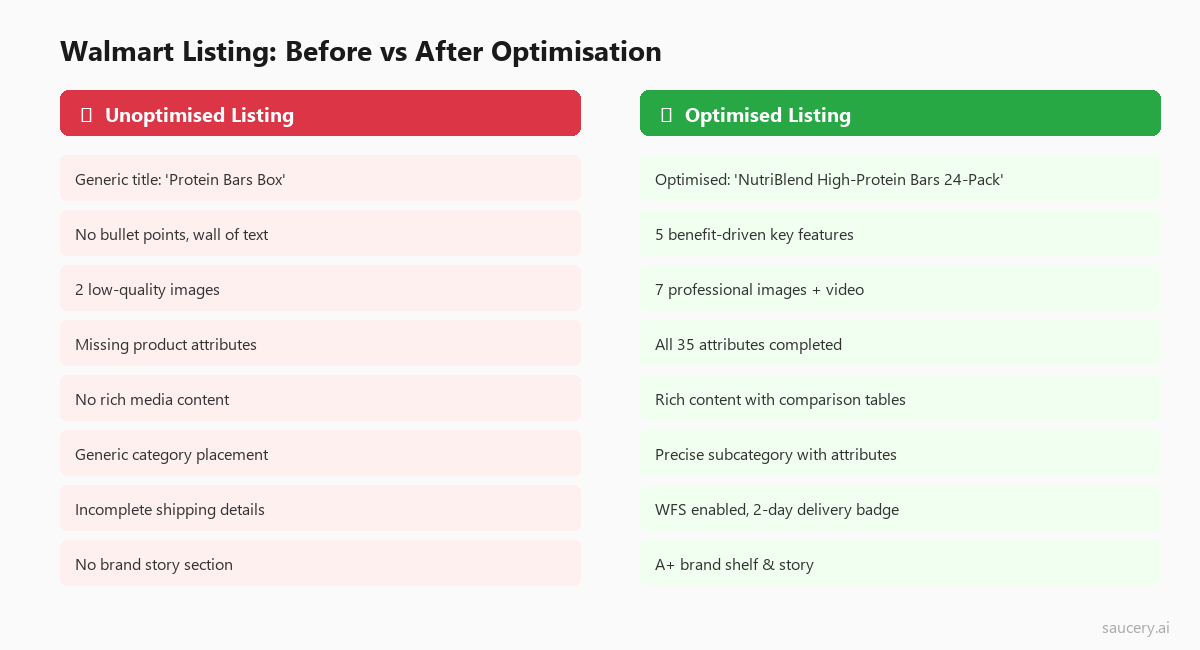
A Step-by-Step Walmart Listing Optimisation Checklist
Whether you are creating a new listing or auditing existing ones, this checklist ensures you cover every optimisation lever. Work through it systematically for each product in your Walmart catalogue.
Pre-Listing Research
- Research top 10 competing products in your Walmart category
- Document the exact search terms shoppers use (Walmart’s auto-suggest is a free research tool)
- Note which competitors use WFS (two-day delivery badge visible in search)
- Identify attribute gaps – what are competitors NOT filling that you can?
- Check pricing benchmarks for your category on Walmart specifically
Title Optimisation
- Follow Brand + Product Line + Quality + Item Name + Pack Count formula
- Keep total length between 50-75 characters
- Ensure primary keyword appears within first 50 characters
- Capitalise appropriately (no all-caps, no special characters)
- Remove promotional language
- Verify it reads naturally as a product name, not a keyword list
Description Fields
- Write Shelf Description with 3+ bullet points, 750+ characters minimum
- Include primary keyword in Shelf Description naturally
- Write Long Description with 750+ characters minimum
- Include secondary and long-tail keywords in Long Description
- Use basic HTML formatting for readability
- Ensure no duplicate content between the two fields
Key Features
- Write 5-10 bullet points (use all available slots)
- Lead first bullet with primary benefit
- Include secondary keywords naturally across bullets
- Address common purchase objections
- Keep each bullet to 1-2 concise sentences
Attributes
- Fill ALL required attributes accurately
- Fill ALL recommended attributes
- Fill ALL optional attributes that apply to your product
- Double-check category-specific attributes (dietary, certifications, dimensions)
- Verify attribute values match Walmart’s accepted format/options
Images
- Upload minimum 4 images, ideally 6-7
- Main image: white background, product filling 80%+ of frame
- Include alternate angle, scale reference, and lifestyle images
- All images minimum 1000×1000 pixels
- No text overlays or watermarks
- Swatch images for all variants
Fulfilment and Pricing
- Enrol in WFS for two-day delivery eligibility
- Verify price parity with other channels
- Check competitiveness against top category products
- Consider multipack options for value positioning
- Ensure free shipping qualification
Post-Launch Monitoring
- Check Listing Quality Score within 24 hours of publishing
- Address any score improvement recommendations immediately
- Monitor search ranking for target keywords weekly
- Track conversion rate and adjust content if below category average
- Request reviews through Walmart’s Review Accelerator program
Advanced Walmart SEO Tactics
Once your fundamentals are solid – complete attributes, optimised title, dual descriptions, quality images – these advanced tactics can push your listings further ahead of the competition.
Walmart Auto-Suggest Mining
Walmart.com’s search bar provides auto-complete suggestions based on actual shopper search behaviour. Type your primary keyword and note every suggestion. These are confirmed search terms with proven volume on Walmart specifically – not transferred from Google or Amazon keyword tools.
Document these suggestions and integrate them across your listing fields. Because Walmart’s search is more literal, these exact phrases are high-value targets.
Category Browse Optimisation
Not all Walmart product discovery happens through search. Many shoppers browse categories directly, using filters to narrow results. Your category placement and attribute completeness determine whether you appear in these browsing sessions.
Ensure your product is in the most specific applicable category. If Walmart offers “Hot Sauces” as a sub-category under “Condiments,” place your product there – not in the generic “Condiments” parent category where it competes against ketchup and mustard.
Rich Content and Walmart Brand Portal
Walmart’s Brand Portal allows registered brands to create enhanced content – similar to Amazon’s A+ Content. This includes:
- Rich media modules (comparison charts, feature highlights)
- Brand story sections
- Enhanced image galleries
- Video content on product pages
Rich content does not directly impact search ranking, but it significantly impacts conversion rate – which feeds back into ranking through the conversion rate signal. Brands with enhanced content typically see 10-20% higher conversion rates on their product pages.
Review Velocity Strategy
Walmart’s Review Accelerator program allows sellers to send automated review requests to customers after delivery. Enrol every product. Because review counts on Walmart are generally lower than Amazon, each new review has proportionally more impact on both ranking and conversion.
Focus on getting past the key thresholds: 5 reviews (minimum for credibility), 25 reviews (category competitive), and 100 reviews (category dominant in most Walmart categories).
Seasonal and Trend-Based Optimisation
Walmart’s algorithm responds to seasonal relevance. Update your descriptions and key features to reflect seasonal use cases before peak periods. A hot sauce listing might emphasise “perfect for Super Bowl party wings” in January, “BBQ season essential” in May, and “holiday gift set” in November.
These updates refresh your content (Walmart’s algorithm may give slight preference to recently updated listings) while targeting seasonal search terms that spike predictably.
Common Walmart Listing Mistakes to Avoid
In reviewing hundreds of Walmart product listings across food, beverage, and consumer goods categories, these are the mistakes that most commonly suppress visibility and conversion.
1. Copy-Pasting Amazon Listings
The most frequent error. Amazon titles are too long, Amazon’s backend keyword field creates false confidence that visible content is “enough,” and Amazon’s formatting conventions (all-caps keywords, promotional language) violate Walmart’s guidelines. Treat each platform as distinct.
2. Ignoring Optional Attributes
Most sellers fill required attributes and stop. This is like filling in half an exam and wondering why your score is low. Optional attributes are optional for listing publication – they are not optional for ranking competitiveness.
3. Thin Descriptions
Meeting the 750-character minimum with filler text that adds no keywords or value. Both description fields should be substantial, keyword-rich, and genuinely informative. Think of them as content assets, not compliance checkboxes.
4. Price Inflation
Setting Walmart prices higher than other channels “because the fees are different.” Walmart’s algorithm actively suppresses overpriced listings, and their price monitoring tools will flag parity violations. Keep pricing consistent or offer Walmart-specific value (larger packs, bundles).
5. Neglecting the Listing Quality Score
Walmart gives you a literal score telling you how well-optimised your listing is, with specific recommendations for improvement. Sellers who ignore this are leaving free performance gains on the table. Check scores weekly and address every recommendation.
6. Using Minimum Image Count
One or two product images signal low effort to both shoppers and the algorithm. The Listing Quality Score penalises low image count, and conversion rates drop measurably when shoppers cannot see the product from multiple angles and in context.
7. Self-Fulfilling in Competitive Categories
If your competitors use WFS and you do not, they get the two-day delivery badge and 75% impression boost while you do not. In competitive categories, self-fulfilment is a structural disadvantage that no amount of content optimisation can overcome.
Measuring Walmart Listing Performance
Optimisation without measurement is just guessing. Here are the key metrics to track and the tools available for monitoring your Walmart listing performance.
Key Performance Metrics
- Listing Quality Score – Your primary optimisation metric. Track weekly.
- Organic search impressions – How often your product appears in search results.
- Click-through rate (CTR) – What percentage of impressions result in clicks. Low CTR suggests title or main image issues.
- Conversion rate – What percentage of page views result in purchases. Low conversion suggests description, image, or pricing issues.
- Keyword rankings – Your position for target search terms. Track your top 5-10 keywords manually or through third-party tools.
- Buy Box win rate – If multiple sellers offer the same product, how often you win the default purchase option.
Walmart Seller Center Analytics
Walmart provides performance analytics through Seller Center including:
- Sales trends and revenue data
- Item-level performance breakdown
- Return rates and reasons
- Customer satisfaction scores
- Listing quality trends over time
Review these weekly. Look for patterns: which products have high impressions but low conversion (listing content issue), which have low impressions but high conversion (visibility/ranking issue), and which have declining performance (competitive pressure requiring re-optimisation).
The Future of Walmart Marketplace: What to Expect
Understanding where Walmart Marketplace is heading helps you prepare your optimisation strategy for what comes next.
Increasing competition is inevitable. The 40,000+ sellers per year growth rate means today’s relatively uncrowded categories will become more contested. Sellers who establish strong review profiles, sales velocity, and optimised listings now are building moats that will be increasingly expensive for newcomers to overcome.
Algorithm sophistication will increase. Walmart’s search technology will continue evolving toward better semantic understanding. But the fundamentals – quality content, complete attributes, competitive pricing, fast delivery – will remain the foundation regardless of algorithmic changes.
Advertising will become more competitive. As more sellers join and discover Walmart Connect’s currently favourable CPC rates, those rates will increase. Organic ranking becomes more valuable over time as paid visibility becomes more expensive.
Integration with physical retail will deepen. Walmart’s omnichannel strategy means marketplace sellers may eventually gain pathways to in-store shelf placement. Strong marketplace performance positions you for these opportunities as they emerge.
The strategic takeaway: optimise now, while the investment required is low and the returns are disproportionately high. Every month you wait, the competition gets denser and the cost of establishing visibility increases.
Frequently Asked Questions
How long does it take for Walmart listing optimisation changes to affect ranking?
Most content changes are reflected in search within 24-48 hours. However, the ranking impact takes longer to materialise – typically 1-2 weeks for content changes to fully influence your position. Fulfilment changes (switching to WFS) can show impression improvements within days due to the two-day delivery badge. Monitor your Listing Quality Score immediately after changes to confirm Walmart has processed the updates correctly.
Can I use the same product listing on Walmart and Amazon?
Technically yes, but you should not. The platforms have different title length requirements (50-75 vs 80-200 characters), different description structures (two fields vs one), and different algorithm behaviours (exact match vs semantic search). A listing optimised for Amazon will underperform on Walmart in most cases. Create platform-specific versions of your content while maintaining consistent product information and pricing.
What is a good Listing Quality Score on Walmart?
Aim for 90% or above. Listings below 60% may experience visibility suppression. Scores between 60-80% are functional but leave ranking potential on the table. Above 90% indicates you have addressed all major optimisation opportunities Walmart identifies. Check your score in Seller Center under the Growth Opportunities tab and address every specific recommendation Walmart provides.
Does Walmart have backend search terms like Amazon?
No. Walmart does not offer hidden keyword fields. All search optimisation must happen through visible content: titles, shelf descriptions, long descriptions, key features, and product attributes. This means your keyword strategy must be integrated naturally into customer-facing content without making it read like a keyword list.
How important is Walmart Fulfilment Services (WFS) for ranking?
Very important in competitive categories. The two-day delivery badge associated with WFS provides approximately 75% more impressions according to Walmart’s own data. Additionally, WFS products qualify for Walmart+ preferential treatment and Buy Box advantages. In categories with minimal competition, self-fulfilment can still work. In contested categories, WFS is effectively required for competitive visibility.
How many images should I use on Walmart product listings?
Walmart requires a minimum of one but recommends four or more. Top-performing listings typically use 6-7 images. Include a white-background main image, alternate angles, lifestyle/in-use shots, and detail close-ups. Each additional image reduces purchase hesitation and improves your Listing Quality Score. Do not use text overlays or watermarks – Walmart is stricter about this than Amazon.
Is Walmart Marketplace worth it for small brands?
Yes, particularly now while competition is low. Small brands that establish strong listings, reviews, and sales velocity now are building competitive moats that will become increasingly difficult to replicate as more sellers join. The 150,000 seller count compared to Amazon’s 3.1 million means individual listing quality has proportionally more impact. Brands in the $5M-$250M revenue range expanding from Amazon to Walmart are consistently finding that their per-listing ROI on optimisation is higher on Walmart due to the thinner competitive landscape.
From Listing to Launch: Your Next Steps
Walmart listing optimisation is not a one-time task – it is an ongoing competitive advantage. The sellers who win on Walmart in 2026 and beyond are those who treat their listings as living assets, continuously refined based on performance data, competitive changes, and algorithm evolution.
Start with the fundamentals: a precise, formula-driven title under 75 characters. Two substantial descriptions loaded with natural keyword usage. Complete attribute profiles that unlock every discovery pathway. Professional images that build confidence. Competitive pricing that aligns with Walmart’s value-first customer base. And WFS fulfilment that signals reliability to both shoppers and the algorithm.
Then layer on the advanced tactics: auto-suggest keyword mining, seasonal content updates, Review Accelerator enrolment, and Walmart Connect advertising for new product launches.
The window of relatively low competition on Walmart is closing. Every month, thousands of new sellers join. The question is not whether Walmart Marketplace will become competitive – it is whether you will have established your position before it does.
For a broader perspective on how listing optimisation works across all major marketplaces, see our comprehensive e-commerce listing optimisation pillar guide.
Same product. Better listing. More sales.
Find out which version of your product listing converts best – before you publish.
Subscribe for F&B Consumer Insights
Data-driven insights on food & beverage consumer preferences, straight to your inbox.