On Amazon, there are 4,000+ listings for “wireless earbuds under $50.” They all have the same chipset, similar battery life, and identical form factors. The ones that sell 10,000 units a month aren’t better products – they’re better differentiated.
This is the uncomfortable truth about e-commerce in 2026: physical product superiority is table stakes. The brands winning in crowded categories aren’t necessarily making better things. They’re making the same things mean something different to specific buyers.
Product differentiation isn’t about being unique for uniqueness’ sake. It’s about being different in a way that changes a purchase decision. And in a world where private-label manufacturers can replicate any product in 90 days, your differentiation strategy is the only sustainable competitive advantage you have.
This guide breaks down exactly how to find, build, and communicate differentiation that actually converts – with 20 real examples from brands doing it right across Amazon, Shopify, eBay, and Etsy.
What Product Differentiation Actually Means in E-commerce
Let’s start by killing the textbook definition. Michael Porter’s original framework defined differentiation as performing different activities or performing similar activities in different ways. That was 1996. He was talking about airlines and furniture stores.
In e-commerce, product differentiation means something more specific and more urgent: it’s the reason a buyer clicks your listing instead of the 47 others on the same search results page.
Not Just “Being Different” – Being Different Where It Matters
There’s a gap between being objectively different and being perceived as different at the moment of purchase. Your product might use a proprietary blend of 17 botanical extracts. But if that difference doesn’t register in the 3-7 seconds a shopper spends scanning your listing, it doesn’t exist.
Differentiation in e-commerce operates at three levels:
- Product-level differentiation: The physical thing is genuinely different (ingredients, materials, design, function)
- Listing-level differentiation: How you present, frame, and communicate the product is different (copy, images, positioning)
- Audience-level differentiation: Who you’re talking to is different, even if the product is functionally identical
Most sellers obsess over level 1 and ignore levels 2 and 3. That’s backwards. Research from Harvard Business Review shows that how a product is framed changes purchase intent by 30-50%, even when the underlying product is identical.
Product Differentiation vs Marketing Differentiation
Here’s a distinction that matters enormously for e-commerce sellers with limited R&D budgets:
Product differentiation = the thing itself is different. New formula. Different material. Added feature. This requires investment in product development and often means new SKUs, new packaging, new supply chains.
Marketing differentiation = the thing is the same (or similar), but how you position it, who you position it for, and what story you tell about it is different. This requires investment in customer research and copywriting.
Both are valid. But marketing differentiation is faster, cheaper, and often more effective – because the constraint in most categories isn’t product quality. It’s communication clarity.
A protein bar with 20g of protein is not differentiated. A protein bar positioned as “the only bar designed for intermittent fasters who break their fast at the gym” is differentiated – even if the formula is identical to 50 competitors.
Why Physical Product Differences Are Optional (Listing Differentiation Is Not)
Consider this: on Amazon, two listings for functionally identical products can have a 10x difference in conversion rate. Same product. Same price. Same reviews. The difference is entirely in how the listing communicates value.
This is because e-commerce buyers don’t compare products. They compare listings. They compare perceptions of products, filtered through titles, images, bullet points, and reviews. Your listing IS your product in the buyer’s mind until the package arrives.
That means listing differentiation isn’t optional. Even if your product is genuinely superior, you need to differentiate at the listing level or that superiority is invisible. And if your product is a commodity – functionally identical to competitors – listing differentiation is your only path to margin.
This connects directly to e-commerce listing optimisation – but differentiation is the strategic layer that sits above optimisation. Optimisation makes your listing perform better. Differentiation makes your listing stand for something.
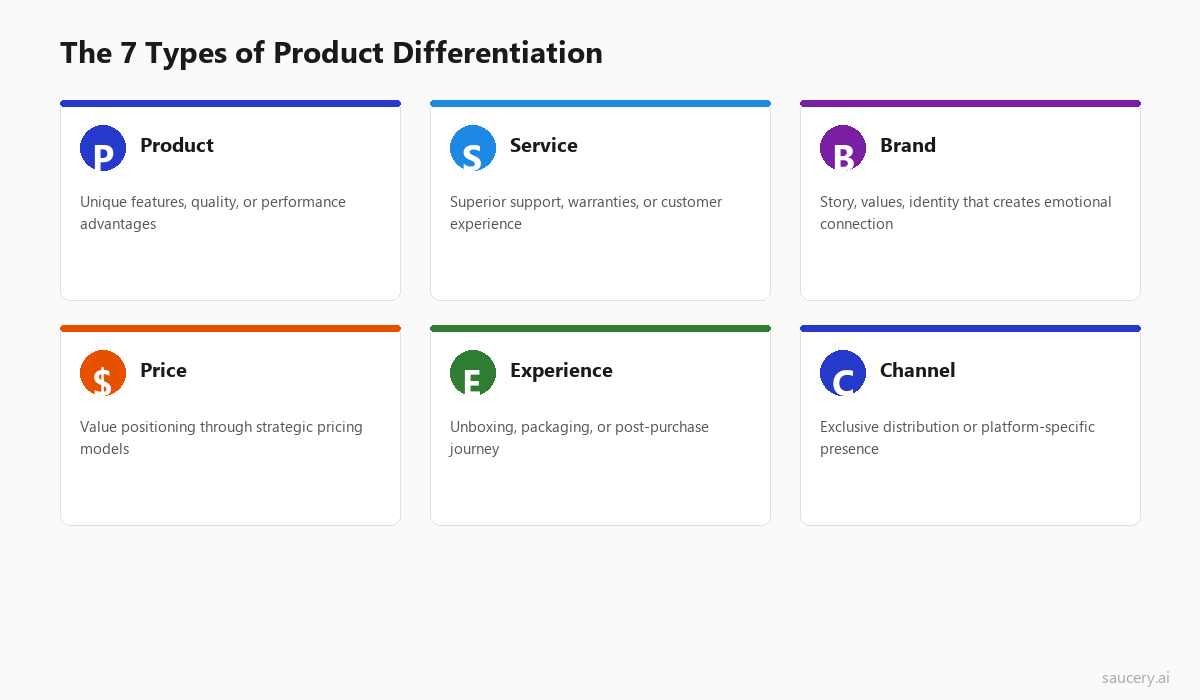
The 7 Types of Product Differentiation for E-commerce Sellers
Not all differentiation is created equal. Some types require product changes. Others require only positioning changes. Here are the seven levers available to you, ordered from most to least product investment required.
1. Feature Differentiation (Actual Product Differences)
This is the most obvious form: your product does something competitors don’t. An extra pocket. A longer battery. A patented mechanism. A unique ingredient.
When it works: The feature solves a specific, acknowledged pain point that buyers actively search for. “Waterproof” for hiking boots. “Spill-proof” for kids’ cups. “Foldable” for commuter bikes.
When it doesn’t: The feature is cool but irrelevant to the purchase decision. Bluetooth-enabled water bottles. AI-powered toothbrushes. Features that solve problems nobody has.
E-commerce application: Lead your title and first bullet point with the feature. Use comparison images showing what you have that others don’t. Feature differentiation only works if it’s immediately visible in the listing.
2. Quality Differentiation (Materials, Certifications, Testing)
Your product uses better materials, meets higher standards, or undergoes more rigorous testing. This is the “premium” play – same category, higher execution.
When it works: Quality is verifiable and visible. Third-party certifications (USDA Organic, B Corp, OEKO-TEX). Lab test results. Material specifications that buyers can evaluate. Transparent supply chain documentation.
When it doesn’t: Quality claims are generic and unverifiable. “Premium quality.” “Best materials.” “Superior craftsmanship.” Without proof, these are noise.
E-commerce application: Certifications belong in your title (if character limits allow) and definitely in your images. Show lab results. Show the material close-up. Show the certification badge. Quality differentiation requires evidence, not adjectives.
3. Design Differentiation (Aesthetics, Packaging, Unboxing)
The product looks different, feels different, or arrives differently. This encompasses industrial design, graphic design, colour choices, packaging materials, and the unboxing experience.
When it works: The category is visually homogeneous and buyers are style-conscious. Think supplements (every bottle looks the same), kitchen tools (sea of black and silver), or personal care (wall of white packaging).
When it doesn’t: When the buyer never sees the product (industrial supplies, replacement parts) or when aesthetics conflict with perceived quality (a neon-pink power drill).
E-commerce application: Design differentiation is the easiest to communicate in listings because it’s visual by nature. Your main image IS your design differentiation. Invest disproportionately in product photography and packaging design that photographs well.
4. Price Differentiation (Not Just Cheaper – Value Framing)
Price differentiation isn’t about being the cheapest. It’s about changing how the buyer evaluates cost. This includes bundling, subscription models, per-unit pricing, and strategic anchoring.
When it works: You reframe the comparison set. Selling individually when everyone sells multipacks (lower entry point). Selling annual subscriptions when everyone sells monthly (lower effective price). Bundling complementary items when everyone sells standalone (higher perceived value).
When it doesn’t: When you simply undercut on price without a cost advantage. That’s a race to the bottom, not differentiation. As we cover in our product pricing strategy guide, sustainable pricing requires structural advantages, not just thinner margins.
E-commerce application: Use “price per unit” or “price per serving” in your bullets when it favours you. Create bundles that change the comparison. Offer a quantity tier that competitors don’t. Price differentiation should make the buyer feel clever, not cheap.
5. Service Differentiation (Warranty, Support, Bundling)
When the product is identical, the service wrapper can be the differentiator. Extended warranties. Dedicated support lines. Hassle-free returns. Setup assistance. Complementary accessories included.
When it works: High-consideration purchases where buyers worry about post-purchase risk. Electronics, furniture, appliances, anything expensive enough that “what if it breaks?” enters the decision.
When it doesn’t: Low-cost consumables where nobody thinks about support. Nobody wants a “dedicated customer success manager” for their $8 bag of coffee beans.
E-commerce application: Put your warranty/guarantee in your title if possible (“5-Year Warranty Included”). Use a bullet point specifically for risk reversal. Include service commitments in your images (badge graphics for “Lifetime Guarantee” or “Free Replacement”).
6. Story Differentiation (Founder Story, Origin, Process)
Why does this product exist? Who made it? Where does it come from? How is it made? Story differentiation gives buyers an emotional reason to choose you when rational reasons are equivalent.
When it works: The story is authentic, specific, and relevant to product quality. “Fourth-generation family farm” for food products. “Developed by a physiotherapist” for ergonomic products. “Made by refugees rebuilding their lives” for handmade goods.
When it doesn’t: The story is generic (“we’re passionate about quality”), disconnected from the product, or feels manufactured. Buyers have excellent BS detectors.
E-commerce application: A+ Content and Enhanced Brand Content exist specifically for this. Use your brand story section. Put a founder photo in your image stack. On Shopify, your About page should be your second-most optimised page. Story doesn’t belong in bullet points – it belongs in the emotional, visual sections of your listing.
7. Audience Differentiation (Same Product, Specific Niche)
This is the most underused and potentially most powerful form of differentiation: take the same product and position it for a specific audience segment that nobody else is speaking to directly.
“Protein bars” is a category. “Protein bars for runners” is a niche. “Protein bars for female runners over 40 who train before sunrise” is a micro-niche. Each level of specificity reduces your addressable market but dramatically increases your conversion rate within it.
When it works: The audience has specific needs, language, or identity that generic products ignore. When “for [specific group]” genuinely changes how the buyer evaluates the product.
When it doesn’t: When the niche is too small to sustain a business, or when the audience label feels forced. “Wireless earbuds for left-handed people” isn’t a real niche because handedness doesn’t affect earbud usage.
E-commerce application: Use audience-specific language in your title. Show your specific user in your lifestyle images. Reference their specific use case in bullets. On Amazon, target long-tail keywords that include the audience (“yoga mat for tall men” rather than just “yoga mat”). This is the unique selling proposition in action – same physical product, completely different positioning.
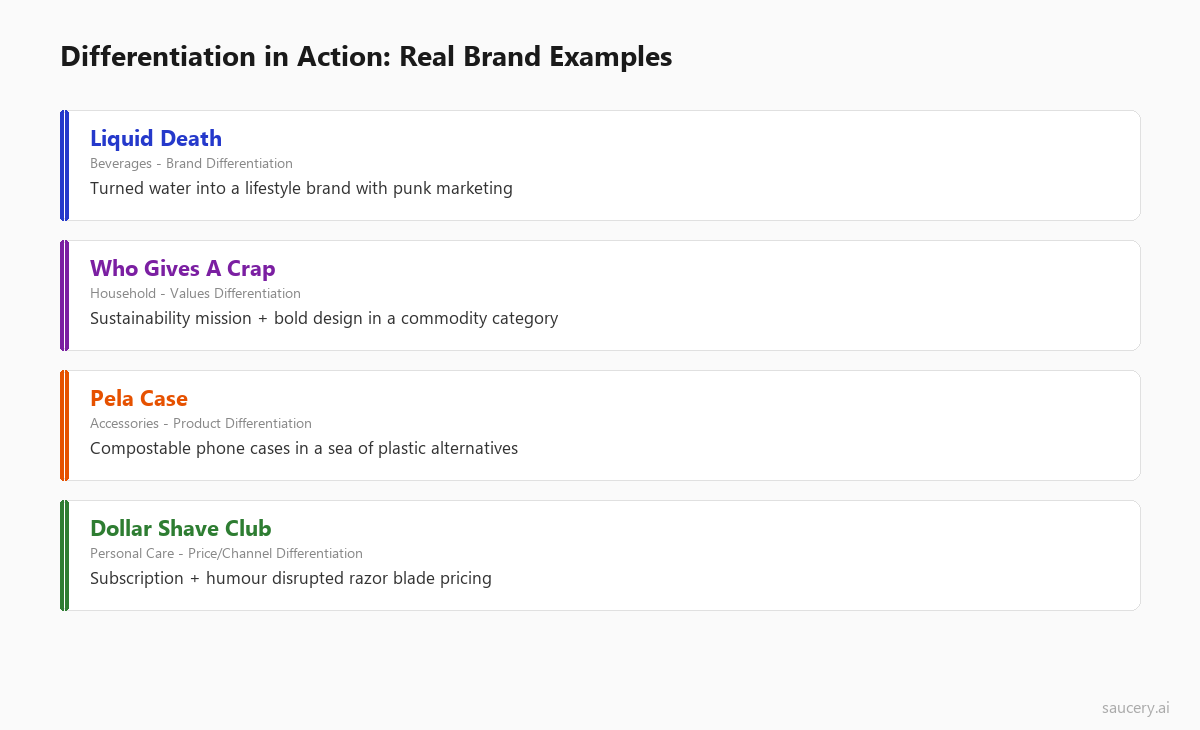
Product Differentiation Examples: 20 Real Brands Doing It Right
Theory is useful. Examples are better. Here are 20 brands that have successfully differentiated in commodity categories – broken down by where they sell and how they did it.
Amazon: 5 Commodity Products That Differentiated Successfully
1. Anker (Portable Chargers)
What they sell: Power banks and charging cables – pure commodity electronics.
How they differentiated: Service + quality differentiation. While competitors offered 6-month warranties, Anker offered 18-month warranties and responsive customer support. They also invested in third-party safety certifications (UL, FCC) and prominently displayed them.
Where it shows in the listing: “18-Month Warranty” in the title. Safety certification badges in the first image. A dedicated bullet point for their “worry-free” guarantee. Every listing opens with the risk reversal.
Result: Anker became the #1 selling charging brand on Amazon, generating over $1 billion in revenue by 2020, primarily through Amazon sales. In a category with 10,000+ competitors.
2. Liquid I.V. (Hydration Packets)
What they sell: Electrolyte powder – functionally similar to dozens of competitors including Pedialyte, Nuun, and DripDrop.
How they differentiated: Story + quality differentiation. They positioned around “Cellular Transport Technology” (CTT) – a science-backed mechanism that sounds proprietary even though the underlying science (osmolarity optimisation) is well-established. They also led with the “3x hydration” claim backed by clinical research.
Where it shows in the listing: “Hydration Multiplier” in the product name. “3x the electrolytes” in bullet one. CTT explanation with a science graphic in images. The mechanism IS the differentiator.
Result: Acquired by Unilever for an estimated $500 million in 2022. They dominated a category where the product itself is essentially sugar, salt, and potassium in a packet.
3. Celestial Seasonings vs Traditional Medicinals (Herbal Tea)
What they sell: Herbal tea bags – commodity product where the actual herbs are sourced from similar suppliers globally.
How they differentiated: Audience differentiation. Celestial Seasonings positioned as a flavour/comfort brand (“Sleepytime,” “Tension Tamer”) while Traditional Medicinals positioned as a medicinal/functional brand (“Throat Coat,” “Smooth Move”). Same category, completely different buyer mindset.
Where it shows in the listing: Celestial Seasonings uses warm, lifestyle imagery and flavour descriptions. Traditional Medicinals uses clinical language, herbalist credentials, and pharmacopoeia-grade claims. Same shelf, different buyer.
Result: Both brands dominate their respective segments of the herbal tea category on Amazon, with Traditional Medicinals holding the top position in “medicinal tea” and Celestial Seasonings in “relaxation tea” – despite near-identical ingredient profiles for some products.
4. FIXD (OBD2 Scanner)
What they sell: An OBD2 car diagnostic scanner – a product where the hardware is essentially the same $3 Bluetooth chip across all brands.
How they differentiated: Audience differentiation + design differentiation. While every competitor targeted mechanics and car enthusiasts (technical language, black devices), FIXD targeted “regular people who hate going to the mechanic.” White device. Plain-English explanations. “Know what’s wrong before you get ripped off.”
Where it shows in the listing: Title says “Car Health Monitor” not “OBD2 Scanner.” Images show a stressed woman at a mechanic, not an engine bay. Bullets say “Translates check engine codes into plain English” not “Reads P0xxx diagnostic trouble codes.”
Result: Over 2 million units sold. While identical-hardware competitors sell for $12-15, FIXD sells for $59.99. Same chip. 4x the price. Pure positioning.
5. Death Wish Coffee
What they sell: Coffee beans – one of the most commoditised products on Earth.
How they differentiated: Feature + story + design differentiation. They claimed “world’s strongest coffee” with 200% more caffeine than average. They backed it with bold skull-and-crossbones branding that’s impossible to confuse with anything else on the shelf.
Where it shows in the listing: Skull logo dominates the main image. “WORLD’S STRONGEST COFFEE” is in the title. Every bullet reinforces the extreme caffeine positioning. The listing feels dangerous, not cozy.
Result: Won Intuit’s Super Bowl commercial contest, generating $10 million in earned media. Became the #1 selling organic coffee on Amazon. In coffee. Where there are literally tens of thousands of competitors.
DTC/Shopify: 5 Brands That Built Differentiation Into Their Store
6. Hims/Hers (Men’s Health Products)
What they sell: Generic finasteride, minoxidil, and sildenafil – literally the same FDA-approved molecules available from any pharmacy.
How they differentiated: Design + audience + service differentiation. They stripped away the shame-laden branding of traditional men’s health products. Millennial-friendly aesthetics. Instagram-worthy packaging. Telehealth consultation included. They made buying erectile dysfunction medication feel like ordering from Glossier.
Where it shows: Clean, pastel product pages. No clinical photography. Lifestyle imagery with diverse, confident men. Subscription model with discreet packaging. The entire experience IS the differentiation.
Result: Over $1 billion in revenue in 2024. Selling generic drugs. The product differentiation is zero – the experience differentiation is everything.
7. Who Gives A Crap (Toilet Paper)
What they sell: Toilet paper – the ultimate commodity product.
How they differentiated: Story + design differentiation. 50% of profits go to building toilets in the developing world. Bold, colourful wrapper designs that people actually display in their bathrooms. They turned a product you hide under the sink into a product you put on the shelf.
Where it shows: The product photography IS the differentiation – colourful wrappers against white backgrounds. Homepage leads with “Good for your bum. Great for the world.” Product pages show exactly where the money goes.
Result: Over $200 million AUD in revenue. Selling toilet paper direct-to-consumer at a premium. The product is functionally equivalent to Costco’s Kirkland brand at 3x the price.
8. Athletic Greens / AG1 (Greens Powder)
What they sell: A greens powder supplement – a category with hundreds of competitors using similar ingredient lists.
How they differentiated: Quality + service differentiation. They positioned as “the one greens powder” – not the cheapest, not the most ingredients, but the one that obsessive optimisers trust. Third-party tested. NSF certified. Travel packets included. A single SKU with total focus.
Where it shows: One product. One page. No menu of options. The simplicity IS the statement. Backed by podcast advertising that made it feel ubiquitous among high-performers. Subscription-first pricing with free welcome kit.
Result: Valued at over $1.2 billion. Selling one product, at $99/month, in a category where competitors sell for $25. The product isn’t 4x better. The positioning is 4x more focused.
9. Ridge Wallet
What they sell: A metal cardholder – a product category with dozens of nearly identical options on Amazon for $15-20.
How they differentiated: Design + feature + story differentiation. Launched on Kickstarter with a clear enemy: “the bulky bifold wallet.” Titanium and carbon fibre materials. RFID blocking. Minimalist design that looks premium. The product is positioned as a category disruption, not a category entry.
Where it shows: Product pages lead with comparison images (thick old wallet vs slim Ridge). Materials are highlighted with close-up hero shots. The “365-day trial” removes risk. Every page reinforces “this replaces your wallet” not “this is a cardholder.”
Result: Over $100 million in revenue, bootstrapped. In a category where the physical product can be replicated for $5 on Alibaba.
10. Pela Case (Phone Cases)
What they sell: Phone cases – possibly the most saturated accessory category in existence.
How they differentiated: Story + quality differentiation. “World’s first compostable phone case.” Made from plant-based materials. Every case diverts waste from landfill. They turned a disposable accessory into an environmental statement.
Where it shows: Homepage shows the case decomposing in time-lapse. Material composition is front and centre. Impact metrics (“X tonnes diverted from landfill”) replace feature specs. The sustainability IS the product.
Result: Multi-million dollar DTC brand selling phone cases at $50+ when Amazon alternatives exist for $10. The compostable material costs marginally more, but the pricing premium is 5x the cost difference.
eBay/Etsy: 5 Differentiation Angles for Marketplace Sellers
11. Vintage Sellers Using Provenance (eBay)
What they sell: Secondhand Levi’s 501 jeans – available from thousands of sellers at any given time.
How they differentiated: Story differentiation through provenance. Top sellers don’t just list “Levi’s 501, 32×30, good condition.” They provide factory codes, production dates, fade patterns, and style-era context. “1993 Valencia Street factory, natural whisker fade, pre-1996 red tab” turns commodity into collectible.
Where it shows in the listing: Detailed photo sets showing selvedge, tab, patch, and stitching. Description reads like an authentication guide. Tags reference specific era keywords (“90s vintage Levi’s USA made”).
Result: Same jeans that sell for $25 from casual sellers routinely sell for $150+ from provenance-focused sellers. The product is identical. The story and expertise are the differentiator.
12. CaitlynMinimalist (Etsy Jewellery)
What they sell: Personalised name necklaces – a category with 50,000+ listings on Etsy.
How they differentiated: Design + quality differentiation. While most sellers use the same 3-4 script fonts and identical gold-plated chain, CaitlynMinimalist invested in unique typeface development, higher-quality materials (sterling silver, 18k gold vermeil), and lifestyle photography that looks editorial rather than product-shot.
Where it shows in the listing: Photos look like magazine editorials. Multiple font options shown in context (on a real neck, not a white background). Reviews specifically mention quality exceeding expectations. Gift packaging photographed and prominent.
Result: Over 3 million sales on Etsy. One of the platform’s top 10 sellers. In personalised jewellery – a category where barriers to entry are essentially zero.
13. ThreeBirdNest (Etsy Headbands/Accessories)
What they sell: Knit headbands, boot cuffs, and accessories – products available from hundreds of sellers and also mass-produced overseas.
How they differentiated: Audience + story differentiation. Built an Instagram-first brand around a specific aesthetic (boho-chic, Pacific Northwest lifestyle). The founder’s personal style became the brand. They weren’t selling headbands – they were selling membership in an aesthetic tribe.
Where it shows in the listing: Every product photo is a lifestyle shot with a consistent visual identity. Listings reference specific occasions (“festival season,” “cabin weekend”). The brand voice is personal and community-focused.
Result: Grew from Etsy to a standalone DTC brand doing seven figures annually. Selling products that cost $2 to make for $25-40, because the community and aesthetic are the value.
14. Refurbished Tech Specialists (eBay)
What they sell: Refurbished iPhones and MacBooks – identical products to thousands of other sellers.
How they differentiated: Service differentiation. Top refurbished sellers like Decluttr and Back Market (both active on eBay) offer standardised grading systems (“Like New,” “Good,” “Fair” with specific criteria), 12-month warranties, and data-wiping certificates. They turned “used electronics” from risky to reliable.
Where it shows in the listing: Grading criteria spelled out in bullet points. Warranty badge in the first image. “What’s included” list with charger, box, certificate. Professional product photography on white background instead of kitchen-table snapshots.
Result: Premium pricing (10-20% above equivalent listings without warranties). Higher conversion rates. Repeat purchase rates far exceeding casual sellers. The product is literally identical – the service layer is the entire margin.
15. Curated Vintage Sellers (eBay/Etsy)
What they sell: Secondhand clothing and homeware – the same products sitting in charity shops everywhere.
How they differentiated: Audience differentiation through curation. Sellers like Frankie Collective don’t just list vintage items. They curate specific aesthetics – reworked Nike, Y2K streetwear, specific-decade pieces. They’re not thrift stores. They’re style editors.
Where it shows in the listing: Consistent photography style. Styled flat-lays or on-model shots that tell a story. Collections grouped by aesthetic rather than category. Descriptions that place items in cultural context (“Seen on Bella Hadid,” “Core Y2K silhouette”).
Result: Frankie Collective turned vintage Nike from $5 thrift finds into $200+ collectibles. Same product. Different curation, different photography, different story, different price.
Bonus: 5 Additional Product Differentiation Examples Across Categories
16. Bombas (Socks) – Donated-pair model + specific technical features for different activities. “Socks engineered for running” vs “socks for hiking” vs “socks for everyday.” Same brand, audience-differentiated SKUs. Each listing speaks to a specific use case.
17. Tushy (Bidets) – Took a stigmatised category and used humour + design to make it approachable. Pastel colours. Irreverent copy (“For people who poop”). Turned a $30 hardware product into a $99 lifestyle brand through pure positioning.
18. Haus (Aperitifs) – Audience differentiation. Same category as Aperol and Campari but positioned for “people who think cocktails are too much effort and wine is too boring.” Lower ABV, Instagram aesthetics, subscription model. Same liquid category, completely different buyer.
19. Bite Toothpaste Bits – Format differentiation. Same ingredients as regular toothpaste, delivered as dissolvable tablets. The format IS the entire differentiation. Positioned around plastic waste reduction. Same active ingredients, different delivery, 3x the price per use.
20. Scrub Daddy (Sponges) – Feature differentiation. A sponge that changes firmness with water temperature. One genuine functional difference, communicated relentlessly through demonstrations. Shark Tank appearance provided story differentiation. Over $200 million in retail sales – selling sponges.
How to Find Your Differentiation Angle
You’ve seen what differentiation looks like. Now the practical question: how do you find yours? Here are four proven methods that don’t require a $50,000 research budget.
Review Mining: What Do Competitors’ Negative Reviews Say?
Your competitors’ 1-3 star reviews are a free differentiation roadmap. They tell you exactly what buyers wanted but didn’t get.
Process:
- Pull up the top 5 competitors in your category on Amazon
- Filter reviews to 1-3 stars
- Categorise complaints into themes (quality, sizing, packaging, taste, durability, instructions, etc.)
- Identify the 2-3 complaints that appear across multiple competitors
- These are your differentiation opportunities
Example: If you’re entering the insulated water bottle category and every competitor has 2-star reviews saying “the lid leaks in my bag,” your differentiation is a genuinely leak-proof lid. Lead with it. “The Only Bottle With a Triple-Seal Lid” becomes your title.
The key insight: negative reviews reveal differentiation opportunities that are already validated. These aren’t hypothetical pain points. They’re documented frustrations from real buyers who spent real money.
Search Term Analysis: What Are People Looking for That Nobody Provides?
Every search query is an expression of unmet demand. When someone searches “yoga mat for bad knees” or “protein powder that doesn’t taste chalky,” they’re telling you exactly what differentiation they’ll pay for.
Process:
- Use Amazon’s search bar autocomplete to find long-tail queries in your category
- Note modifiers that indicate specific needs: “for [audience]”, “without [problem]”, “with [feature]”
- Check if any existing listings specifically address these modifiers in their title/bullets
- If search volume exists but nobody directly addresses it, that’s your opening
Example: “Collagen powder no taste” has significant search volume. Most collagen brands lead with their source (marine, bovine, multi) or their bonus ingredients (vitamin C, biotin). Very few lead with “genuinely tasteless.” If your product dissolves without flavour, that’s your differentiation angle – because buyers are actively searching for it.
This connects to Amazon listing optimisation – your differentiation angle should align with the search terms buyers actually use.
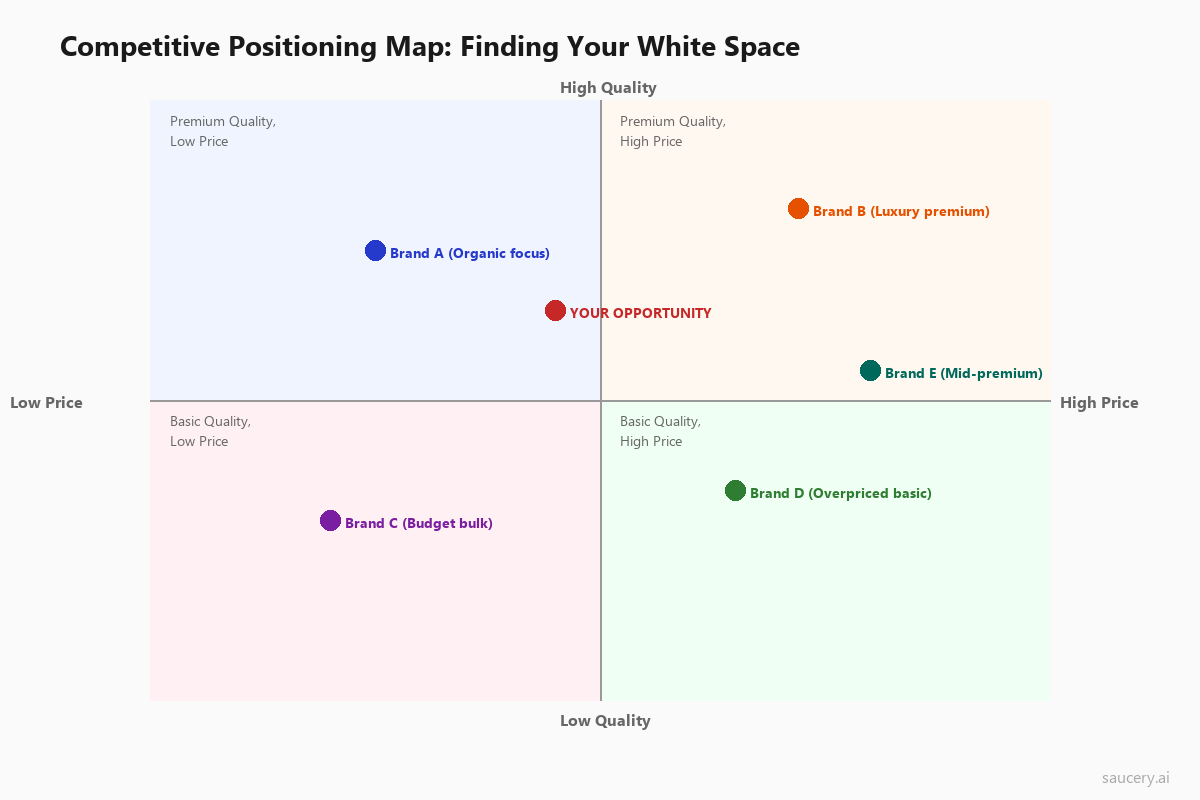
Competitor Gap Mapping
Create a simple matrix of your top 10 competitors across the key attributes buyers care about. Look for gaps – combinations of attributes that nobody occupies.
Process:
- List your top 10 competitors
- Identify 5-7 key attributes (price point, primary claim, target audience, key feature, aesthetic, origin, certification)
- Map each competitor’s position on each attribute
- Find the white spaces – combinations that nobody owns
Example: In the granola category, you might find: plenty of “organic + premium” options, plenty of “cheap + bulk” options, but no “organic + athlete-focused + macro-optimised” option. That’s a gap. Not because nobody could make it, but because nobody has claimed that positioning.
Gap mapping often reveals that the best differentiation opportunities aren’t about being better at one thing – they’re about combining attributes that nobody has combined before.
Customer Interview Insights
If you have existing customers (even a few), they hold differentiation gold. Not in what they say about your product, but in how they describe their buying process.
Key questions:
- “What were you using before you found us?”
- “What made you switch?”
- “What almost stopped you from buying?”
- “How would you describe this product to a friend?”
- “What surprised you after using it?”
The language your customers use to describe why they chose you is often better differentiation copy than anything you’d write yourself. They’ll say things like “I was tired of X” or “I needed something that Y” – these are differentiation angles expressed in buyer language.
Pay special attention to the “How would you describe it to a friend?” answer. That’s your differentiation distilled into natural language. If multiple customers describe you the same way, that’s your positioning.
How to Communicate Differentiation in Your Listing
Finding your differentiation is step one. Communicating it clearly in every element of your listing is step two – and it’s where most sellers fail. They know what makes them different but bury it in paragraph three of their description.
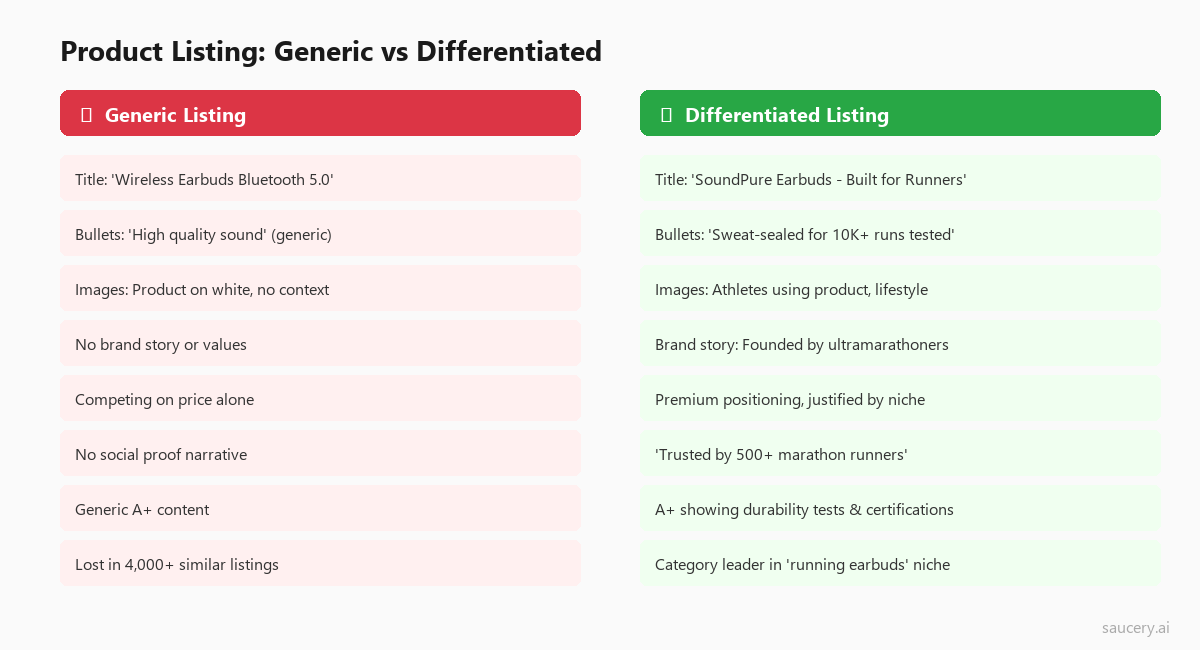
Here’s how to embed differentiation into every listing element:
Title: Lead With the Differentiator, Not the Category
Most sellers write titles like: “[Brand] [Category] – [Feature], [Feature], [Feature]”
Differentiated titles read like: “[Brand] [Differentiator] [Category] – [Benefit]”
Undifferentiated: “ProFit Protein Bars – 20g Protein, Low Sugar, Gluten Free, 12 Pack”
Differentiated: “ProFit Marathon Fuel Bars – Designed for Runners, 20g Protein, Sustained Energy, 12 Pack”
The second title tells you immediately who it’s for and how it’s different. It will rank for “protein bars for runners” while the first competes against every protein bar ever made for “protein bars.”
Rule of thumb: if you delete your brand name and the title could belong to any competitor, you haven’t differentiated. Your title should be uniquely yours.
Bullet Points: Benefit of the Difference, Not Just the Feature
Every bullet should follow this structure: [Differentiation claim] – [Why it matters to the buyer]
Undifferentiated: “Contains 20g of whey protein isolate per serving”
Differentiated: “FAST-ABSORBING PROTEIN FOR POST-RUN RECOVERY – 20g whey isolate hits your muscles within 30 minutes of finishing your run, when the recovery window is most critical”
The feature is the same (20g whey isolate). But the differentiated version connects it to a specific audience (runners), a specific use case (post-run), and a specific benefit (recovery window timing). It’s no longer competing with every protein product. It’s speaking to one person about one moment.
Your first bullet should always be your primary differentiator. Bullets 2-3 should support it with evidence. Bullets 4-5 can cover standard features and specs.
Images: SHOW the Difference
Your image stack should prove your differentiation visually. Here’s how to structure it:
- Image 1 (Main): Product clearly showing its design differentiation
- Image 2: Comparison or “vs” image showing your product against the generic alternative
- Image 3: Your specific user/audience in context
- Image 4: Close-up of the differentiating feature or material
- Image 5: Certification badges, test results, or proof of claims
- Image 6: Size/scale/quantity context
- Image 7: Lifestyle/benefit shot showing the outcome of your differentiation
The “comparison image” (Image 2) is particularly powerful. Show the category norm alongside your product. “Their bulky wallet vs our slim Ridge.” “Typical plastic packaging vs our compostable case.” “Generic sponge vs temperature-responsive Scrub Daddy.” Make the differentiation visual and instant.
A+ Content / Enhanced Descriptions: Tell the Differentiation Story
A+ Content (Amazon) and enhanced product descriptions (Shopify/other platforms) are where you have space to build the full differentiation narrative. This is where story differentiation, process differentiation, and founder narrative live.
Structure for A+ Content:
- Hero banner: Bold differentiation claim + supporting image
- Comparison chart: You vs category standard (not specific competitors)
- Process/origin story: Why this product exists and how it’s made differently
- Use case scenarios: Specific situations where your differentiation matters most
- Social proof: Reviews that specifically mention your differentiator
The goal of A+ Content isn’t to repeat your bullet points with pictures. It’s to build conviction around your differentiation claim. If your differentiator is “designed for runners,” your A+ Content should show the running-specific design decisions, the testing with runners, and reviews from runners.
For a deeper dive on structuring your entire listing around differentiation, see our guide to e-commerce listing optimisation.
Testing Differentiation Claims Before You Commit
Here’s where most differentiation strategies fail: the founder picks a differentiation angle that sounds good in a brainstorm, commits to packaging, updates all listings, and then discovers that buyers don’t care.
Differentiation that resonates with you is not the same as differentiation that resonates with buyers. You need to test before you commit.
Why You Should Test Before Committing to Packaging/Listing
Packaging changes cost $5,000-$20,000 minimum (new dies, new print runs, minimum order quantities). Listing changes on Amazon take 2-4 weeks to reflect in search rankings. A rebrand takes 3-6 months to propagate across all channels.
If you commit to the wrong differentiation angle, you’ve burned both money and time. And in fast-moving e-commerce categories, time is the more expensive loss.
Testing first costs a fraction of committing wrong. Whether you use A/B testing on your listings, customer surveys, or AI-powered prediction tools, validation before commitment is the highest-ROI activity in your differentiation strategy.
The Risk of Differentiation That Doesn’t Resonate
There are two failure modes for differentiation claims:
- Sounds good to you, irrelevant to buyer: You’re excited about your proprietary manufacturing process. The buyer just wants to know if it fits in their bag.
- Relevant to buyer, not credible from you: You claim “clinical-grade quality” but you’re a 2-year-old brand with no certifications. The claim creates doubt rather than confidence.
Both are expensive to discover post-launch. Testing reveals them before money is committed.
How AI Shoppers Can Predict Which Differentiation Angle Drives Purchase
Traditional A/B testing on live listings has a fundamental problem: it takes 2-4 weeks to reach statistical significance, during which you’re splitting traffic and potentially hurting your organic ranking. You also can only test one variable at a time.
AI-powered modelled shoppers offer an alternative: test multiple differentiation angles simultaneously, get results in hours, and identify the strongest angle before touching your live listing.
The approach works by presenting AI shoppers – calibrated to represent your target demographic – with different versions of your differentiation claim and measuring which one drives the highest purchase intent. It’s not a replacement for real-world testing, but it’s an efficient filter that eliminates weak options before you invest in live testing.
Real Example: “Only 6 Ingredients” vs “11g Protein Per Bar”
Consider a snack bar brand deciding between two front-of-pack claims. Both are true. Both are legitimate differentiation angles. But they appeal to different buyer motivations:
- “Only 6 Ingredients” – appeals to clean-label seekers, ingredient-conscious parents, “less is more” buyers
- “11g Protein Per Bar” – appeals to fitness-focused buyers, macro-counters, functional-nutrition seekers
When tested against a representative panel of modelled shoppers in the snack bar category, the protein claim drove 12% higher purchase intent than the ingredient simplicity claim. Not because “clean label” is a bad positioning – but because in the snack bar category specifically, functional nutrition claims are a stronger primary purchase trigger.
The nuance: “Only 6 Ingredients” performed better as a secondary claim (second bullet, supporting image) once the primary protein claim had captured attention. The optimal strategy wasn’t choosing one or the other – it was sequencing: lead with protein, support with simplicity.
Without testing, the founder would have guessed. And in this case, the founder’s instinct was to lead with ingredient simplicity because it felt more “brand-aligned.” Testing revealed that brand alignment and buyer alignment don’t always match.
When Differentiation Fails (And What to Do Instead)
Not every differentiation strategy works. Sometimes the angle is wrong. Sometimes the market doesn’t care. Here are the three most common failure modes and how to recover.
Differentiation That’s True But Irrelevant
Your product is genuinely different, but the difference doesn’t factor into the purchase decision.
Examples:
- “Hand-poured candles” – most buyers can’t tell the difference between hand-poured and machine-poured
- “Made in [country]” when the buyer has no quality association with that origin
- “Patent-pending design” when the buyer can’t see what the patent does for them
- “10 years of research” when the outcome is the same as competitors
The fix: Translate the feature into a buyer-relevant benefit. “Hand-poured” becomes “Each candle has a unique marbling pattern – no two are identical.” “Patent-pending” becomes “The only lid that seals from both sides – leaked bags are a thing of the past.” The differentiation isn’t the process or the patent – it’s the outcome for the buyer.
If you truly can’t connect your difference to a buyer benefit, it’s not differentiation. It’s trivia.
Differentiation That’s Relevant But Not Credible
The claim matters to buyers, but they don’t believe it coming from you.
Examples:
- A new supplement brand claiming “clinical-grade” without clinical trials
- A generic electronics brand claiming “military-grade durability” with no testing evidence
- “Luxury quality” from a brand with no luxury signifiers (cheap packaging, stock photos, grammatical errors in the listing)
- “Best-in-class” from a brand with 12 reviews
The fix: Either invest in the credibility signals that support the claim (certifications, third-party testing, professional photography, brand aesthetics) or scale back the claim to something you can credibly own. “Lab-tested purity” is credible if you publish the lab results. “Clinical-grade” is not credible without published trials.
Credibility follows a hierarchy: third-party validation > customer reviews > detailed process transparency > brand assertion. The further down that hierarchy your evidence sits, the less credible your differentiation claim.
When to Compete on Execution Instead of Uniqueness
Sometimes the honest answer is: your product isn’t meaningfully different, and no amount of positioning gymnastics will create genuine differentiation. In these cases, you compete on execution.
Execution-based competition means:
- Better product photography than anyone in the category
- Faster shipping (FBA, 2-day, same-day where possible)
- More reviews, more recent reviews, better review responses
- Tighter inventory management (never out of stock while competitors fluctuate)
- Better PPC efficiency (lower ACoS, higher organic rank from consistent sales velocity)
- Superior customer service (faster response times, better resolution rates)
This isn’t glamorous. It’s not the “10x better product” story that startup culture celebrates. But for many categories – especially commoditised ones like phone chargers, basic supplements, or household consumables – consistent execution IS the differentiation. The brand that’s always in stock, always fast, always responsive, and always well-photographed wins over time.
Execution differentiation compounds. Each small advantage (slightly better images, slightly faster delivery, slightly more reviews) multiplies together. A brand that’s 10% better at everything outperforms a brand that’s 50% better at one thing.
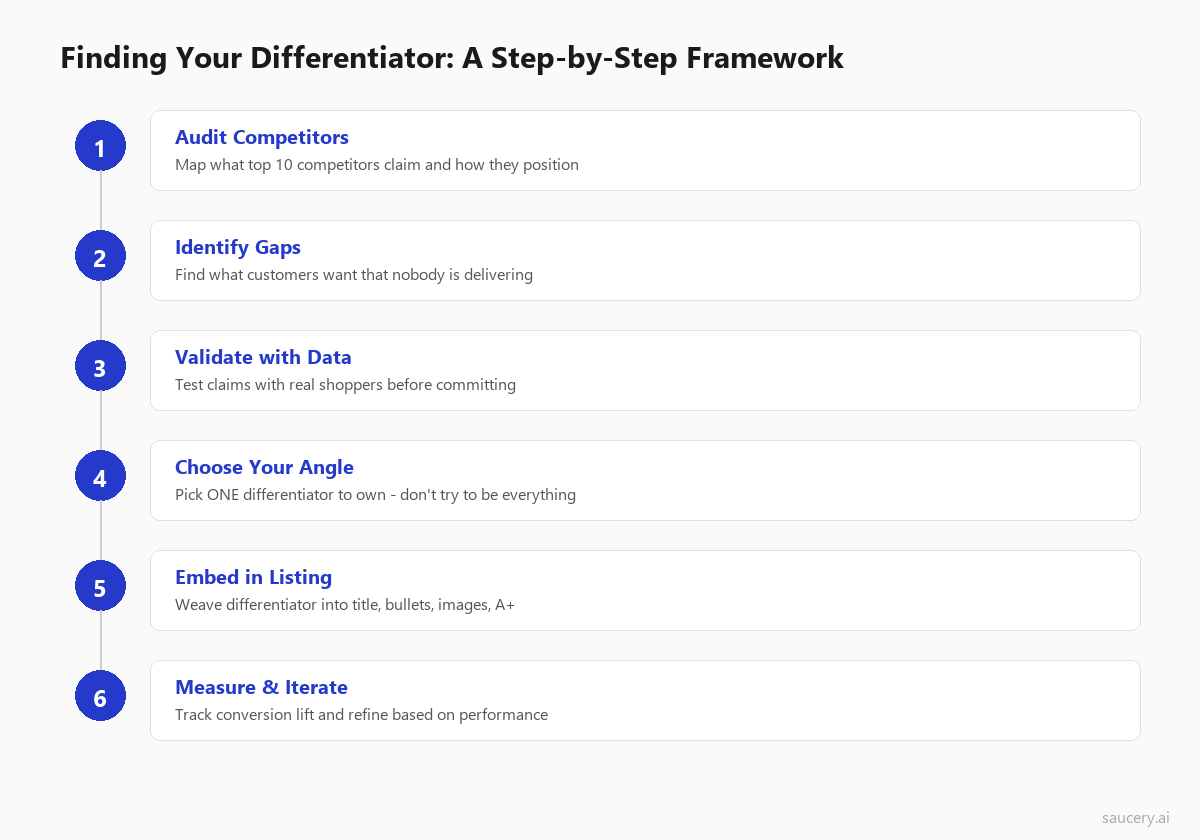
Building a Differentiation Strategy: Step by Step
Let’s pull this together into an actionable process. Whether you’re launching a new product or repositioning an existing one, here’s how to build differentiation systematically.
Step 1: Audit Your Category
Before deciding how to differentiate, understand what “normal” looks like in your category.
- What do the top 10 listings look like? (Titles, images, price range, review counts)
- What claims do they all make? (These are table stakes, not differentiators)
- What language do they all use? (This is your opportunity to sound different)
- What do they all look like? (This is your opportunity to look different)
The goal is to identify category conventions – because differentiation means deliberately breaking at least one convention.
Step 2: Identify 3-5 Potential Differentiation Angles
Using the methods above (review mining, search analysis, gap mapping, customer interviews), generate 3-5 potential differentiation angles. For each, note:
- Which of the 7 types does it fall under?
- Does it require product changes or just positioning changes?
- Can you credibly deliver on this claim?
- Is there search demand for this specific angle?
Step 3: Test Before Committing
The investment in testing is trivial compared to the cost of committing to the wrong angle (new packaging, updated listings, shifted inventory, and 3-6 months of underperformance before you realise the angle isn’t working).
Step 4: Implement Across Every Touchpoint
Once you’ve identified the winning angle, implement it consistently across:
- Product title (lead with the differentiator)
- Main image (show the differentiator visually)
- Bullet points (benefit of the difference for the buyer)
- A+ Content (tell the differentiation story)
- Backend keywords (long-tail terms that include your differentiator)
- PPC campaigns (bid on differentiation-specific keywords)
- Packaging (reinforce at unboxing for reviews and repeat purchase)
- Email/insert cards (remind buyers why they chose you)
Differentiation only works when it’s consistent and omnipresent. A differentiator buried in bullet point #4 that doesn’t appear in your title, images, or A+ Content isn’t differentiation. It’s a detail.
Step 5: Measure and Evolve
Track whether your differentiation is actually working:
- Conversion rate: Did it improve after implementing differentiation?
- Average selling price: Can you command a premium?
- Review content: Do reviews mention your differentiator? (This is the strongest signal)
- Search ranking: Are you ranking for differentiation-specific long-tail terms?
- Competitor response: Are competitors copying your angle? (Means it’s working, but time to evolve)
Differentiation is not permanent. What’s unique today becomes category standard tomorrow. The brands that win long-term are those that continuously evolve their differentiation as competitors catch up.
Product Differentiation and Your Unique Selling Proposition
Product differentiation is the raw material. Your unique selling proposition (USP) is the refined output – the single sentence that captures why someone should buy from you instead of anyone else.
The relationship works like this:
- Differentiation = all the ways you’re different (could be many)
- USP = the ONE difference you lead with (must be singular and clear)
You might have multiple differentiation angles (better materials + unique audience + compelling story). But your USP picks the strongest one and makes it the headline. The others support and reinforce, but one leads.
Death Wish Coffee has multiple differentiators (strong flavour, organic certification, bold branding, founder story). Their USP is one thing: “World’s Strongest Coffee.” Everything else supports that single claim.
If you’re struggling to choose your USP from among multiple differentiation angles, that’s exactly where testing becomes essential. Don’t guess which angle is strongest. Measure it.
Frequently Asked Questions
What is product differentiation in simple terms?
Product differentiation is what makes your product stand out from competitors in a way that influences purchase decisions. It’s not just being different – it’s being different in a way that matters to the buyer at the moment they’re choosing between your product and alternatives. This can be a physical product difference (better ingredients, unique feature), a positioning difference (targeting a specific audience), or a communication difference (clearer messaging about an existing benefit).
What are the main types of product differentiation?
There are seven main types: (1) Feature differentiation – actual product differences; (2) Quality differentiation – better materials or certifications; (3) Design differentiation – aesthetics and packaging; (4) Price differentiation – value framing, not just being cheaper; (5) Service differentiation – warranties, support, bundling; (6) Story differentiation – founder narrative, origin, process; (7) Audience differentiation – same product positioned for a specific niche. Most successful brands combine 2-3 types rather than relying on just one.
Can you differentiate a product without changing the product itself?
Yes – and it’s often more effective than product changes. Audience differentiation (positioning the same product for a specific group), story differentiation (why the product exists), and service differentiation (what wraps around the product) all require zero changes to the physical item. The FIXD OBD2 scanner example illustrates this perfectly: same hardware chip as $15 competitors, sold for $60 through superior positioning and audience targeting. In e-commerce, buyers compare listings, not products – which means listing-level differentiation is often more impactful than product-level changes.
How do I know if my differentiation is working?
Four key signals: (1) Conversion rate improves after implementing the differentiation in your listing; (2) You can command a price premium over functionally identical competitors; (3) Customer reviews organically mention your differentiator (“I bought this because…”); (4) You rank for long-tail search terms that include your differentiation angle. The strongest signal is reviews – when buyers unpromptedly repeat your differentiation language, it has genuinely landed.
What’s the difference between product differentiation and competitive advantage?
Product differentiation is one source of competitive advantage, but not the only one. Competitive advantage also includes cost advantages (you can make the same product cheaper), distribution advantages (exclusive retailer relationships), network effects (more users make the product better), and switching costs (customers are locked in). Differentiation is the most accessible competitive advantage for small e-commerce sellers because it doesn’t require scale, capital, or exclusive partnerships – it requires insight into what buyers value and clear communication of that value.
How many differentiation angles should I use?
Lead with one primary angle (your USP) and support with 2-3 secondary angles. Trying to communicate more than four differentiators dilutes all of them. Think of it as a hierarchy: your title and main image communicate your primary differentiator. Your first 2-3 bullet points expand on it and introduce secondary differentiators. Your A+ Content and description provide the full depth. If you lead with too many claims simultaneously, buyers remember none of them.
Should I differentiate on price?
Only if you have a structural cost advantage that competitors cannot replicate. Being cheaper without a cost advantage is not differentiation – it’s thinner margins. Sustainable price differentiation comes from proprietary supply chains, direct-from-manufacturer sourcing, subscription models that reduce acquisition costs, or bundling strategies that change the comparison set. If your only strategy is “undercut the competition,” you’ll attract price-sensitive buyers who leave the moment someone undercuts you. Price differentiation works when it’s about framing value differently (per-serving pricing, annual bundles, inclusive accessories) rather than simply being the cheapest option. See our product pricing strategy guide for more on sustainable pricing approaches.
From Differentiation to Decision
Product differentiation isn’t a one-time exercise. It’s an ongoing discipline. Markets shift. Competitors copy. Buyer preferences evolve. What differentiated you last year might be table stakes this year.
The brands that sustain differentiation over time share three habits:
- They listen continuously. Not annual surveys – ongoing review monitoring, search trend watching, and customer conversation.
- They test before committing. Every new differentiation angle is validated before it touches packaging or primary listings.
- They lead with one thing. Not five differentiators. Not seven benefits. One clear, ownable, memorable claim that everything else supports.
The wireless earbuds seller who stands out among 4,000 competitors doesn’t do it by being slightly better at everything. They do it by being unmistakably the best choice for someone specific, solving something specific, in a way that’s immediately obvious from the listing.
That’s differentiation. Not being different. Being the obvious choice for the right buyer.
Same product. Better listing. More sales.
Find out which version of your product listing converts best – before you publish.
Subscribe for F&B Consumer Insights
Data-driven insights on food & beverage consumer preferences, straight to your inbox.