Etsy’s search algorithm has fundamentally changed. Keywords get you qualified to appear – but buyer behaviour determines how high you rank. Here’s what the data shows works in 2026.
If you’ve been selling on Etsy for any length of time, you’ve probably noticed something: the old tricks don’t work like they used to. Stuffing your titles with every keyword combination you can think of, gaming renewal timing, or copying what top sellers did three years ago – none of it delivers consistent results anymore.
That’s because Etsy’s search engine has evolved into something far more sophisticated than a simple keyword-matching system. Today, Etsy uses a combination of relevancy signals, listing quality metrics, and real buyer behaviour data to decide which listings appear – and in what order – for any given search.
This guide breaks down exactly how Etsy search works in 2026, what’s changed, and the specific optimisation strategies that data shows are working right now. Whether you’re launching your first shop or trying to revive listings that have plateaued, the principles here will give you a clear framework for getting found.
How Etsy Search Works in 2026
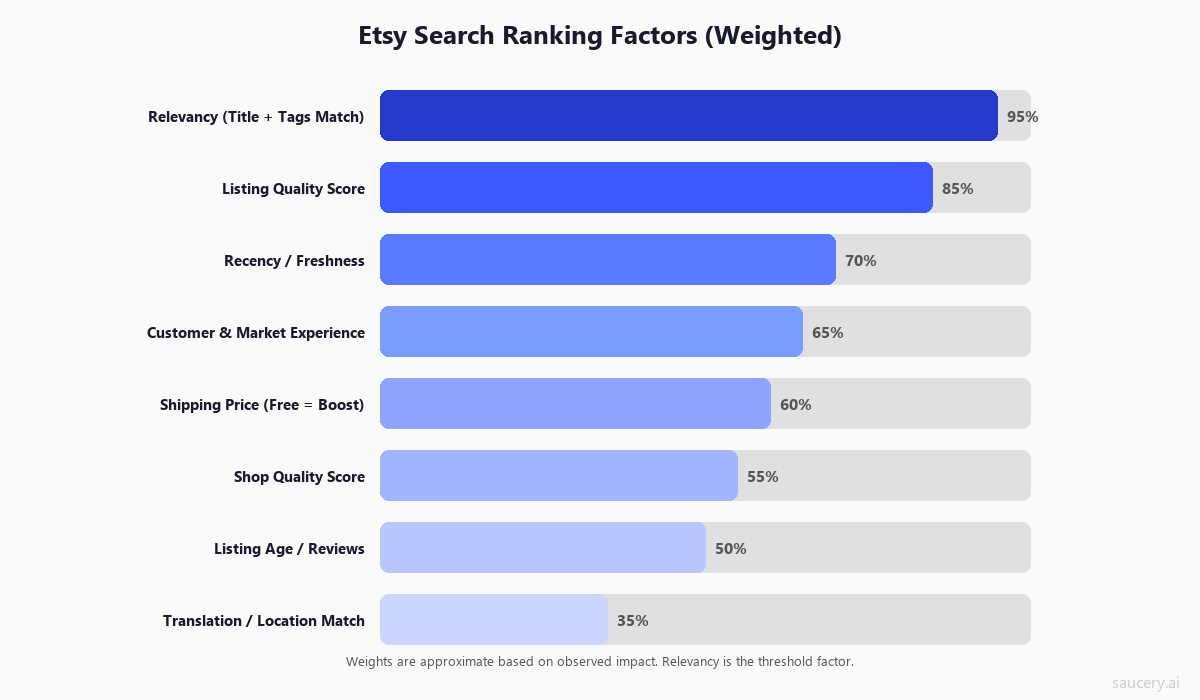
Before diving into tactics, you need to understand the system you’re optimising for. Etsy’s search algorithm evaluates listings across several dimensions simultaneously. Think of it as a multi-stage filter: first, your listing needs to qualify as relevant, then it needs to prove it deserves a high position.
Stage 1: Relevancy Matching
When a buyer types a search query, Etsy first identifies which listings are relevant to that query. This is the qualification stage – you either match or you don’t. Relevancy is determined by keywords found in your:
- Title (140 characters)
- Tags (13 tags, up to 20 characters each)
- Categories and subcategories
- Attributes (colour, material, occasion, etc.)
- Description (indexed since May 2022)
If your listing doesn’t contain the words a buyer searches for – in any of these fields – it simply won’t appear. Full stop. This is why keyword research remains the foundation of Etsy SEO, even as the algorithm has grown more complex.
Stage 2: Listing Quality Score
Once Etsy identifies relevant listings, it needs to rank them. This is where Listing Quality Score comes in. According to Etsy’s Seller Handbook, this score is calculated from real buyer interactions with your listing:
- Click-through rate (CTR): How often buyers click your listing when it appears in search results
- Favourites: How often buyers heart your listing
- Add-to-cart rate: How often viewers add your product to their basket
- Purchase conversion rate: How often viewers actually buy
- Time on page: How long buyers spend looking at your listing
This is the critical shift many sellers miss. You can have perfect keywords, but if buyers aren’t engaging with your listing when they find it, Etsy will progressively show it to fewer people. The algorithm is essentially saying: “We showed this to buyers and they weren’t interested, so we’ll show something else instead.”
Stage 3: Recency and Freshness
Etsy gives new and recently renewed listings a temporary visibility boost. This is the “recency boost” and it serves two purposes: it helps new sellers get initial exposure, and it gives Etsy fresh data about how buyers respond to a listing.
When you publish a new listing or renew an existing one ($0.20 per renewal), Etsy will temporarily show it to more buyers to gauge their response. If the listing performs well during this window, it earns a higher long-term position. If it doesn’t, it settles into a lower rank.
This is why your listing needs to be fully optimised before you publish or renew. You get one shot at that initial impression window – waste it with poor photos or a confusing title, and you’ve spent $0.20 to train the algorithm that your listing underperforms.
Stage 4: Customer and Market Experience Score
Etsy also evaluates your shop as a whole. Your Customer and Market Experience Score reflects:
- Complete shop policies (returns, shipping, etc.)
- A filled-out About section with your story
- Positive review history and response to negative reviews
- On-time shipping and tracking uploads
- Message response time
- Any open cases or intellectual property issues
Think of this as a trust multiplier. Two listings with identical keywords and similar quality scores will be ranked differently if one comes from a shop with complete policies and excellent reviews, versus one with missing information and unresolved complaints.
Stage 5: Personalisation
Finally, Etsy personalises search results based on each buyer’s history. A buyer who has previously purchased handmade jewellery will see different results for “gift for mum” than a buyer who typically buys vintage homewares. This means your ranking position isn’t fixed – it varies by buyer.
You can’t directly optimise for personalisation, but understanding it explains why your search position seems to fluctuate. What you can do is ensure your listing clearly communicates what it is and who it’s for, so Etsy can match you to the right buyers.
Title Optimisation: Your 140-Character First Impression
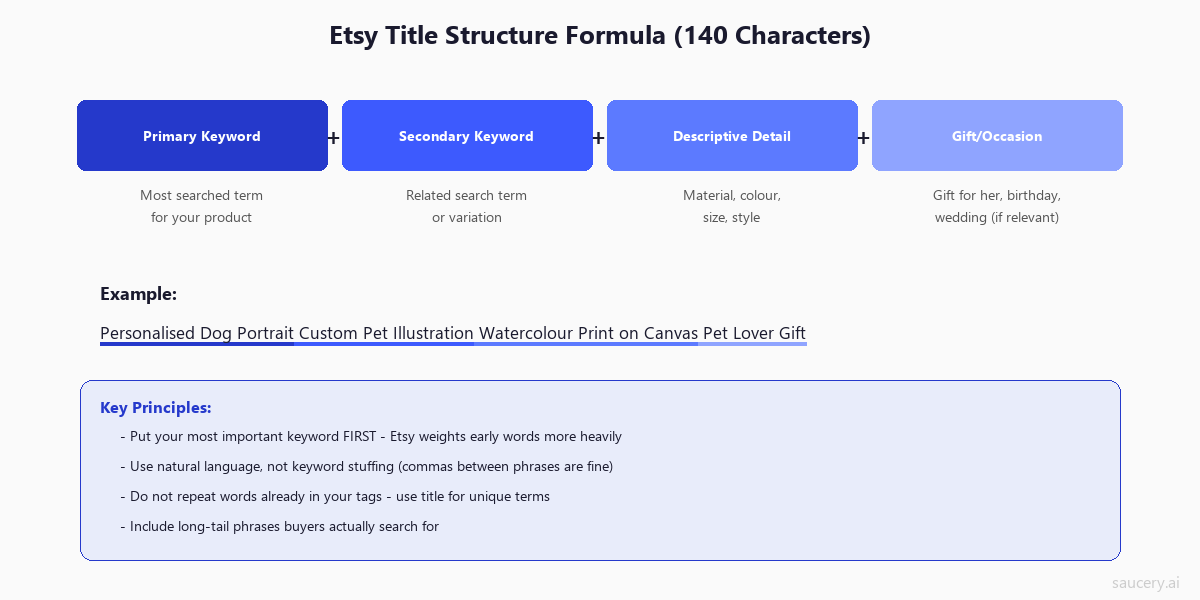
Your title is the single most visible element in Etsy search results (alongside your thumbnail image). It serves two critical functions simultaneously: it tells Etsy’s algorithm what your product is, and it tells human buyers whether to click.
Many sellers optimise for one and ignore the other. That’s a mistake. A keyword-stuffed title might match more queries, but if it reads like gibberish to buyers, your CTR drops – and CTR directly feeds your Listing Quality Score.
The Front-Loading Principle
Etsy weights the first words in your title more heavily than later words. This is confirmed in the Etsy Seller Handbook and consistently validated by seller experiments tracked on platforms like eRank.
Front-load your primary keyword phrase – the exact phrase buyers are most likely to search. If you sell personalised wooden chopping boards, “Personalised Chopping Board” should be the first words in your title, not buried after “Beautiful Handmade Kitchen Gift.”
Title Structure That Works
The best-performing Etsy titles follow a pattern: Primary Keyword + Key Attribute + Who It’s For or Occasion. They read naturally while incorporating essential search terms.
Good examples:
- “Personalised Chopping Board – Engraved Oak Cutting Board for Couples – Wedding Gift” (81 characters)
- “Handmade Ceramic Mug – Large Pottery Coffee Cup in Speckled Blue Glaze – Gift for Him” (86 characters)
- “Vintage Brass Candlestick Holders – Pair of Art Deco Candle Holders – 1920s Home Decor” (87 characters)
Poor examples:
- “Board Cutting Board Chopping Board Wood Board Personalised Board Custom Board Gift” (keyword stuffing – reads terribly, hurts CTR)
- “Beautiful Handmade Gift for Someone Special Who Loves Cooking in Their Kitchen” (no product keywords – Etsy can’t match this to searches)
- “CB-2847-OAK” (product code tells neither the algorithm nor buyers anything useful)
Title Best Practices
- Use all 140 characters – but only if you can do so naturally. A 90-character title that reads well outperforms a 140-character title that’s clearly stuffed.
- Use separators – dashes or pipes (|) between phrases help readability without hurting SEO.
- Include your product type – seems obvious, but many sellers use creative names without the generic product term buyers actually search.
- Don’t repeat words – if “personalised” is in your title, it doesn’t need to be in there twice. Use that character space for additional descriptors.
- Think about what buyers type – not what sounds poetic. “Engagement Ring” outperforms “Symbol of Eternal Love” in search every time.
Tags: The Most Critical Element for Etsy Search
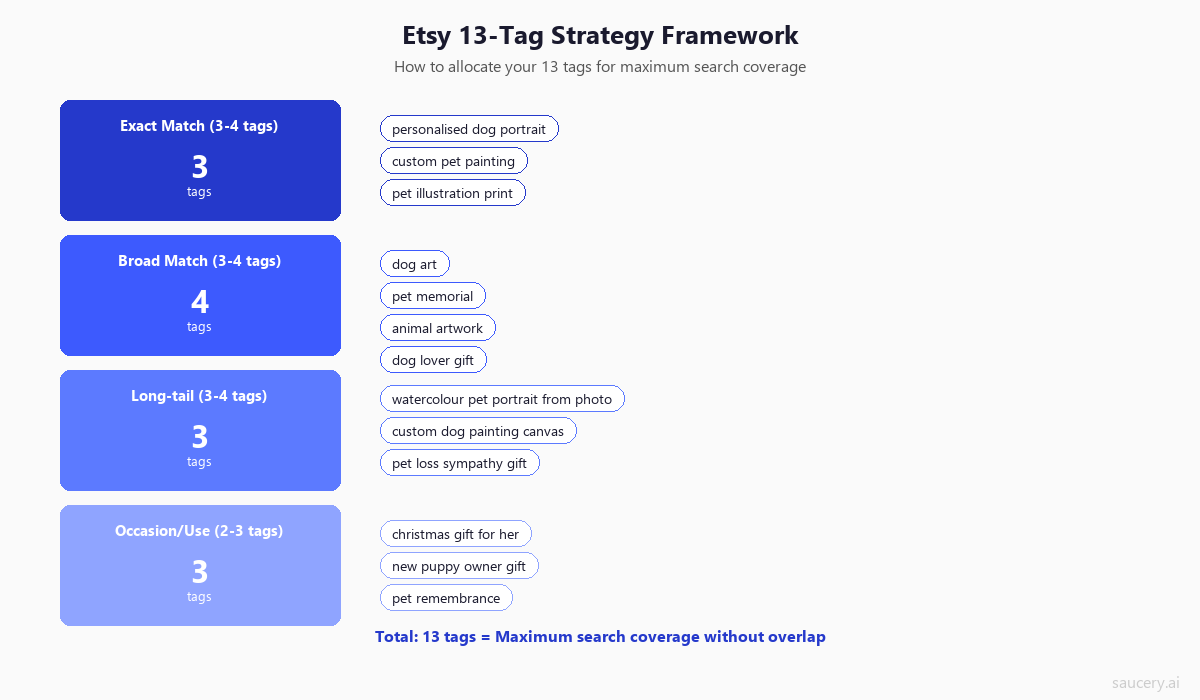
If titles are your first impression, tags are your secret weapon. Etsy gives you 13 tags of up to 20 characters each – and unlike Amazon (which has backend keywords) or Google (which reads all your page content), tags are your primary mechanism for expanding which searches you appear in.
This makes tags arguably the most important element of Etsy SEO. Your title catches the primary search terms. Your tags catch everything else – the synonyms, the long-tail phrases, the gift occasions, the style descriptors that buyers use when they’re browsing rather than searching for something specific.
The Golden Rules of Etsy Tags
1. Use all 13 tags. Always.
Every unused tag is a missed opportunity to appear in a search. There is no scenario where leaving tags empty helps you. Data from Marmalead consistently shows that listings using all 13 tags get significantly more search impressions than those using fewer.
2. Use multi-word phrases, not single words.
A tag like “blue” wastes 16 of your 20 available characters and matches an incredibly broad (and competitive) search. A tag like “navy blue home decor” uses your character allowance efficiently and matches a specific buyer intent.
Etsy matches tags to searches as phrases, but also breaks them into individual words. So a tag of “rustic wedding gift” will match searches for “rustic wedding gift,” “rustic gift,” “wedding gift,” and potentially “rustic” and “wedding” individually. You get more coverage from phrases than from single words.
3. Don’t duplicate words that are already in your category or attributes.
If you’ve selected the category “Jewellery > Necklaces > Pendant Necklaces,” you don’t need to waste a tag on “pendant necklace” – Etsy already knows this from your category. Use that tag for something your category doesn’t cover, like “layering necklace” or “gift for girlfriend.”
4. Your category acts as a “14th tag.”
The category and subcategory you select function as additional search terms. Choose the most specific category available for your product – it gives you free keyword coverage without using any of your 13 tag slots.
What to Include in Your Tag Set
Think of your 13 tags as covering different angles of how a buyer might search for your product:
- Synonyms and alternative names (2-3 tags): Different words buyers use for the same product. “Chopping board” vs “cutting board” vs “cheese board.”
- Occasion and gift terms (2-3 tags): “Wedding gift,” “anniversary present,” “housewarming gift,” “Christmas gift for cook.”
- Recipient terms (1-2 tags): “Gift for her,” “gift for couple,” “gift for foodie.”
- Style and aesthetic descriptors (2-3 tags): “Rustic kitchen,” “farmhouse decor,” “minimalist design,” “boho style.”
- Material or technique terms (1-2 tags): “Solid oak wood,” “hand engraved,” “food safe finish.”
- Long-tail specific phrases (2-3 tags): “Personalised wedding gift,” “custom chopping board UK,” “engraved kitchen gift.”
Tag Set Example: Personalised Oak Chopping Board
Here’s what a well-optimised tag set looks like in practice:
- cutting board custom
- personalised gift
- wedding gift couple
- engraved chopping board
- anniversary gift
- housewarming gift
- rustic kitchen decor
- gift for foodie
- oak wood board
- new home gift
- engagement gift
- cheese board custom
- gift for couple
Notice how each tag covers different search intent. There’s minimal word repetition across tags. Each one could be something a real buyer actually types into Etsy’s search bar.
Descriptions: The Overlooked SEO Opportunity
Here’s something many Etsy sellers still don’t know: Etsy has indexed descriptions in search since May 2022. Before that date, descriptions were essentially invisible to Etsy’s search algorithm. They existed only for buyers who clicked through to your listing.
That changed, and it represents one of the biggest untapped opportunities in Etsy SEO right now. Why? Because the majority of sellers haven’t updated their descriptions to reflect this change. They’re still writing descriptions as if only humans read them – or worse, they’re still using the bare-minimum “ships in 3-5 days” style descriptions that were common when descriptions didn’t matter for search.
How to Optimise Your Etsy Description for Search
Front-load keywords in your first paragraph. Just like Google’s search algorithm, Etsy likely gives more weight to text that appears early in your description. Your first 2-3 sentences should naturally incorporate your primary keywords – the same terms you’re targeting in your title and tags.
Example first paragraph:
“This personalised chopping board is handcrafted from solid oak and custom engraved with your choice of text. Perfect as a wedding gift, anniversary present, or housewarming gift for couples who love cooking together. Each cutting board is made to order in our workshop and finished with food-safe oil.”
Notice how that paragraph naturally includes “personalised chopping board,” “solid oak,” “custom engraved,” “wedding gift,” “anniversary present,” “housewarming gift,” “cutting board,” and “made to order” – all terms buyers might search for. But it reads naturally. There’s no awkward keyword stuffing.
Description Structure That Serves Both SEO and Buyers
After your keyword-rich opening paragraph, structure your description to serve the buyer:
- Product story (2-3 sentences): Materials, process, inspiration. What makes this product special?
- Specifications: Dimensions, weight, materials, colour options. Be specific – “30cm x 20cm x 2cm thick” is better than “medium sized.”
- Personalisation details: If applicable, exactly what can be customised and how to provide their requirements.
- Care instructions: How to maintain the product. This builds confidence in the purchase.
- Shipping information: Processing time, shipping method, packaging details.
- Gift-ready details: If you offer gift wrapping or the product comes in presentable packaging, say so.
Each section gives you natural opportunities to include relevant keywords without forcing them. Mentioning “hand wash only with mild soap” in care instructions reinforces that it’s a natural wood product. Mentioning “arrives in a kraft gift box” reinforces the gift angle.
Description Length
There’s no confirmed ideal length, but data suggests descriptions between 300-600 words perform well. Short enough that buyers can scan quickly, long enough to include comprehensive keyword coverage and product details. The Etsy Community forums frequently cite longer, more detailed descriptions correlating with higher conversion rates – likely because buyers feel more confident purchasing when they have complete information.
Categories and Attributes: Your Free Search Coverage
Categories and attributes are the most efficient SEO elements on Etsy because they provide search coverage without using any of your limited title characters or tag slots.
Category Selection as Your “14th Tag”
When you select a category and subcategory for your listing, those category terms become searchable keywords associated with your product. A listing in “Home & Living > Kitchen & Dining > Cutting Boards” automatically gains relevancy for searches containing “cutting boards,” “kitchen,” and “dining” – without spending a single tag on those terms.
Always select the most specific subcategory available. Etsy’s category tree goes quite deep, and each level adds search terms to your listing. If you sell personalised chopping boards and there’s a subcategory for “Personalised Cutting Boards,” use it rather than the broader “Cutting Boards” category.
Attributes: Hidden Keyword Multipliers
Depending on your category, Etsy offers various attributes you can fill in: colour, material, occasion, recipient, style, and more. Each attribute value acts as an additional search term.
If you set “Occasion: Wedding” as an attribute, your listing gains relevancy for wedding-related searches without using a tag. If you set “Material: Oak,” buyers filtering by material will see your listing.
Fill in every available attribute. Many sellers skip optional attributes because they seem like minor details. But each one is a free keyword you’re leaving on the table. A listing with all attributes filled gets exposure in filtered searches that a listing with empty attributes will never appear in.
According to Etsy’s own guidance, buyers increasingly use category filters and attribute filters to narrow search results. If your attributes aren’t filled in, you’re invisible to these buyers.
Images and Thumbnails: Where CTR Is Won or Lost
Here’s the connection many sellers miss: your images directly impact your Etsy SEO ranking, even though images don’t contain keywords. The mechanism is click-through rate.
When your listing appears in search results, the only visual element buyers see is your first image (thumbnail) and your title. If your thumbnail doesn’t compel clicks, your CTR drops, your Listing Quality Score drops, and Etsy shows your listing to fewer people. Your images are therefore a critical SEO element – just not in the traditional keyword sense.
First Image: Your Search Thumbnail
Your first image is the most important photo in your entire listing. It appears in search results, category pages, favourites lists, and social media shares. It must:
- Clearly show what the product is – even at thumbnail size on mobile
- Stand out from surrounding listings – consider what the typical search results page looks like in your category
- Show the product at its best – good lighting, clean background, attractive styling
- Be consistent with your shop aesthetic – building brand recognition across your listings
Many top sellers use a clean, bright background for their thumbnail image specifically because it stands out against the busier lifestyle photos that dominate many categories. Others do the opposite – using a rich, moody lifestyle shot when their competitors use plain white backgrounds. The key is differentiation within your specific category.
Supporting Images (2-10)
Etsy allows up to 10 images per listing. Use as many as you can meaningfully fill. Research from Etsy’s own data shows listings with more photos tend to convert better. Consider including:
- Scale reference: Product held in hand, next to a common object, or shown in its intended environment
- Detail shots: Close-ups of craftsmanship, texture, material quality, engravings
- Lifestyle use: Product being used as intended (cutting board with food being prepared, mug being held)
- Variations: Different colour options, sizes, or personalisation examples
- Packaging: If it arrives gift-ready, show the unboxing experience
- Size chart or dimensions graphic: Especially important for wearables or items where size matters
Video: The Underused Advantage
Etsy allows a 5-15 second video on each listing. Listings with video get a small play icon on their thumbnail in search results, which can improve CTR simply through visual differentiation. Videos also increase time-on-page, which feeds back into your Listing Quality Score.
Keep videos simple: show the product from multiple angles, demonstrate its use, or show the personalisation process. No audio is needed – most buyers browse with sound off.
Listing Quality Score: The Behaviour-Driven Ranking Factor
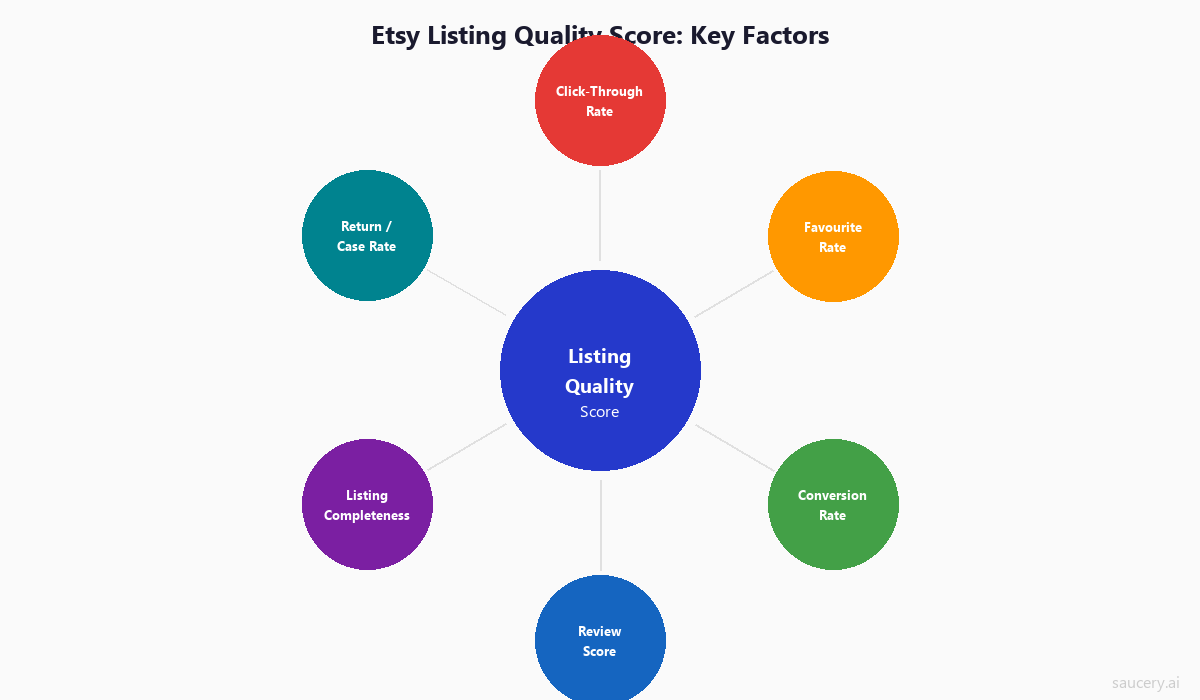
Understanding Listing Quality Score is the key to understanding why some perfectly-keyworded listings sit on page 5 while seemingly less-optimised listings dominate page 1. Keywords qualify you to appear. Buyer behaviour determines where you rank.
The Metrics That Matter
Etsy measures and tracks:
- Click-through rate: Of all the times your listing appeared in search results, what percentage of buyers clicked on it? This is heavily influenced by your thumbnail image and title.
- Favourite rate: Of all viewers, what percentage favourited your listing? Indicates strong buyer interest even if they don’t purchase immediately.
- Add-to-cart rate: Stronger purchase intent signal than favourites.
- Conversion rate: The ultimate signal – what percentage of viewers actually purchase?
- Time on page: Are buyers reading your description and looking at all your photos? Longer engagement suggests a quality listing.
Each of these metrics feeds back into your ranking position for the searches where your listing appeared. High performance = higher rankings = more visibility = more sales. Low performance = lower rankings = less visibility = fewer sales. It’s a virtuous or vicious cycle.
Why CTR Matters So Much
Of all the behaviour signals, click-through rate is the first domino. If buyers don’t click, none of the other metrics can accumulate. You could have the most compelling description and the best price in your category, but if your thumbnail and title don’t earn the click, no one will ever see them.
This is why image quality and title clarity aren’t just “nice to have” – they’re core SEO elements. A listing with mediocre keywords but an irresistible thumbnail will often outrank a listing with perfect keywords but a poor photo. The click data proves to Etsy which listing buyers prefer.
The Renewal Strategy
Every renewal costs $0.20 and triggers the recency boost – that temporary window of increased visibility. Smart sellers use this strategically:
- Only renew optimised listings: Don’t waste the recency boost on a listing with poor photos or an unoptimised title. Fix it first, then renew.
- Time your renewals: Etsy traffic peaks vary by category, but generally mid-week and Sunday evenings see high activity. Renewing during peak traffic means your recency boost reaches more potential buyers.
- Don’t over-renew: The recency boost has diminishing returns. Renewing a listing every day won’t help if buyers aren’t responding to it. Fix the underlying issues instead.
- Use renewals for seasonal moments: Renew your “Valentine’s Day gift” listings in late January when buyers start searching. The recency boost plus seasonal demand creates a powerful combination.
Think of each renewal as a $0.20 investment in data. You’re paying Etsy to test your listing with fresh buyers. If the listing converts, that $0.20 earns you a lasting position improvement. If it doesn’t, you’ve paid $0.20 to confirm something needs fixing.
How Etsy SEO Differs from Amazon and eBay
If you sell on multiple platforms, understanding how Etsy’s approach differs from Amazon and eBay will prevent you from applying the wrong strategies. Each platform has a fundamentally different search philosophy shaped by what they’re trying to optimise for.
For a broader look at how listing optimisation works across different marketplaces, see our guide to e-commerce listing optimisation.
No Backend Keywords
Amazon gives sellers backend keyword fields – hidden search terms that buyers never see but the algorithm reads. This lets Amazon sellers stuff hundreds of keywords without affecting the buyer experience.
Etsy has no equivalent. Your tags are the closest thing to backend keywords, but you only get 13 of them at 20 characters each – and they’re visible to anyone who views your listing source. This means every keyword choice involves a trade-off, and you need to be much more strategic about which searches you target.
Buyer Behaviour Over Raw Sales Velocity
Amazon’s A9/A10 algorithm heavily rewards sales velocity – the more units you sell per day, the higher you rank, almost regardless of other factors. This creates a “rich get richer” dynamic where established sellers with ad budgets dominate.
Etsy’s algorithm is more nuanced. While purchases are one signal, Etsy also weights favourites, add-to-cart actions, and click-through rates. A newer listing that buyers are engaging with positively can outrank an older listing with more total sales but lower engagement rates. This makes Etsy more accessible for new sellers than Amazon.
Storytelling and Branding Matter
On Amazon, buyers are primarily comparing price, reviews, and delivery speed. The brand story is secondary. On Etsy, the handmade and unique positioning means buyers actively seek connection with makers. Your About section, your product descriptions, your process photos – these all contribute to the buyer’s decision and therefore your conversion rate, which feeds back into your search ranking.
Understanding your unique selling proposition is particularly important on Etsy, where “why buy from this maker” is a question every buyer subconsciously asks.
The Recency Mechanism
Amazon and eBay don’t have an equivalent to Etsy’s $0.20 renewal boost. On Amazon, the only way to get visibility for a new listing is through advertising or external traffic. Etsy’s recency boost is a unique mechanism that gives every seller – regardless of budget – periodic access to fresh visibility.
Creative Freedom
Amazon mandates white-background product photography, strict title formats, and bullet-point descriptions. eBay has more flexibility but defaults to a commodity marketplace feel. Etsy gives sellers near-total creative freedom in how they present their products – styled photography, brand storytelling, artistic descriptions. This freedom is both an opportunity (you can differentiate through presentation) and a risk (poor presentation hurts you more when there are no guardrails).
Etsy Keyword Research: Finding What Buyers Actually Search
Effective Etsy SEO starts with understanding what words buyers use when searching for products like yours. This isn’t guesswork – there are specific methods and tools for finding real Etsy search data.
Etsy’s Own Search Bar (Autocomplete)
The simplest keyword research method is free and built into Etsy itself. Start typing a relevant term in Etsy’s search bar and observe the autocomplete suggestions. These suggestions are based on real buyer search behaviour – Etsy is showing you what people actually type.
For example, typing “personalised chopping” might suggest: “personalised chopping board,” “personalised chopping board wedding,” “personalised chopping board family,” “personalised chopping board oak.” Each suggestion represents a real search with real volume.
Use this method systematically:
- Start with your core product term
- Add each letter of the alphabet after it (“personalised chopping a,” “personalised chopping b,” etc.)
- Note down every relevant suggestion
- These become candidates for your title, tags, and description keywords
Dedicated Etsy SEO Tools
Several tools provide more detailed Etsy search data:
- eRank: Shows estimated search volumes, competition levels, and click rates for Etsy keywords. The free tier covers basic research; paid plans offer deeper analytics.
- Marmalead: Provides keyword suggestions, engagement scores, and seasonal trend data specific to Etsy. Particularly useful for identifying long-tail opportunities.
- Alura: Newer tool offering competition analysis and keyword tracking alongside basic research features.
These tools aren’t perfect – Etsy doesn’t publicly share exact search volume data, so all third-party numbers are estimates. But they’re directionally useful for comparing relative demand between keywords and identifying terms you might not have considered.
Competitor Analysis
Look at the top-ranking listings for your target searches. What keywords appear in their titles and tags? (Tags are visible by viewing page source on desktop, or by using tools like eRank that display them.) You’re not copying competitors – you’re understanding what the algorithm currently rewards for those searches.
Pay attention to patterns: if the top 5 results for “handmade ceramic mug” all include “pottery” in their tags, that’s a signal you should too. If they all mention “gift” in their titles, gift intent is clearly important for that search.
Pricing and Its Indirect Effect on Etsy SEO
Pricing doesn’t directly influence Etsy’s search algorithm – there’s no “price rank” factor. But pricing profoundly affects the buyer behaviour signals that do determine your ranking.
A listing priced significantly above competitors for a seemingly similar product will have lower conversion rates. Lower conversion = lower Listing Quality Score = lower rankings. Conversely, a listing priced below its perceived value can see higher conversion rates, boosting its ranking position.
This doesn’t mean you should race to the bottom on price. Etsy buyers expect to pay more for handmade and personalised items – that’s why they’re on Etsy rather than Amazon. But your price needs to feel justified by the perceived quality of your listing. Professional photos, detailed descriptions, and strong reviews all justify higher prices by building perceived value.
For a deeper exploration of pricing psychology and testing strategies, see our product pricing strategy guide.
Common Etsy SEO Mistakes (And How to Fix Them)
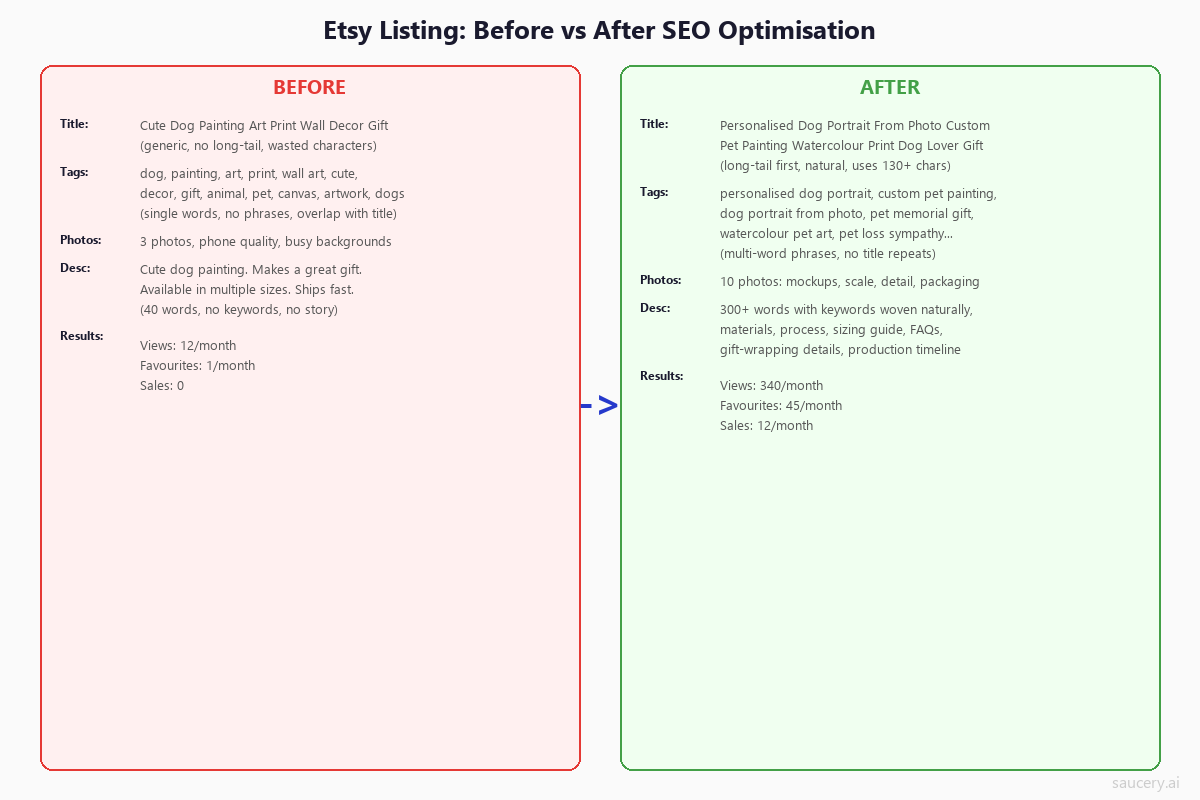
After analysing thousands of Etsy listings, certain mistakes appear again and again. Each one silently limits your visibility without giving you any obvious error message. Etsy won’t tell you your SEO is poor – your listings will simply not appear where you expect them to.
Mistake 1: Using Single-Word Tags
The problem: Tags like “blue,” “gift,” “wood,” or “handmade” waste the majority of your 20-character allowance and target incredibly broad, competitive searches where you have virtually no chance of ranking.
The fix: Replace every single-word tag with a multi-word phrase. “Blue” becomes “navy blue ceramic.” “Gift” becomes “birthday gift for her.” “Wood” becomes “reclaimed wood decor.” You maintain relevancy for the individual words while also matching more specific (and less competitive) long-tail searches.
Mistake 2: Duplicating Words Across Tags, Titles, and Attributes
The problem: If your title says “Handmade Ceramic Mug,” your first tag is “handmade ceramic mug,” your category is “Ceramics > Mugs,” and your material attribute is “Ceramic” – you’ve used four slots to communicate the same information. You get zero additional search coverage from the repetition.
The fix: Audit your entire listing for keyword overlap. Your title, tags, category, attributes, and description should each cover different ground. If “ceramic mug” is in your title and category, use your tags for terms like “pottery coffee cup,” “stoneware cup,” “artisan mug” – synonyms and alternative phrases that expand your reach.
Mistake 3: Ignoring Descriptions
The problem: Many sellers still treat descriptions as an afterthought – either copying their title into the description, writing a single sentence, or using only shipping information. Since descriptions have been indexed since May 2022, this means leaving significant keyword coverage on the table.
The fix: Write descriptions of 300-600 words that naturally incorporate keywords in context. Front-load the most important terms in your first paragraph. Tell your product’s story while weaving in searchable phrases. Every description should be unique – don’t duplicate the same template across listings.
Mistake 4: Not Using All 13 Tags
The problem: Some sellers use 5-8 tags and leave the rest empty, believing that fewer, more targeted tags are better than filling all slots. This isn’t how Etsy works. Empty tag slots provide zero search coverage.
The fix: Always use all 13 tags. If you can’t think of 13 relevant phrases, you haven’t done enough keyword research. Use Etsy autocomplete, competitor analysis, and tools like eRank to identify additional relevant search terms. There is always more search demand than 13 tags can cover.
Mistake 5: Keyword Stuffing Titles
The problem: Titles like “Mug Ceramic Mug Coffee Mug Tea Mug Handmade Mug Pottery Mug Gift Mug Custom Mug” might seem like clever SEO, but they destroy readability. Buyers in search results see a garbled mess and skip to the next listing. Your CTR drops, your Listing Quality Score drops, and your ranking drops.
The fix: Write titles that read as natural phrases a human would understand. Use your tags for keyword expansion – that’s literally what they’re for. A title like “Handmade Ceramic Coffee Mug – Large Speckled Pottery Cup – Gift for Tea Lover” contains plenty of keywords while remaining readable and click-worthy.
Mistake 6: Neglecting Shop Completeness
The problem: Missing shop policies, empty About section, no shop icon or banner. These don’t directly affect keyword relevancy, but they affect your Customer and Market Experience Score, which is a ranking factor.
The fix: Complete every section of your shop: full return/exchange policy, detailed shipping policies, compelling About section with your story and photos, shop announcement, and a professional shop icon. It takes an hour and permanently improves your standing.
Mistake 7: Never Updating Listings
The problem: Publishing a listing and never touching it again means you miss seasonal opportunities, never test alternative keywords, and never benefit from what you’ve learned about what works.
The fix: Review your listings quarterly. Update tags to reflect seasonal searches (add “Christmas gift” tags in October, “Mother’s Day” in March). Test different primary keywords in your title. Update your photos if you’ve improved your photography. Treat your listings as living documents, not set-and-forget posts.
Building a Long-Term Etsy SEO Strategy
Etsy SEO isn’t a one-time optimisation task. It’s an ongoing process of testing, measuring, and refining. Here’s how to build a sustainable approach that compounds over time.
Track What’s Working
Etsy’s built-in Stats dashboard shows you which search terms are driving visits to your listings. Check this weekly and look for patterns:
- Which keywords are sending the most traffic?
- Which keywords have high impressions but low clicks? (Title/image problem)
- Which keywords have high clicks but low conversions? (Price/description/expectation mismatch)
- Are there unexpected keywords appearing? (Opportunities to lean into)
Test Systematically
Don’t change everything at once. If you update your title, tags, photos, and price simultaneously, you’ll never know what made the difference. Change one element at a time, give it 2-4 weeks to accumulate data, then assess.
Common tests worth running:
- Different primary keywords in titles
- Lifestyle photo vs plain background for thumbnail
- Different tag sets targeting different buyer intents
- Description rewrites with different keyword emphasis
- Different price points for the same product
Seasonal Planning
Search behaviour on Etsy is heavily seasonal. “Wedding gift” peaks April-August. “Christmas gift” dominates October-December. “Valentine’s gift” spikes in January-February. Plan your tag updates and renewals around these cycles to maximise the recency boost during high-demand periods.
Create a calendar marking key gift-giving occasions in your market and update your relevant listings 4-6 weeks before each one. This gives you time to build ranking momentum before the peak search period.
Advanced Etsy SEO Tactics
External Traffic Bonus
Etsy has confirmed that listings receiving traffic from external sources (social media, blogs, email newsletters) receive a ranking boost. The logic is straightforward: external traffic brings additional buyers to Etsy’s platform, and Etsy rewards sellers who contribute to platform growth.
This means your Instagram, Pinterest, TikTok, and email marketing efforts have a double benefit: direct sales from that traffic, plus improved organic search ranking on Etsy. Pinterest is particularly effective for Etsy sellers because its visual, discovery-oriented format naturally drives high-intent traffic to product listings.
Etsy Ads and Organic Ranking
Does running Etsy Ads improve your organic ranking? Etsy officially says no – ads and organic search are separate systems. However, there’s an indirect connection: if your ads generate sales, those sales contribute to your Listing Quality Score, which does affect organic ranking.
Think of ads as an accelerator for new listings. They can help you accumulate the initial sales and engagement data that your Listing Quality Score needs, particularly during the crucial first few weeks when you have no buyer behaviour history. Once your organic ranking stabilises, you can reduce ad spend and rely on organic traffic.
Multi-Variation Listing Strategy
Listings with multiple variations (sizes, colours, personalisation options) tend to accumulate stronger Listing Quality Scores because all sales across variations are attributed to a single listing. Rather than splitting your sales across five separate listings for five sizes, a single listing with five size options concentrates all that buyer behaviour data into one quality score.
However, separate listings can target different keywords. If “small ceramic mug” and “large ceramic mug” have meaningfully different search volumes, separate listings let you optimise titles and tags for each. The trade-off is splitting your quality score data.
The general rule: use variations when the products are truly the same item in different options, and use separate listings when the products serve different buyer intents or would benefit from different keyword targeting.
Measuring Your Etsy SEO Success
How do you know if your optimisation efforts are working? Track these metrics over time:
- Search impressions: How often your listings appear in search results (Etsy Stats)
- Search clicks: How often buyers click through from search results
- Search CTR: Clicks divided by impressions – your thumbnail/title effectiveness
- Conversion rate: Views to purchases – your listing page effectiveness
- Revenue per listing: Which listings earn the most, indicating strong search positioning
- Top search terms: Which keywords are driving your traffic
Improvement takes time. After optimising a listing, expect 2-4 weeks before you see meaningful changes in search performance. Etsy’s algorithm needs time to re-evaluate your listing with fresh buyer behaviour data. If you’re seeing steady improvement over months rather than days, you’re on the right track.
Frequently Asked Questions
How long does it take for Etsy SEO changes to take effect?
Most keyword changes (title, tags, description updates) are indexed by Etsy within 24-48 hours. However, seeing ranking improvements takes longer – typically 2-4 weeks – because Etsy needs to accumulate fresh buyer behaviour data based on your optimised listing. During this period, Etsy is testing whether buyers respond better to your updated listing than they did to the previous version. Be patient and resist the urge to make additional changes before you’ve given the first round time to work.
Do Etsy tags need to match search terms exactly?
No – Etsy uses broad matching for tags. A tag of “handmade ceramic mug” can match searches for “handmade mug,” “ceramic mug,” “handmade ceramic,” and variations with different word orders. Etsy also understands some plurals and common misspellings. However, exact matches tend to rank higher than partial matches, so your most important keyword phrases should appear as complete tags where possible.
Should I use all 140 characters in my Etsy title?
Use as many characters as you can while maintaining readability. A natural-sounding 100-character title will outperform a forced 140-character title stuffed with awkward keyword combinations. Remember that titles appear in search results – if they look spammy or confusing, buyers won’t click, and low CTR hurts your ranking more than any extra keywords help. That said, most sellers can naturally fill 100-130 characters with genuinely useful keyword phrases separated by dashes or pipes.
How often should I renew my Etsy listings?
There’s no universal answer – it depends on your margins and competition level. A common approach is renewing your top-performing listings once or twice per week during peak seasons, and monthly during slower periods. Each renewal costs $0.20, so factor that into your per-item costs. Most importantly, only renew listings that are fully optimised. Renewing a listing with poor photos or weak keywords just wastes money – you’re paying for visibility but failing to convert that visibility into engagement or sales.
Does Etsy SEO work differently for digital products vs physical products?
The core algorithm works the same way for both. However, digital products typically have different buyer behaviour patterns: higher add-to-cart rates, instant delivery expectations, and different keyword language (“printable,” “instant download,” “digital template”). Digital sellers also can’t use physical product attributes like material or dimensions. The keyword research and quality score principles remain identical – you still need relevant keywords, compelling thumbnails, and high engagement rates to rank well.
Can I rank on Etsy without running Etsy Ads?
Absolutely. Etsy’s organic and paid search systems are separate. Many successful sellers generate all their traffic organically through strong SEO. Ads can accelerate initial visibility for new listings or during competitive seasons, but they’re not required for long-term ranking success. Focus on creating listings that genuinely serve buyer needs – correct keywords, compelling images, competitive pricing, and excellent customer experience – and organic rankings will follow as buyer behaviour signals accumulate.
What’s the most important single factor for Etsy SEO in 2026?
If forced to choose one factor, it’s click-through rate from search results. CTR is the gateway metric – without clicks, no other buyer behaviour signals can accumulate. And CTR is primarily determined by your first image and title. A listing with an irresistible thumbnail and clear, keyword-rich title will outperform one with perfect backend optimisation but a forgettable presence in search results. Invest disproportionately in your main photo and title – they’re doing the heaviest lifting for your search visibility.
Putting It All Together
Etsy SEO in 2026 comes down to a simple framework: be relevant, be compelling, be consistent.
Be relevant: Use thorough keyword research to ensure your listings contain the terms buyers actually search. Optimise your titles, use all 13 tags strategically, write keyword-rich descriptions, and fill every available attribute.
Be compelling: Once Etsy shows your listing to buyers, make sure they engage with it. Invest in exceptional photography, write titles that are clear and clickable, price your products competitively for their perceived value, and tell a story that connects with buyers.
Be consistent: SEO is not a one-time task. Review your stats regularly, update your listings seasonally, test new keywords and images, and keep improving based on what the data tells you.
The sellers who thrive on Etsy in 2026 aren’t the ones with secret algorithm hacks. They’re the ones who systematically optimise every element of their listings, track what works, and iterate relentlessly. The algorithm rewards listings that buyers love – so make listings that buyers love, and the SEO takes care of itself.
Same Product. Better Listing. More Sales.
Find out which version of your product listing converts best – before you publish.
Subscribe for F&B Consumer Insights
Data-driven insights on food & beverage consumer preferences, straight to your inbox.