You’ve identified your USP. Now the question is: where does it go? Your title? First bullet point? Main image? The answer depends on the platform – and the data says most sellers put it in the wrong place.
A strong unique selling proposition is the foundation of every successful e-commerce product. But having a USP and expressing it effectively on a product listing are two completely different skills. One is strategy. The other is execution under constraints.
This guide bridges that gap. You’ll learn exactly where your USP belongs on Amazon, eBay, Etsy, Walmart, and Shopify – with character limits, placement hierarchies, and real examples showing the same USP expressed five different ways.
The USP-to-Listing Translation Problem
Your USP is a concept – a strategic statement about what makes your product different. “The only hot sauce fermented for 3 years” is clear, memorable, and differentiated. But a product listing is not a brand strategy document. It’s a format with hard constraints.
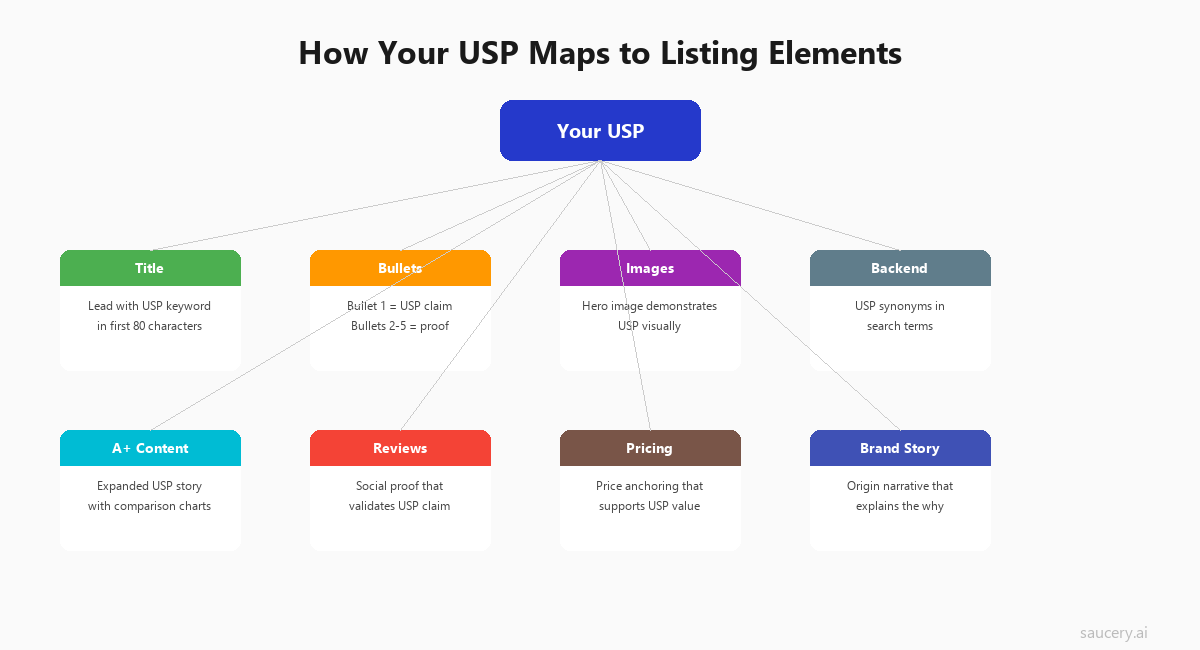
Consider the character limits you’re working with:
| Platform | Title Limit | Key Constraint |
|---|---|---|
| Amazon | 200 chars (80 visible) | First 80 chars appear in search results |
| eBay | 80 chars | No backend keywords – title is everything |
| Etsy | 140 chars | Front-loading critical for search |
| Walmart | 50-75 chars recommended | Strict content quality guidelines |
| Shopify | 70 chars (SEO title) | Google truncates beyond 55-60 chars |
The same USP needs different expressions on different platforms. Not different USPs – different expressions. That distinction matters. Your core differentiator stays constant. How you communicate it adapts to each platform’s format, algorithm, and buyer behaviour. Our eBay listing optimisation guide covers platform-specific tactics. See our Etsy SEO guide for platform-specific details. Our Walmart listing optimisation guide has the full breakdown.
According to Jungle Scout’s listing optimization research, 70% of Amazon shoppers never scroll past the first page of results. Your USP must appear within the first 80 characters of your title to have any impact on click-through rate. For the complete approach, see our Amazon listing optimisation guide.
Why Most Sellers Get This Wrong
The most common mistake is treating every listing like a blank page. Sellers write their USP once – usually the way it appears in their brand deck – and paste it everywhere. Same wording in an Amazon title, an eBay listing, and an Etsy description. Our e-commerce listing optimisation guide covers the full process.
This fails for three reasons:
- Algorithm differences. Amazon A9 weighs title keywords heavily. eBay Cassini favours item specifics. Etsy’s search prioritises tags over descriptions. The same words perform differently depending on where they sit.
- Buyer behaviour differences. Amazon shoppers scan titles and bullet points. Etsy buyers read stories. Walmart shoppers compare specifications. Your USP expression needs to match how people actually consume information on each platform.
- Format constraints. You cannot fit “The only hot sauce fermented for 3 years using traditional Korean onggi pottery methods” into a 50-character Walmart title. You need a compressed version that preserves the core claim.
The solution is a systematic approach: understand where your USP has the most impact on each platform, then craft platform-specific expressions that preserve your core differentiator while respecting each format’s constraints. Research on what shoppers actually read on product listings confirms this pattern.
Where to Place Your USP on Amazon
Amazon gives you more real estate than any other marketplace – but the hierarchy of visibility is steep. Here’s where your USP belongs, in order of impact on conversion:
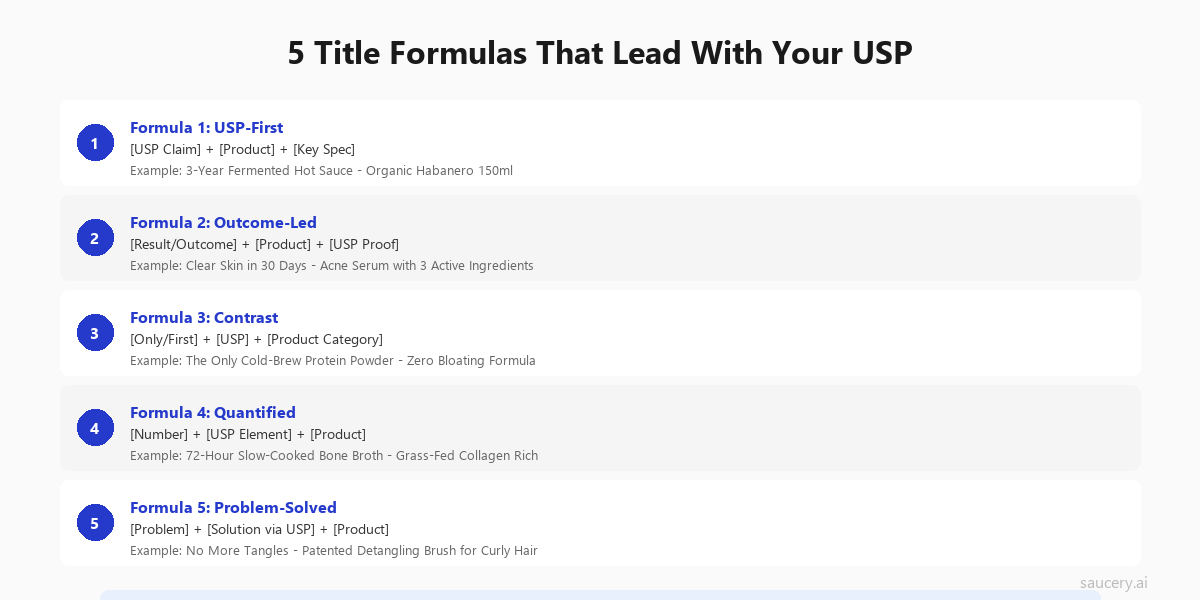
Title (First 80 Characters)
Your title is the single most important element for both search ranking and click-through rate. Amazon’s Style Guide recommends the format: Brand + Product Line + Material/Key Feature + Product Type + Size/Quantity.
Your USP should occupy the “Key Feature” slot. This typically appears within the first 80 characters that display in search results on desktop. On mobile, you get even less – often just 60 characters.
The rule: if a shopper only reads your title, they should understand what makes your product different.
First Bullet Point
The first bullet point is where you expand your USP into a benefit statement. The title introduces the differentiator. The first bullet explains why it matters to the buyer.
According to research from Helium 10, the first bullet point receives 3x more attention than bullets 3-5. If your USP appears in bullet 4, you’ve already lost most of your audience.
Main Image
Amazon’s main image must be on a white background with no text overlays. But your secondary images can – and should – visually communicate your USP. Image 2 is prime real estate for an infographic that makes your differentiator immediately visible.
Backend Keywords
Backend search terms are invisible to shoppers but indexed by Amazon’s algorithm. Use this space for synonyms and long-tail variations of your USP. If your USP is “3-year fermented,” your backend keywords might include: aged hot sauce, barrel-aged, slow fermented, traditionally fermented, long fermentation process.
A+ Content
A+ Content (formerly Enhanced Brand Content) lets you tell the visual story behind your USP. This is where you show the process, the ingredients, the craft – everything that supports why your USP is true and why it matters. Our full Amazon listing optimisation guide covers A+ Content strategy in detail.
Where to Place Your USP on eBay
eBay is fundamentally different from Amazon because there are no backend keywords. Your title is your entire search strategy. Every important word must be visible to the buyer. A strong USP is central to any go-to-market strategy.
Title (All 80 Characters)
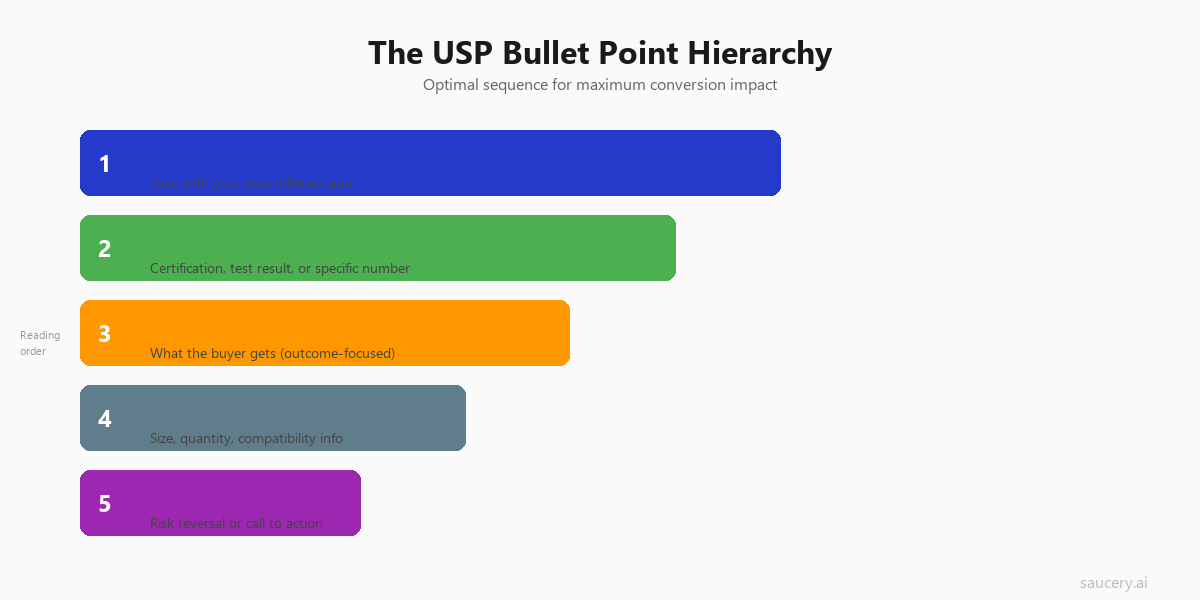
On eBay, you should use all 80 characters. Unlike Amazon where backend keywords handle secondary terms, eBay titles need to contain every keyword variant you want to rank for. Your USP should appear within the first 40-50 characters, with the remaining space used for supporting keywords and product identifiers.
eBay’s Cassini search engine weighs title keywords, but also considers how well your title matches the buyer’s exact search query. Front-loading your USP means it appears in more partial matches.
Item Specifics
Item specifics are eBay’s structured data fields – and they’re increasingly important for search visibility. If your USP relates to a product attribute (organic, handmade, a specific material, a production method), make sure it appears in the relevant item specific field. Cassini uses these for filtering, and buyers frequently narrow results by item specifics.
First Image
Unlike Amazon, eBay allows text overlays on listing images. Your first gallery image can include a brief text callout highlighting your USP. Keep it to 3-5 words maximum – this is a visual hook, not a paragraph. For detailed strategies, see our eBay listing optimisation guide.
Where to Place Your USP on Etsy
Etsy rewards authenticity and story. The platform’s buyers are specifically looking for unique, handcrafted, and differentiated products. Your USP isn’t just a ranking factor here – it’s the entire reason someone chooses your listing over a competitor’s.
Title (Front-Loaded)
Etsy gives you 140 characters, but the search algorithm weights the beginning of your title more heavily. Put your primary USP phrase first, followed by descriptors and category terms. Etsy’s search documentation confirms that word order matters – the first few words carry disproportionate weight.
Tags (13 Available)
Etsy gives you exactly 13 tags, and each can be a multi-word phrase up to 20 characters. Use at least 3-4 of these for USP variations and related phrases. If your USP is “3-year fermented hot sauce,” your tags might include: aged hot sauce, fermented hot sauce, artisan hot sauce, small batch sauce, traditional fermented.
Tags don’t need to repeat exact title words – Etsy combines title and tags for search matching. Use tags to capture related searches that your title doesn’t cover. Read our complete Etsy SEO guide for tag optimization strategies.
Description (First Paragraph)
Etsy descriptions don’t directly impact search ranking (tags and titles do), but they’re critical for conversion. The first paragraph is what buyers see before clicking “read more.” This is where you expand your USP into a story – why you ferment for 3 years, what happens during that process, how it changes the flavour profile.
Etsy buyers are buying the story as much as the product. Your USP expression here should be narrative, personal, and specific.
Where to Place Your USP on Walmart
Walmart has the tightest title constraints and the strictest content quality guidelines. Their algorithm penalises keyword stuffing, and their Content Quality Scorecard actively downgrades listings that don’t follow their format rules.
Title (50-75 Characters)
Walmart recommends titles between 50-75 characters. That’s roughly half of what Amazon allows. Your USP expression here must be ultra-concise – the compressed essence of your differentiator in as few words as possible.
The format Walmart prefers: Brand + Product Name + Key Differentiator + Size. Your USP occupies the “Key Differentiator” slot, and you might only have 15-20 characters to express it.
Shelf Description
Walmart’s shelf description (the short bullets visible on the search results page) is where your USP gets expanded. The first bullet should be a benefit-driven USP statement. Keep it under 80 characters per bullet – Walmart truncates longer text. Our Walmart listing optimisation guide has detailed formatting requirements.
Detailed Description
The detailed description section gives you room for the full USP narrative. This is where you can tell the complete story – the 3-year fermentation process, the sourcing of ingredients, the flavour complexity that results. Walmart’s algorithm indexes this content, so include natural keyword variations of your USP here.
Where to Place Your USP on Shopify
Shopify is your own storefront – you control everything. But that freedom creates its own challenge: with no character limits forcing concision, many sellers bury their USP in long-winded product descriptions. The discipline of marketplace listings actually helps here.
SEO Title (Under 55 Characters)
Your Shopify SEO title is what appears in Google search results. Google truncates at approximately 55-60 characters on desktop. Your USP keyword phrase should appear within this limit. This is your Google SERP pitch – the reason someone clicks your result instead of a competitor’s.
Product Description
Unlike marketplaces, Shopify gives you unlimited description space and full HTML formatting. But the principle holds: your USP should appear in the first 100 words. Above the fold. Before any “read more” truncation. Many Shopify themes show only the first 2-3 sentences on collection pages.
Meta Description
Your Shopify meta description (155 characters) is your Google SERP pitch. It should contain your USP expressed as a benefit to the searcher. This isn’t about keywords for ranking – Google doesn’t use meta descriptions as a ranking factor. It’s about click-through rate. A compelling USP in your meta description can double your organic CTR.
Real Example: One USP, Five Platforms
Let’s take a single USP and show how it should be expressed on each platform. The product: a hot sauce brand whose differentiator is “The only hot sauce fermented for 3 years.”
Amazon Title
Full title (190 chars): Dragon’s Patience 3-Year Fermented Hot Sauce – Aged Habanero Pepper Sauce, Small Batch Craft, Extra Hot, All Natural Ingredients, No Preservatives – 5 oz Bottle
What appears in search (first 80 chars): Dragon’s Patience 3-Year Fermented Hot Sauce – Aged Habanero Pepper Sauce, Smal
USP placement: “3-Year Fermented” appears in characters 20-37. It’s the first descriptor after the brand name. Every search result impression communicates the differentiator.
First bullet point: “AGED 3 FULL YEARS – While other hot sauces are bottled in weeks, Dragon’s Patience is fermented for 1,095 days in ceramic vessels. This extended fermentation develops complex umami depth and a smooth heat that builds without burning.”
eBay Title
Title (80 chars): Dragon’s Patience 3-Year Fermented Hot Sauce Aged Habanero Craft Small Batch 5oz
USP placement: “3-Year Fermented” is characters 20-35. No wasted characters on punctuation or filler words. Every word is a potential search match. “Aged,” “Craft,” and “Small Batch” reinforce the USP without repeating it.
Item specifics: Type: Fermented Hot Sauce | Production Method: 3-Year Fermentation | Style: Artisan/Craft
Etsy Title
Title (138 chars): 3-Year Fermented Hot Sauce, Aged Habanero Artisan Pepper Sauce, Small Batch Craft Hot Sauce Gift, Gourmet Fermented Condiment, Food Lover
USP placement: “3-Year Fermented Hot Sauce” leads the title. On Etsy, the USP IS the first thing – it’s the reason an Etsy buyer clicks. The rest of the title captures gift-related and gourmet searches.
Tags: 3 year fermented, aged hot sauce, fermented hot sauce, artisan pepper sauce, craft hot sauce, gourmet condiment, habanero sauce, hot sauce gift, fermented food gift, small batch sauce, handcrafted sauce, aged habanero, umami hot sauce
Description opening: “Three years. That’s how long each batch of Dragon’s Patience sits in ceramic vessels before it reaches your table. While most hot sauces are mixed and bottled in a single afternoon, ours undergoes a slow transformation…”
Walmart Title
Title (62 chars): Dragon’s Patience 3-Year Fermented Habanero Hot Sauce, 5 oz
USP placement: Compressed to “3-Year Fermented” – just 15 characters to communicate the same differentiator. No unnecessary adjectives. Walmart’s format demands precision.
First shelf bullet: “Fermented for 3 full years to develop complex umami heat – the longest-aged hot sauce on the market”
Shopify SEO Title
SEO title (53 chars): 3-Year Fermented Hot Sauce | Dragon’s Patience
USP placement: USP leads the title. On Google, you’re competing with marketplace listings, review sites, and other DTC brands. Leading with the differentiator makes your SERP result visually distinct from “Hot Sauce – Brand Name” competitors.
Meta description: “The only hot sauce fermented for 3 years. Aged habanero develops complex umami depth and smooth, building heat. Small batch craft from Dragon’s Patience.”
Testing Which USP Expression Converts Best
Here’s what most sellers miss: the same USP can be expressed dozens of ways, and the difference in conversion between a good expression and a great one is often 20-40%.
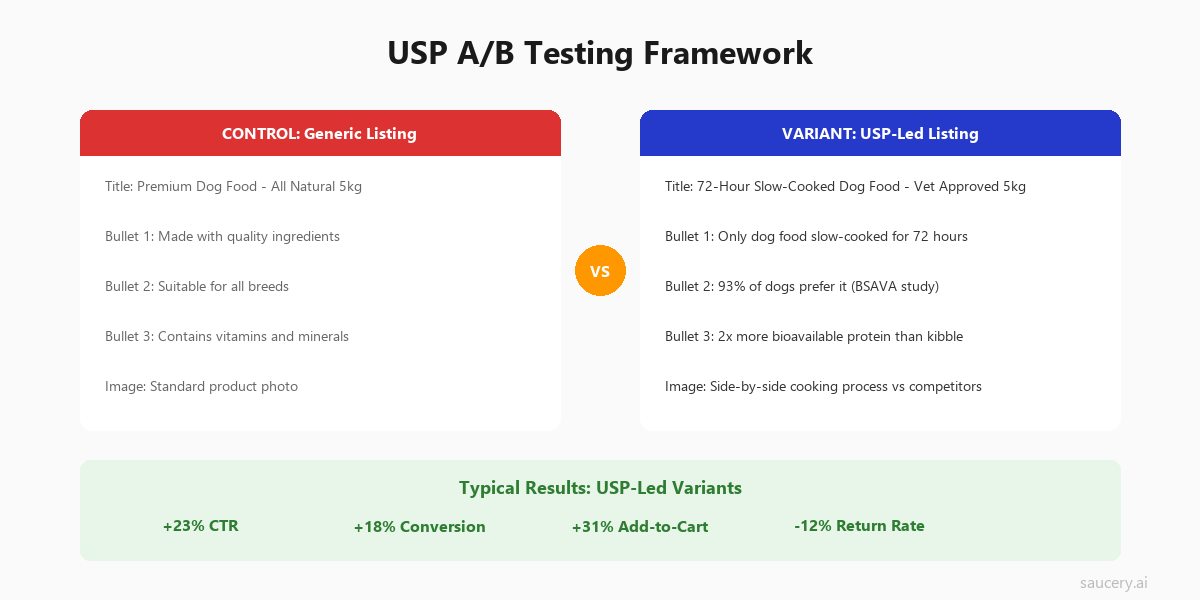
Consider these variations of the same USP:
- “3-Year Fermented Hot Sauce”
- “Aged 1,095 Days for Complex Heat”
- “The Longest-Aged Hot Sauce Available”
- “3 Years in the Making – Slow Fermented Heat”
- “Fermented 3x Longer Than Any Other Hot Sauce”
All five express the same underlying differentiator. But they emphasise different aspects – the process, the time, the comparison, the result. Which one drives more clicks? Which one converts better on the product page?
Traditional A/B testing on Amazon takes 8-12 weeks to reach statistical significance with typical traffic volumes. During that time, you’re losing sales on the underperforming variant. And you can only test two options at a time.
AI shoppers can test all five variations simultaneously and return preference data within minutes. The modelled shoppers evaluate each expression against the same decision criteria real buyers use – specificity, credibility, relevance to their purchase motivation.
What the data consistently shows:
- Specific numbers outperform vague claims. “3-Year Fermented” beats “Slow Fermented” every time. Buyers trust precision.
- Comparative framing increases perceived value. “3x Longer Than Any Other” creates a reference point. It positions your product against the category.
- Benefit language outperforms process language. “Complex Heat” (what the buyer gets) edges out “Slow Fermented” (how you make it) – unless your audience specifically values craft process.
- Word order matters more than word choice. Leading with “3-Year” versus burying it mid-sentence can shift preference by 15-25%. The same words in a different order produce different results.
The point isn’t that one formula always wins. It’s that you can’t know which expression resonates with your specific audience without testing. And testing before you commit to a platform listing is dramatically cheaper than testing live.
A Framework for Platform-Specific USP Expression
Rather than writing each platform listing from scratch, use this framework to systematically adapt your USP:
Step 1: Define Your Core USP Statement
Write your USP in one sentence, 10-15 words maximum. This is your source of truth. Every platform expression derives from this single statement.
Example: “The only hot sauce fermented for 3 years in ceramic vessels.”
Step 2: Extract the Compression Hierarchy
Identify which elements of your USP can be compressed or removed without losing the core differentiator:
- Essential (cannot remove): “3-year fermented” – this IS the differentiator
- Important (include when space allows): “only” – the exclusivity claim
- Supporting (include in expanded formats): “ceramic vessels” – the craft element
This hierarchy tells you what to keep when you’re writing for Walmart’s 50-character limit versus Etsy’s 140-character title.
Step 3: Create Platform Expression Variants
Using your compression hierarchy, write the shortest possible expression (for Walmart), then expand outward for platforms with more space:
- Ultra-short (15-20 chars): “3-Year Fermented” – Walmart, Shopify SEO title
- Short (30-40 chars): “3-Year Fermented in Ceramic Vessels” – eBay, Amazon title
- Medium (60-80 chars): “The Only Hot Sauce Fermented for 3 Years in Traditional Ceramic Vessels” – Etsy title, Amazon bullets
- Full narrative (unlimited): “Three years. That’s how long each batch sits…” – Etsy description, Shopify product page, A+ Content
Step 4: Match Buyer Language Per Platform
Each platform attracts slightly different buyer personas. Adapt your language accordingly:
- Amazon: Specification-oriented. Buyers want facts. “3-Year Fermented” is a spec.
- eBay: Deal and rarity-oriented. “Rare 3-Year Aged” emphasises scarcity.
- Etsy: Story and craft-oriented. “Patiently fermented for 3 full years” emphasises the human element.
- Walmart: Value-oriented. “Premium 3-Year Fermented” justifies the price point.
- Shopify: Brand-oriented. “Our signature 3-year fermentation” emphasises brand identity.
Common Mistakes in USP Placement
After reviewing thousands of e-commerce listings, these are the patterns that consistently underperform:
1. Burying Your USP in Bullet 4 or 5
Eye-tracking studies from the Nielsen Norman Group confirm that web readers follow an F-shaped pattern. They read the first bullet completely, scan the second, and skim the rest. If your USP appears in bullet 4, approximately 20% of visitors will ever see it.
Fix: Your USP belongs in the title and first bullet point. Everything else is supporting evidence.
2. Using Corporate Language Instead of Buyer Language
“Proprietary extended fermentation process leveraging traditional methodologies” says the same thing as “Fermented for 3 years the old-fashioned way.” One sounds like a press release. The other sounds like a product you’d buy.
Your internal brand documents use corporate language because they’re written for stakeholders. Your product listings are written for buyers who have 3 seconds to decide whether to click. Write for them.
3. Different USPs on Different Platforms
Some sellers lead with “handcrafted” on Etsy, “premium quality” on Amazon, and “best value” on Walmart. These aren’t different expressions of the same USP – they’re different USPs entirely. This fragments your brand and confuses buyers who encounter you on multiple platforms.
The fix: one USP, expressed differently. “3-Year Fermented” is the core claim everywhere. How you frame it changes. What you claim does not.
4. Not Testing Before Committing
Most sellers write their listing copy once and leave it unchanged for months. They never test whether “3-Year Fermented” outperforms “Aged 1,095 Days” or whether leading with the brand name or the USP produces better click-through rates.
The cost of getting this wrong compounds daily. Every day with a suboptimal title is lost traffic and lost sales. Testing upfront – even imperfect testing – eliminates the worst options before they cost you money.
5. Ignoring Platform Algorithm Updates
Amazon’s algorithm has evolved significantly from A9 to what sellers now call A10. eBay’s Cassini weighs factors differently than it did two years ago. Etsy’s search algorithm updates quarterly. Your USP placement strategy needs periodic review.
Set a quarterly calendar reminder to audit your top listings. Check whether your USP is still appearing in the most visible position given current platform formatting.
The Cross-Platform USP Consistency Audit
Once you’ve written your platform-specific USP expressions, run this quick audit:
- Core claim check: Does every platform listing communicate the same fundamental differentiator? (Different words, same meaning.)
- Visibility check: On each platform, is your USP in the most visible position available? (Title for Amazon/eBay/Etsy, first bullet for Walmart, SEO title for Shopify.)
- Character limit check: Does every title fit within the platform’s recommended length without truncation of the USP element?
- Buyer language check: Would a real buyer use the words you’ve chosen? Search your USP terms in each platform’s search bar – do autocomplete suggestions match your wording?
- Differentiation check: Search your product category on each platform. Does your listing’s USP expression make you visually distinct from the first 10 results?
If any listing fails one of these checks, revise it. Your listing optimisation strategy is only as strong as your weakest platform expression.
From USP to Conversion: The Complete Workflow
Here’s the complete process for turning your USP into high-converting listings across all platforms:
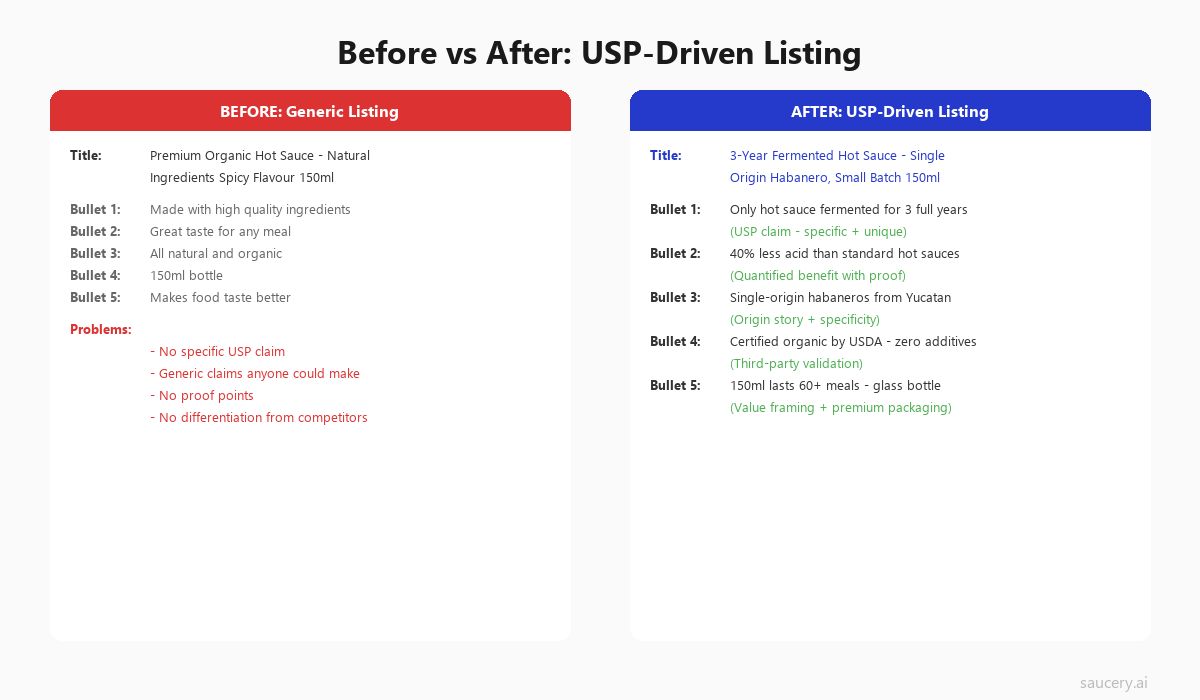
- Define your USP – If you haven’t done this yet, start with our complete USP guide.
- Create your compression hierarchy – Essential, important, and supporting elements.
- Write platform expressions – From ultra-short (Walmart) to full narrative (Shopify/Etsy description).
- Test expressions – Run your top 3-5 title variants through AI shoppers to identify the strongest performer.
- Implement across platforms – Strongest variant goes live, with platform-appropriate adaptations.
- Audit quarterly – Check visibility, consistency, and performance. Adjust for algorithm changes.
This isn’t a one-time exercise. Your USP expression should evolve as you learn what resonates with your specific audience. But the framework ensures you’re always starting from a position of strategic clarity rather than guesswork.
Same product. Better listing. More sales.
Find out which version of your product listing converts best – before you publish.
Frequently Asked Questions
Should my USP be exactly the same on every platform?
The core claim should be the same, but the expression should adapt to each platform. “3-Year Fermented” is the consistent differentiator – but on Etsy it might become a story (“Patiently aged for three full years…”) while on Walmart it stays as a tight specification. Same USP, different format. Never use a completely different differentiator on each platform – that fragments your brand and confuses buyers who find you in multiple places.
What if my USP is too long for a marketplace title?
Use the compression hierarchy method. Identify the one or two words that carry your differentiator and cannot be removed – that’s your ultra-short expression for tight character limits. “Handcrafted using traditional Japanese fermentation methods passed down through four generations” compresses to “4th-Gen Fermented” for a Walmart title. The full story lives in your description and A+ content.
How do I know if my USP placement is actually working?
Track three metrics: click-through rate (is your title/thumbnail compelling enough to click?), conversion rate (does your listing page deliver on the title’s promise?), and search impression share (is your title keyword-rich enough to appear in relevant searches?). If your CTR is high but conversion is low, your USP expression is attracting interest but your listing isn’t supporting the claim. If impressions are low but conversion is high, your USP wording isn’t matching what buyers actually search for.
Can I A/B test my USP placement on Amazon?
Amazon offers Manage Your Experiments (A/B testing) for Brand Registered sellers. You can test titles, images, and A+ Content. The limitation is time – each test needs 8-12 weeks for statistical significance, and you can only test one element at a time. For faster iteration, use AI shoppers to narrow your options from many down to 2-3 strong candidates, then validate the winner with a live A/B test. This hybrid approach gives you speed and real-world validation.
What’s more important – keyword optimisation or USP clarity in my title?
Both, and they’re not mutually exclusive. Your USP should contain your target keyword naturally. “3-Year Fermented Hot Sauce” is both a USP expression and a keyword phrase that shoppers actually search for. The best titles integrate differentiation and search relevance in the same words. If you’re forced to choose (on extremely tight character limits), prioritise the USP in the visible title and put keyword variations in backend fields (Amazon) or tags (Etsy). A title that ranks but doesn’t differentiate will get impressions but poor click-through.
Your USP is your most valuable competitive asset. But an asset that sits in a strategy document generates zero revenue. The sellers who win are the ones who express their differentiator clearly, consistently, and in the right place on every platform where they sell. Use the framework in this guide to translate your USP from concept to conversion – and test before you commit.
Subscribe for F&B Consumer Insights
Data-driven insights on food & beverage consumer preferences, straight to your inbox.