The best USPs don’t describe what a product is. They describe what changes for the buyer. Here are 50 real examples from brands that outsell their competition – broken down by category, with analysis of exactly why each one works and where it appears in their customer-facing materials.
Most e-commerce sellers treat their unique selling proposition like a tagline exercise. Something to fill in on a brand strategy template, then forget about. But the brands dominating their categories on Amazon, Shopify, and in retail have done something different. They have turned their USP into a conversion weapon – embedding it in titles, bullet points, hero images, and packaging in ways that stop scrolling thumbs and redirect purchase decisions.
This guide contains 50 real USP examples from brands actively selling online right now. Not theoretical frameworks. Not Fortune 500 mission statements. Real product-level propositions that are winning in competitive categories. Each example includes where the USP appears, why it works, and what pattern it follows so you can apply the same logic to your own products.
If you are building a unique selling proposition for your own product – or trying to sharpen one that is not converting – these examples will show you what “good” actually looks like in practice.
What Makes a USP Example Worth Studying
Not every brand claim qualifies as a USP. Before diving into the examples, here is the filter that separates a genuine unique selling proposition from generic marketing copy:
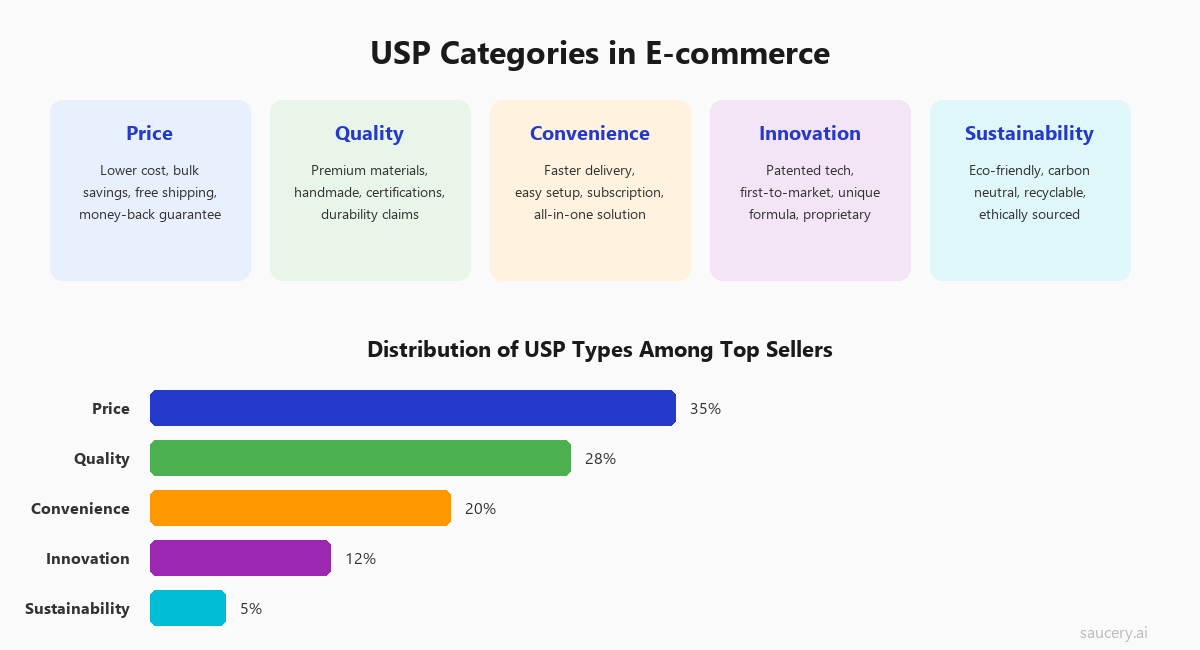
Specific. It makes a claim that can be verified or measured. “High quality” is not specific. “Made from 100% grass-fed beef with zero sugar” is specific. The more concrete the claim, the more credible it feels to a buyer scanning options. Understanding what shoppers actually read on product listings helps you place your USP where it will have maximum impact.
Measurable. The buyer can evaluate whether the claim is true – either through the product itself, through reviews, or through certifications. “Dermatologist recommended” can be checked. “The best skincare” cannot.
Different. It positions the product against alternatives in a way that creates clear separation. If every competitor makes the same claim, it is not a USP – it is table stakes. The USP has to make competitors look like they are missing something.
Relevant to the buyer’s decision moment. This is where most USPs fail. The claim might be true, might be specific, might be unique – but if it does not address what the buyer is actually worried about at the moment of purchase, it does not move behaviour. A USP about sustainability falls flat if the buyer’s primary concern is whether the product actually works.
Every example in this guide passes all four criteria. That is what makes them worth studying – and worth borrowing patterns from.
Amazon Private Label and FBA USP Examples
Amazon is where USPs are tested in the most brutal conditions. Buyers are comparing 10+ options side by side, often making decisions in under 30 seconds. The brands winning on Amazon have USPs that work at thumbnail speed – scannable, specific, and different enough to justify a click.
1. Jungle Creations (Jungle Stix) – “The Only Marshmallow Roasting Stick with an Integrated Safety Lock”
Where it appears: product title, main image overlay, first bullet point
Why it works: Every marshmallow stick on Amazon looks identical. By claiming a specific safety feature (the integrated lock that prevents telescoping during use), Jungle Stix created a category of one. Parents – the actual buyers – care about safety more than price. This USP turns a commodity into a premium product that justifies a higher price point. The word “only” does heavy lifting, implying every competitor is less safe.
2. Anker – “The Technology That Charges Faster”
Where it appears: Brand tagline, A+ Content, bullet points (PowerIQ and VoltageBoost named technologies)
Why it works: Anker named their charging technology (PowerIQ) and embedded it into every listing. When buyers see competing chargers, they see generic specs. When they see Anker, they see a branded, proprietary system. This is the “ingredient branding” pattern – creating a named process that implies R&D investment. It transformed a category where every product is technically similar into one where Anker appears technologically superior.
3. Tuft & Needle – “Adaptive Foam That Sleeps Cooler Than Memory Foam”
Where it appears: Product title, comparison charts, A+ Content hero image
Why it works: The mattress-in-a-box category exploded on Amazon, and every brand claimed “comfort.” Tuft & Needle identified the number one complaint about memory foam – heat retention – and positioned directly against it. Their USP does not say “we are comfortable.” It says “we solved the specific problem you had with the last mattress you tried.” Negative framing against the category leader (memory foam) creates instant differentiation.
4. Mighty Patch – “A Hydrocolloid Patch That Shows You It’s Working”
Where it appears: Main image (shows white patch turning yellow), bullet points, title
Why it works: Hydrocolloid patches existed in pharmacies for years. Mighty Patch’s breakthrough was making the mechanism visible – the patch changes colour as it absorbs, giving the user visual proof of efficacy. Their USP is not “clears acne” (every patch says that). It is “you can see it working.” This taps into the buyer’s deepest objection: “how do I know this actually does anything?” The visual proof embedded in the product becomes the USP itself.
5. Instant Pot – “7 Appliances in 1”
Where it appears: Product title, main image badge, first bullet point
Why it works: The multi-cooker category was crowded with products listing features. Instant Pot collapsed the entire value proposition into a single number: 7-in-1. This creates an instant value calculation in the buyer’s mind. Instead of comparing pressure cooker vs. slow cooker vs. rice cooker, the buyer thinks “I can replace seven separate appliances with one purchase.” The specificity of the number makes it credible, and the kitchen counter space saved makes it emotionally compelling.
6. FitBark – “The Only Dog Activity Monitor Recommended by Veterinarians”
Where it appears: Title, A+ Content, social proof section
Why it works: Pet tech is full of gadgets that look impressive but lack credibility. FitBark’s USP borrows authority from veterinarians – the one voice pet owners trust above all others. “Recommended by veterinarians” is a social proof USP that eliminates the buyer’s fear of wasting money on a gimmick. Combined with “only,” it implies every competitor lacks professional endorsement.
7. Rain Design mStand – “Machined From a Single Block of Aluminium”
Where it appears: Bullet points, A+ Content, product description
Why it works: Laptop stands are commodity products. Most are assembled from sheet metal or plastic. Rain Design’s process claim – machined from a single block – implies durability, precision, and premium manufacturing without ever using the word “premium.” Process USPs work because they give the buyer a reason to believe the quality claim. “High quality” is an assertion. “Machined from a single block of aluminium” is evidence.
8. Lifestraw – “Removes 99.999999% of Waterborne Bacteria”
Where it appears: Title, main image, all bullet points
Why it works: When the stakes are high (drinking potentially contaminated water), precision signals seriousness. “Removes bacteria” is generic. “Removes 99.999999% of bacteria” implies testing, certification, and engineering rigour. The extreme precision of the number (seven decimal places) is the USP itself – it communicates “we take this more seriously than anyone.” Buyers choosing a water filter for travel or emergencies want the most thorough option, not the cheapest one.
9. Papier – “Carbon-Neutral Notebooks Made from Certified Sustainable Forests”
Where it appears: Product description, brand story, packaging
Why it works: In a category where most buyers default to price, Papier gives environmentally conscious buyers a reason to pay more. The USP stacks two verifiable claims (carbon-neutral + certified sustainable) that together create a “guilt-free premium” positioning. For their target buyer – someone who has already decided they want a nice notebook – removing the environmental guilt of buying paper products eliminates the last barrier to purchase.
10. Lume Cube – “The Only Lighting Panel Built Specifically for Video Conferencing”
Where it appears: Title, main image showing Zoom setup, first bullet point
Why it works: Ring lights and studio lights existed before 2020. But Lume Cube positioned a product specifically for the exploding video conferencing market. By narrowing the use case in their USP, they became the obvious choice for remote workers who thought “I don’t need studio lighting, I need better Zoom lighting.” The specificity of the use case makes generic competitors feel like they are designed for someone else.
Food and Beverage USP Examples
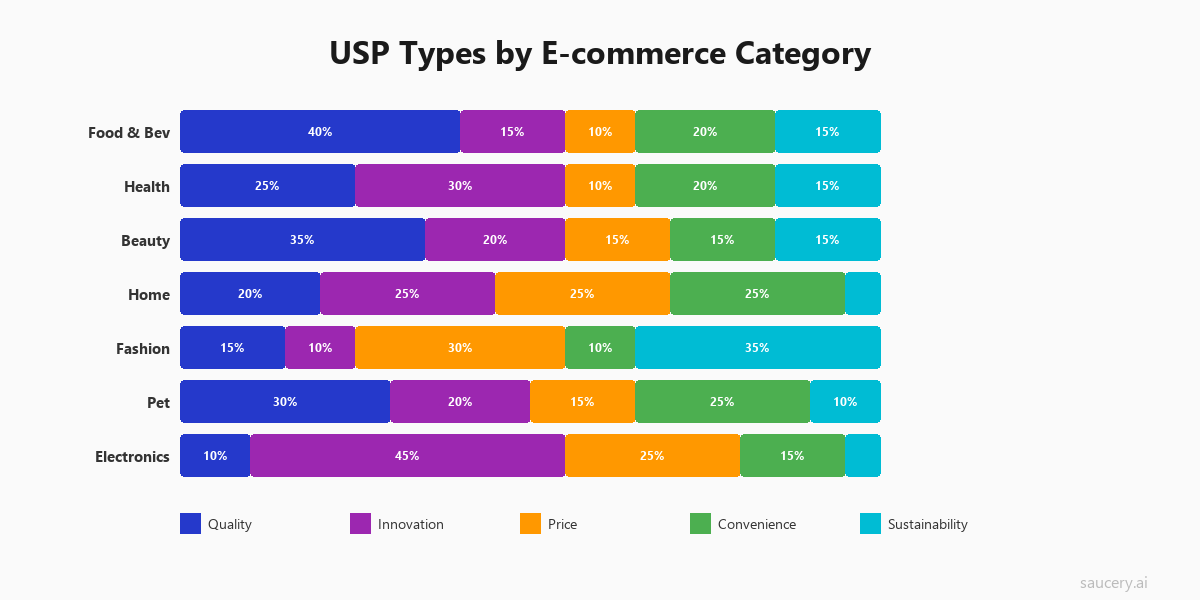
Food and beverage is one of the most competitive e-commerce categories. Buyers have strong preferences, limited attention, and an overwhelming number of options. The brands winning in this space have USPs that create visceral, immediate differentiation – often through bold claims that competitors cannot or will not make.
11. Death Wish Coffee – “World’s Strongest Coffee”
Where it appears: Brand name, packaging, Amazon title, every piece of marketing
Why it works: Death Wish did not try to compete on origin, roast profile, or tasting notes – the terrain where craft coffee brands fight. They identified a segment of coffee buyers who only care about one thing: caffeine strength. “World’s Strongest” is a superlative USP that makes the buying decision binary. If you want the strongest coffee, there is only one choice. The brand name reinforces the USP, making it impossible to separate the product from the proposition.
12. Liquid Death – “Murder Your Thirst”
Where it appears: Brand name, can design, social media, Amazon listing
Why it works: Liquid Death sells water. Their USP is not about the product – it is about the identity of the buyer. “Murder Your Thirst” positions hydration as rebellious rather than healthy. This is a psychographic USP that appeals to people who want to drink water but do not want to look like they are trying to be healthy. The heavy metal branding and aggressive language create tribal belonging. You buy Liquid Death to signal who you are, not because the water is different.
13. Chomps – “Whole30 Approved Beef Sticks with No Sugar, No Soy, No Gluten”
Where it appears: Amazon title, front of package, first bullet point
Why it works: The meat snack category is dominated by brands that add sugar and fillers. Chomps leads with certification (Whole30 Approved) followed by a “without” list that addresses every concern of their health-conscious buyer. The negative framing (“no sugar, no soy, no gluten”) is actually more powerful than positive claims because it directly removes objections. Buyers in this category have been burned before by “healthy” snacks that contain hidden ingredients. The triple negative eliminates that doubt.
14. Magic Spoon – “Childhood Cereal for Grown-Ups: 13g Protein, 0g Sugar”
Where it appears: Website hero, social media ads, product packaging
Why it works: Magic Spoon identified an emotional insight: adults miss the cereals they loved as kids but cannot justify the sugar content. Their USP bridges nostalgia and nutrition with specific numbers. “13g protein, 0g sugar” is the rational justification. “Childhood cereal for grown-ups” is the emotional hook. The combination creates a product that feels indulgent and responsible simultaneously – a position no competitor occupied.
15. Olipop – “A New Kind of Soda with 9g of Prebiotic Fibre”
Where it appears: Can design, Amazon listing, DTC website
Why it works: Olipop does not position against other health drinks. It positions against regular soda – the thing their buyer actually wants to quit but misses. “A new kind of soda” reframes the category. The prebiotic fibre claim adds functional credibility. The USP works because it gives soda lovers permission to keep drinking soda while telling themselves it is healthy. That is a far more compelling proposition than “try this kombucha instead.”
16. Graza – “The Squeeze Bottle Olive Oil for Everyday Cooking”
Where it appears: Product form factor, packaging, DTC website, social media
Why it works: Graza’s USP is not about the oil itself – it is about the format. The squeeze bottle solves a specific usage problem (pouring control, no dripping) while signalling that this oil is meant to be used liberally, not saved for special occasions. The USP is embedded in the physical product design, making it visible at shelf or in any photograph. When competitors sit in glass bottles that all look identical, Graza’s format IS the differentiation.
17. Athletic Brewing – “Craft Beer Taste, Zero Alcohol”
Where it appears: Packaging, brand positioning, Amazon listing, retail shelf
Why it works: Non-alcoholic beer existed for decades with a reputation for tasting terrible. Athletic Brewing leads with “craft beer taste” – directly addressing the objection that kills 90% of NA beer trials. They do not hide the zero alcohol; they lead with the benefit (taste) and follow with the differentiator (no alcohol). For their buyer – someone who wants to participate in beer culture without the alcohol – this USP says “you do not have to compromise.”
18. Kettle & Fire – “Bone Broth Simmered for 20+ Hours with Organic Bones”
Where it appears: Amazon title, packaging, first bullet point
Why it works: This is a pure process USP. “Simmered for 20+ hours” implies patience, craft, and nutrient extraction that shortcuts cannot achieve. The specific time claim creates a mental comparison with every competitor who does not state their cooking time (the buyer assumes they take shortcuts). Combined with “organic bones,” it addresses both the process quality and ingredient quality concerns of health-conscious broth buyers. The time investment becomes a proxy for product quality.
Health and Supplements USP Examples
The supplements category has a credibility problem. Buyers are sceptical of claims, wary of snake oil, and overwhelmed by options. The brands winning in this space use USPs that build trust through specificity, third-party validation, and transparency about what is inside (and what is not).
19. AG1 (Athletic Greens) – “75 Vitamins, Minerals, and Whole-Food Sourced Nutrients in One Scoop”
Where it appears: Website hero, social media ads, podcast sponsorships, packaging
Why it works: The number 75 is doing all the work. It implies comprehensiveness – that this single product replaces an entire supplement shelf. For buyers experiencing “supplement fatigue” (tired of taking 8 different pills every morning), this USP promises simplification. “One scoop” reinforces the ease proposition. The combination of high ingredient count and single serving creates a value perception that justifies the premium price point.
20. Seed – “A Daily Synbiotic for Systemic Health, Backed by Published Research”
Where it appears: Website, packaging, brand positioning
Why it works: In a probiotic market full of unsubstantiated claims, Seed leads with scientific credibility. “Backed by published research” is a trust signal that separates them from the hundreds of probiotic brands making identical colony-count claims. The word “synbiotic” (not probiotic) signals sophistication and proprietary formulation. For educated health consumers who distrust supplement marketing, the academic positioning is the differentiator.
21. Ritual – “The Visible Supply Chain Vitamin: You Can Trace Every Ingredient”
Where it appears: Website (interactive ingredient sourcing map), packaging, social media
Why it works: Ritual’s USP is radical transparency in an industry known for opacity. Their interactive supply chain map lets buyers see exactly where each ingredient comes from. This does not just differentiate – it makes every competitor look like they have something to hide. The USP addresses the deepest supplement buyer fear: “what is actually in this?” By making the answer visible, they convert sceptics into believers.
22. Momentous – “The Only Supplement Brand Used by Every Major Pro Sports League”
Where it appears: Website hero, partnership logos, product pages
Why it works: This is social proof elevated to USP status. When NFL, NBA, MLB, and NHL teams all use the same supplement brand, that is an endorsement no competitor can replicate. For the buyer, it answers: “if it is good enough for professional athletes with access to any brand in the world, it is good enough for me.” The “only” qualifier makes it exclusive rather than just popular.
23. Thorne – “The Most Tested Supplement Brand: Every Batch, Every Product, Every Time”
Where it appears: Website, NSF certification badges, Amazon A+ Content
Why it works: Thorne’s USP is about testing rigour, not ingredients. “Every batch, every product, every time” is a cadence that implies no shortcuts, no exceptions. For buyers who have read about supplement contamination or label inaccuracy, this directly addresses their core fear. The repetitive structure (“every…every…every”) creates a rhythm that makes the commitment feel absolute.
24. Organifi – “Superfood Blends That Taste Good Enough to Look Forward To”
Where it appears: Website, social proof videos, Amazon listing
Why it works: Greens powders have a universal reputation for tasting terrible. Organifi’s USP addresses the actual behaviour blocker – people buy greens supplements and stop using them because the taste is unbearable. “Good enough to look forward to” reframes the expectation from “tolerable” to “enjoyable.” For buyers who have already tried and abandoned other greens products, this USP speaks directly to their lived experience.
25. LMNT – “Zero Sugar Electrolytes with a Science-Backed Ratio of Sodium, Potassium, and Magnesium”
Where it appears: Packaging, website, podcast sponsorships, Amazon listing
Why it works: LMNT stacks three claims: zero sugar (negative framing), specific electrolytes named (transparency), and “science-backed ratio” (credibility). Most electrolyte products either have sugar or have a proprietary blend that hides dosages. LMNT’s USP says: “we will tell you exactly what is in this and why.” The naming of specific minerals (sodium, potassium, magnesium) creates the perception of precision formulation rather than generic supplementation.
26. Transparent Labs – “100% Label Transparency: Full Doses, No Proprietary Blends”
Where it appears: Brand name, every product page, Amazon listings
Why it works: The brand name IS the USP. “Transparent” directly calls out the industry practice of hiding ingredient doses behind “proprietary blends.” For educated supplement buyers who know that most pre-workouts contain token amounts of active ingredients, this USP says: “we show you everything because we have nothing to hide.” It transforms industry standard practice (hiding doses) into a competitor weakness by naming it explicitly.
Beauty and Personal Care USP Examples
Beauty is a category where emotional positioning and scientific credibility both matter. The brands winning here have USPs that combine clinical specificity with aspirational outcomes – proving the product works while making the buyer feel something about using it.
27. The Ordinary – “Clinical Formulations at Honest Prices: No Markups for Marketing”
Where it appears: Brand positioning, website, packaging design, pricing structure
Why it works: The Ordinary exposed the beauty industry’s pricing model – that buyers pay for packaging, celebrity endorsements, and brand cachet rather than formulation quality. Their USP positions every competitor as overpriced by implication. The clinical naming convention (using ingredient names like “Niacinamide 10% + Zinc 1%” instead of aspirational product names) reinforces the no-nonsense, science-first positioning. The price point IS the proof of the USP.
28. Drunk Elephant – “Clean-Compatible Skincare: No Suspicious 6 Ingredients”
Where it appears: Website, brand philosophy, packaging
Why it works: Rather than claiming “clean beauty” (which has no regulated definition), Drunk Elephant created their own standard – the “Suspicious 6” ingredients they exclude. By naming specific exclusions, they created a framework that buyers can understand and verify. This gives the “clean” claim substance. Competitors either have to match the standard or explain why they use ingredients Drunk Elephant has publicly labelled “suspicious.”
29. Paula’s Choice – “Every Product Backed by Peer-Reviewed Science, Not Marketing Claims”
Where it appears: Website (research citations on every product page), brand positioning
Why it works: Paula’s Choice was built on a database of ingredient research. Their USP positions the founder as a watchdog against beauty industry misinformation. Every product page includes citations to published studies. For the research-oriented buyer who reads ingredient lists and Googles clinical studies, this is the only brand that speaks their language. The USP makes emotional beauty marketing look like manipulation by contrast.
30. Olaplex – “The Only Patented Bond-Building Technology That Repairs Hair at the Molecular Level”
Where it appears: Packaging, salon marketing materials, product pages
Why it works: Olaplex’s USP combines a patent (legal proof of uniqueness), a proprietary technology (bond-building), and a specific mechanism (molecular level repair). This triple-stack of credibility claims positions them as genuinely scientifically different rather than just marketing differently. The patent claim is especially powerful because it means competitors literally cannot make the same claim – it is legally protected uniqueness.
31. Glossier – “Beauty Products Inspired by Real People, Not Models”
Where it appears: Brand ethos, social media (UGC-heavy), website imagery
Why it works: Glossier’s USP rejects the aspirational beauty model where products promise to make you look like someone else. By positioning “real people” as their muse, they make traditional beauty brands look out of touch. The UGC-heavy marketing strategy proves the USP – actual customers ARE the marketing. For buyers tired of unattainable beauty standards, Glossier says “we designed this for how you actually look and live.”
32. CeraVe – “Developed with Dermatologists: 3 Essential Ceramides in Every Product”
Where it appears: Packaging, Amazon listings, brand positioning
Why it works: CeraVe embeds professional authority (dermatologists) and specific science (3 essential ceramides) into a USP that appeals to buyers who want skincare that works without unnecessary complexity. The consistency of the ceramide claim across their entire range creates a coherent brand story. Every product contains the same core technology, making the line feel like a system rather than a collection of unrelated products.
33. Fenty Beauty – “Beauty for All: 50 Foundation Shades for Every Skin Tone”
Where it appears: Launch marketing, shade range displays, brand positioning
Why it works: Fenty’s launch with 50 foundation shades was not just a product decision – it was a USP that exposed the entire industry’s failure to serve darker skin tones. The number 50 made every competitor’s 20-shade range look exclusionary. This USP worked because it was both a product truth AND a cultural statement. Buyers with deeper skin tones who had been underserved for decades immediately had a brand that visibly prioritised them.
34. Dr. Squatch – “Natural Soap for Men Who Want to Smell Like a Man, Not a Chemical Factory”
Where it appears: YouTube ads, packaging, Amazon listing, website
Why it works: Dr. Squatch combines natural ingredients with masculine positioning – a gap that existed in the market. Men’s soap was either clinical (Dove, Nivea) or chemical-heavy (Axe, Old Spice). By positioning against “chemical factory,” they make mainstream men’s grooming look unappealing to health-conscious men who also want masculine branding. The humour in their advertising reinforces the USP without undermining the product quality claim.
Home and Kitchen USP Examples
Home and kitchen products often compete primarily on price. The brands that escape price competition do so by making their USP about a specific problem they solve, a specific audience they serve, or a specific standard they meet that justifies the premium.
35. Our Place (Always Pan) – “One Pan That Replaces 8 Pieces of Cookware”
Where it appears: Product name positioning, website hero, social media, packaging
Why it works: Similar to Instant Pot’s “7-in-1” approach, Our Place uses consolidation as the USP. But they add an emotional layer: kitchen simplicity and reduced clutter. For apartment dwellers and minimalists, “replaces 8 pieces” is not just about saving money – it is about saving space, reducing decisions, and simplifying daily life. The name “Always Pan” reinforces that this is the one pan you always reach for.
36. Blueland – “Cleaning Products That Never Create a Single-Use Plastic Bottle”
Where it appears: Brand positioning, packaging (tablet refills), website
Why it works: Blueland’s USP makes you realise something you never considered: every time you buy cleaning spray, you are buying a new plastic bottle for the same liquid. Their refill tablet model eliminates single-use plastic entirely. The USP makes competitors look wasteful without being preachy. For environmentally conscious consumers, this is a USP that requires zero lifestyle sacrifice – the product works identically, it just arrives as a tablet instead of in a new bottle.
37. Casper (Dog Bed) – “A Dog Bed Designed by the Same Sleep Engineers Who Built Our Human Mattresses”
Where it appears: Product page, Amazon listing, brand extension marketing
Why it works: Casper extended their mattress expertise into pet products. The USP borrows credibility from their human mattress reputation – implying that the same R&D, materials science, and comfort engineering applies to the dog bed. For pet owners who spend lavishly on their animals, the “same engineers” claim justifies the premium over generic pet beds. It transforms a pet product into a sleep technology product.
38. Vitamix – “The Only Blender Powerful Enough to Make Hot Soup from Raw Ingredients in 6 Minutes”
Where it appears: Product demonstrations, website, infomercial legacy, Amazon listing
Why it works: Every blender claims to be powerful. Vitamix proves it with a specific, verifiable, remarkable capability: generating enough friction heat to cook raw vegetables into hot soup without any external heat source. This is a USP that creates a “wait, really?” reaction. The 6-minute timeframe makes it specific and testable. Competitors cannot make this claim because their motors are not strong enough – making it a true structural competitive advantage.
39. Dyson (V15 Detect) – “The Only Vacuum That Shows You Microscopic Dust with a Laser”
Where it appears: Product name, marketing videos, retail displays, product page
Why it works: Dyson’s laser detection USP solves a problem buyers did not know they had: you cannot see whether your floor is actually clean. By revealing invisible dust with a green laser, the V15 makes every vacuum without this feature feel like it is working blind. The USP is visual and demonstrable – you can see it working in a 3-second video. That demonstrability makes it one of the most shareable USPs in the home category.
40. Caraway – “Non-Toxic Ceramic Cookware That Looks Good Enough to Leave on the Counter”
Where it appears: Instagram, website imagery, packaging, retail displays
Why it works: Caraway stacks two USPs: health (non-toxic ceramic) and aesthetics (beautiful enough to display). Traditional non-stick cookware had a reputation for looking utilitarian and potentially leaching chemicals. Caraway addresses both concerns simultaneously. For Instagram-generation home cooks who view their kitchen as an extension of their interior design, the aesthetic USP is actually the primary purchase driver – the non-toxic claim is permission to buy what they already want.
41. Fellow (Stagg Kettle) – “Pour-Over Precision: A Gooseneck Kettle with Variable Temperature Control to 1 Degree”
Where it appears: Product page, Amazon listing, specialty coffee retailer descriptions
Why it works: For specialty coffee enthusiasts, water temperature is not a preference – it is a science. “Variable temperature control to 1 degree” speaks directly to buyers who know that 93 degrees Celsius produces different extraction than 96 degrees. The specificity of “1 degree” communicates that this product was designed by and for people who take their coffee seriously. Mainstream kettles with “hot, warm, cool” settings look like toys by comparison.
42. Beeswax Food Wraps (Bee’s Wrap) – “The Reusable Food Wrap That Replaces 300 Metres of Cling Film Per Year”
Where it appears: Packaging, Amazon listing, brand website
Why it works: “300 metres of cling film” is brilliantly specific. It takes an abstract environmental benefit and makes it concrete and measurable. Most eco-friendly products say “reduce waste” – Bee’s Wrap tells you exactly how much waste you are eliminating. The number creates a tangible mental image (300 metres is nearly the length of three football fields) that makes the environmental impact feel significant and personal rather than abstract and collective.
Fashion and Apparel USP Examples
Fashion brands often rely on brand cachet as their differentiator. The DTC brands that have broken through in e-commerce have done so by making specific, measurable claims that traditional fashion would never make – treating clothing more like a functional product than a status symbol.
43. Allbirds – “The World’s Most Comfortable Shoe, Made from Merino Wool and Eucalyptus Fibre”
Where it appears: Brand positioning, website, retail stores, packaging
Why it works: Allbirds stacks a superlative claim (most comfortable) with unusual materials (merino wool, eucalyptus) that serve as proof points. Wool and eucalyptus sound soft, natural, and technically interesting – they make the comfort claim believable. The material USP also creates sustainability credibility without making sustainability the lead message. Comfort is the buy-in; sustainability is the feel-good bonus that removes purchase guilt.
44. CUTS Clothing – “The Only T-Shirt Designed to Be Worn Untucked to a Business Meeting”
Where it appears: Website, social media, product pages
Why it works: CUTS identified a specific use case gap: men who want to look polished without wearing a button-down or tucking in a shirt. By naming the exact context (business meeting) and the exact behaviour (untucked), they create instant recognition for men who have stood in front of their wardrobe having exactly this dilemma. The USP makes the product feel designed for a specific lifestyle rather than being a generic “premium basics” brand.
45. Bombas – “The Most Comfortable Socks Ever Made, and for Every Pair Purchased We Donate One”
Where it appears: Brand positioning, website, packaging, advertising
Why it works: Bombas runs a dual USP: product quality + social impact. But critically, they lead with comfort, not charity. Many “buy one give one” brands lead with the giving, which makes buyers wonder if they are paying for a subpar product plus a donation. Bombas says “these are the most comfortable socks” first – making the social impact a bonus rather than the reason to tolerate mediocrity. The structure matters: product quality THEN social proof.
46. Vuori – “Athletic Clothing Designed to Also Be Your Everyday Wardrobe”
Where it appears: Brand positioning, website imagery (lifestyle, not gym), retail environment
Why it works: Vuori identified that people were already wearing athletic clothing as everyday wear – but feeling slightly self-conscious about it. Their USP gives permission: these clothes are DESIGNED to go from workout to coffee shop to dinner. By designing for the crossover explicitly, they make brands that are “just for the gym” feel limited, and brands that are “just for casual” feel like they lack performance. Vuori occupies the overlap.
Pet Products USP Examples
Pet owners spend emotionally, not rationally. The brands winning in this category have USPs that combine pet health/happiness with owner convenience – because the buyer (human) and the user (pet) are different decision-makers with different needs.
47. Farmer’s Dog – “Fresh Human-Grade Dog Food, Pre-Portioned and Delivered to Your Door”
Where it appears: Website, TV commercials, social media, packaging
Why it works: “Human-grade” is the power word. It immediately makes every other dog food sound like it contains ingredients that humans would not touch. “Pre-portioned” addresses the owner’s convenience need (no measuring, no guessing). “Delivered” eliminates the chore of carrying heavy bags. The USP addresses three concerns in one sentence: quality (human-grade), ease (pre-portioned), and convenience (delivered). Each element removes a different barrier to purchase.
48. BarkBox – “A Monthly Box of Joy: Toys and Treats Customised to Your Dog’s Size and Preferences”
Where it appears: Website, social media, subscription landing page
Why it works: BarkBox’s USP combines emotional payoff (joy) with practical personalisation (customised to size and preferences). The word “joy” is doing important emotional work – this is not about nutrition or health, it is about making your dog happy. For pet owners who view their dog as a family member, monthly joy delivery is an irresistible proposition. The personalisation claim elevates it above generic subscription boxes that send the same items to every subscriber.
49. Fi (Smart Collar) – “GPS Tracking That Lasts 3 Months on a Single Charge”
Where it appears: Website hero, product comparison charts, Amazon listing
Why it works: Every GPS pet tracker exists to solve the same problem: finding a lost pet. But the reason most GPS collars get abandoned is battery life – they die after a day or two, and owners forget to charge them. Fi’s USP addresses the actual adoption barrier. “3 months on a single charge” means the collar works when you need it because you never need to think about it. This is a USP about reliability expressed through a specific, remarkable number.
50. Open Farm – “Ethically Sourced Pet Food Where You Can Trace Every Ingredient Back to the Farm”
Where it appears: Packaging (lot traceability codes), website, brand positioning
Why it works: Similar to Ritual’s supplement transparency, Open Farm uses traceability as their USP. Each bag has a lot code you can enter on their website to see exactly which farms supplied the ingredients. For pet owners concerned about pet food recalls and ingredient quality (a justified fear given the industry’s history), this USP provides the one thing no other brand offers: proof. The ability to verify is more powerful than any claim because it invites scrutiny rather than hiding from it.
Patterns That Emerge Across Winning USPs
After analysing these 50 examples, clear patterns emerge. The strongest USPs are not random – they follow repeatable structures that you can apply to your own products. Here are the five dominant patterns:
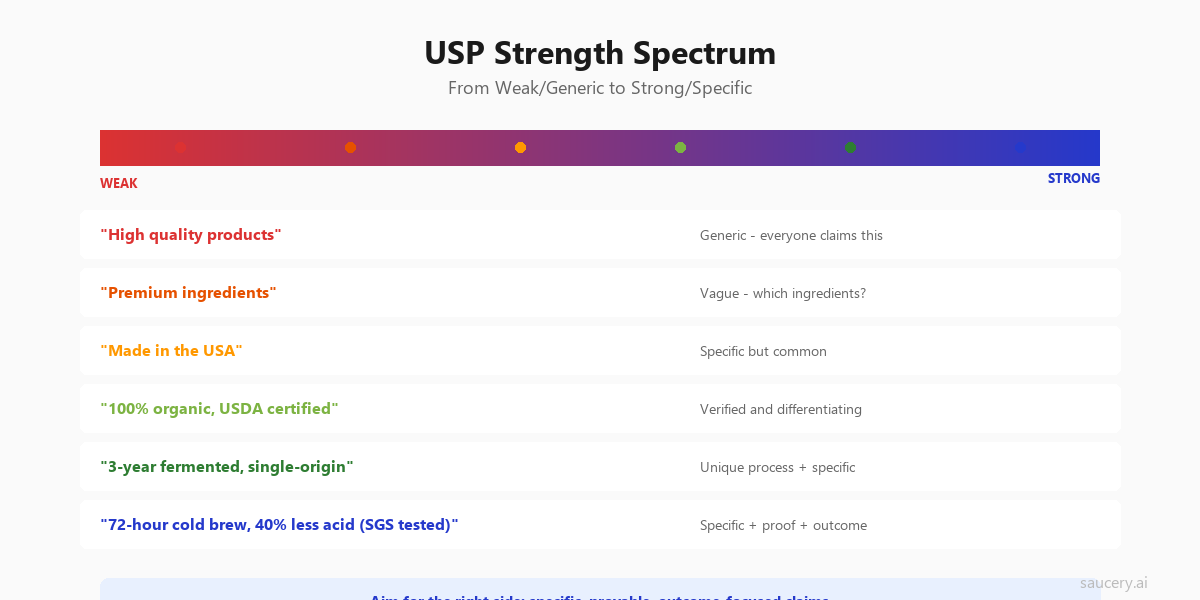
Pattern 1: Specificity (Numbers, Ingredients, Certifications)
The most common thread across all 50 examples is radical specificity. Vague claims create scepticism. Specific claims create credibility.
Examples in action:
- AG1: “75 vitamins and minerals” (not “comprehensive nutrition”)
- Lifestraw: “99.999999% of bacteria” (not “most bacteria”)
- Instant Pot: “7 appliances in 1” (not “multi-functional”)
- Fenty: “50 shades” (not “wide shade range”)
- Fi Collar: “3 months battery life” (not “long-lasting battery”)
Why specificity works: Numbers cannot be argued with. When a buyer sees “75 ingredients,” their brain processes it as fact. When they see “comprehensive,” their brain processes it as opinion. Specificity also implies measurement, testing, and precision – qualities that signal a serious product. If you can make your USP more specific by replacing an adjective with a number, do it every time.
Pattern 2: Negative Framing (“Without X”, “No Y”)
Many winning USPs define themselves by what they exclude rather than what they include. This pattern is especially powerful in categories where buyers have been burned by hidden negatives.
Examples in action:
- Chomps: “No sugar, no soy, no gluten”
- LMNT: “Zero sugar electrolytes”
- Drunk Elephant: “No Suspicious 6”
- Transparent Labs: “No proprietary blends”
- Dr. Squatch: “Not a chemical factory”
Why negative framing works: Buyers have loss aversion – they are more motivated to avoid bad outcomes than to achieve good ones. “No sugar” is psychologically stronger than “naturally sweetened” because it directly eliminates a fear. Negative framing also positions competitors by implication: if you say “no proprietary blends,” the buyer immediately wonders which brands DO use proprietary blends. The absence becomes an accusation directed at everyone else.
Pattern 3: Social Proof Embedded in the USP
Some brands embed social proof directly into their unique selling proposition rather than treating it as a separate section of their listing.
Examples in action:
- Momentous: “Used by every major pro sports league”
- FitBark: “Recommended by veterinarians”
- CeraVe: “Developed with dermatologists”
- Glossier: “Inspired by real people”
- Olaplex: “Patented technology” (patent = institutional validation)
Why embedded social proof works: Traditional social proof (star ratings, review counts) is passive – buyers see it but do not always act on it. When social proof becomes the USP itself, it moves from background validation to foreground differentiation. “Developed with dermatologists” is not a review – it is a product development claim that makes every non-dermatologist-developed competitor seem amateur. The authority figure becomes part of the product story.
Pattern 4: Process Claims (“Cold-Pressed”, “Fermented 3 Years”, “Hand-Poured”)
Process USPs give buyers a reason to believe the quality claim. Instead of asserting “premium” or “high quality,” they show you the work that went into making it.
Examples in action:
- Kettle & Fire: “Simmered for 20+ hours”
- Rain Design: “Machined from a single block of aluminium”
- Papier: “Made from certified sustainable forests”
- Farmer’s Dog: “Human-grade” (implies a food-processing standard)
- Fellow: “Variable temperature control to 1 degree” (implies precision engineering)
Why process claims work: Process is evidence. When a brand says “simmered for 20+ hours,” the buyer does not need to trust a quality assertion – they can understand why the product would be better through the process itself. Slow cooking extracts more nutrients. Machining from a single block eliminates weak joints. The process becomes the proof, making the quality claim self-evident rather than aspirational. Process claims also imply that competitors cut corners – because if they used the same process, they would say so.
Pattern 5: Outcome Claims (“Visible Results in 7 Days”)
Outcome USPs skip the “what” and “how” entirely, leading with the result the buyer actually wants. These are the most compelling USPs when the buyer’s problem is clear and urgent.
Examples in action:
- Mighty Patch: “Shows you it’s working” (visible outcome)
- Tuft & Needle: “Sleeps cooler” (sensory outcome)
- Magic Spoon: “Childhood cereal for grown-ups” (emotional outcome)
- Vitamix: “Hot soup from raw ingredients in 6 minutes” (functional outcome)
- Dyson V15: “Shows you microscopic dust” (visual outcome)
Why outcome claims work: Buyers do not buy products – they buy outcomes. Nobody wants a mattress; they want to sleep cooler. Nobody wants a blender; they want hot soup quickly. Outcome USPs align the product’s language with the buyer’s internal monologue. When the buyer is thinking “I need to sleep cooler” and your USP says “sleeps cooler,” there is zero translation required. The USP speaks the buyer’s language rather than the brand’s language.
How to Write Your Own USP Using These Patterns
Studying examples is useful. Applying the patterns to your own product is what actually moves revenue. Here is a framework for writing a USP that follows the structures proven across these 50 examples:
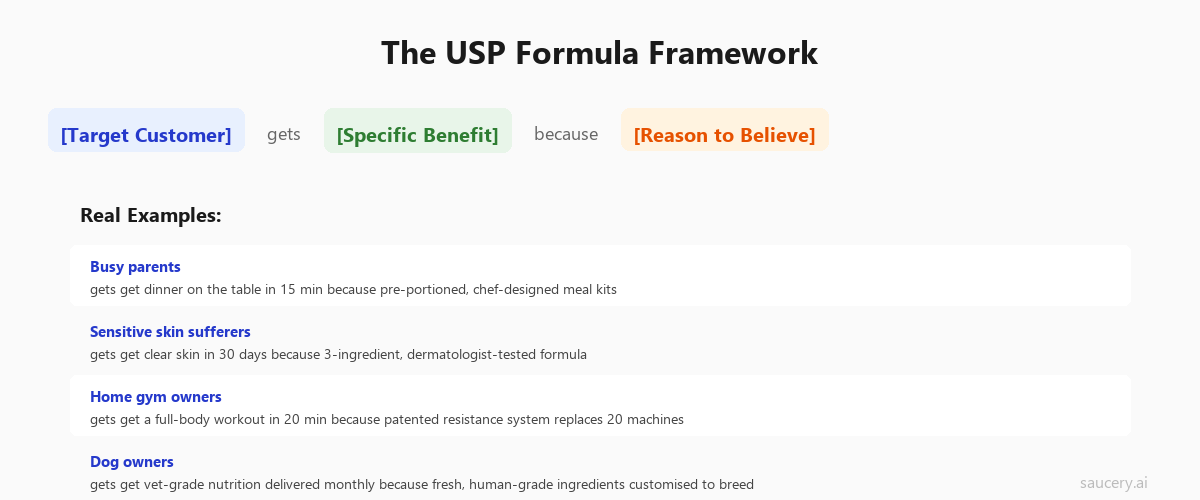
Step 1: Identify Your Buyer’s Primary Objection
Before writing anything, answer this question: What is the single biggest reason a qualified buyer would NOT purchase your product? Not why they would buy – why they would hesitate. That objection is what your USP needs to neutralise.
For supplements, it is “does this actually work?” For food products, it is often “what is really in this?” For tech products, it is frequently “will this be complicated to use?” Your USP should be the answer to that specific objection.
Step 2: Find Your Structural Advantage
A good USP is not just a better claim – it is a claim that competitors cannot easily copy. Look for structural advantages in your product:
- Patent or proprietary technology: If you have it, lead with it (Olaplex model)
- Manufacturing process: If your process is genuinely different, make it visible (Kettle & Fire model)
- Ingredient sourcing: If your supply chain is verifiable, open it up (Ritual model)
- Certification: If you have third-party validation competitors lack, put it first (Chomps model)
- Format innovation: If your product form is different, let the format be the USP (Graza model)
Step 3: Choose Your Pattern
Based on your buyer’s objection and your structural advantage, select the pattern that creates the strongest connection:
If your advantage is measurable – use the Specificity Pattern. Replace every adjective with a number. “Fast-acting” becomes “works in 15 minutes.” “Comprehensive” becomes “47 ingredients.”
If your buyer’s fear is about hidden negatives – use Negative Framing. Lead with what you exclude. “No artificial sweeteners, no fillers, no proprietary blends.”
If you have credible authority endorsement – use Embedded Social Proof. “Developed with [authority figure]” or “Chosen by [impressive group].”
If your production method is genuinely superior – use a Process Claim. “Fermented for 90 days” or “Hand-assembled in 47 steps.”
If your buyer knows exactly what outcome they want – use an Outcome Claim. “Visible results in 7 days” or “Lasts 3 months on a single charge.”
Step 4: Apply the Placement Formula
A USP that exists in your brand guidelines but not on your product listing is worthless. Based on these 50 examples, winning brands place their USP in:
- Product title: First 80 characters on Amazon (visible before scroll)
- Main image: As a badge, overlay, or visual proof (Mighty Patch showing colour change)
- First bullet point: Expanded version of the title USP with supporting detail
- A+ Content hero image: Full-width visual reinforcement
- Packaging: So it appears in unboxing photos and UGC
Your USP should appear in ALL of these locations – not just one. Repetition across touchpoints builds belief. If a buyer sees the same specific claim in the title, image, bullet, and review photos, it transitions from “marketing claim” to “product truth” in their mind.
Step 5: Validate with the “So What?” Test
Before finalising your USP, apply this test: read it aloud and ask “so what?” after each clause. If you cannot answer “so what?” with a clear buyer benefit, the USP is not buyer-centric enough.
“Made from premium materials” – so what? (No clear buyer benefit)
“Made from merino wool that regulates temperature so your feet never overheat” – the “so what?” is answered within the claim itself.
Every USP in this guide passes the “so what?” test because the buyer benefit is either explicit or immediately obvious. Make sure yours does too.
How to Test Which USP Resonates Most
Here is the uncomfortable truth about USPs: you can follow every framework perfectly and still pick the wrong one. The five patterns above are proven structures – but which specific claim within those structures will resonate with YOUR buyers is not something you can logic your way to.
The brands in this guide did not stumble onto their winning USPs by accident. They tested. They iterated. They measured which claims actually changed purchase behaviour rather than just sounding good in a strategy meeting.
The problem with traditional USP testing is time and cost. Running A/B tests on Amazon listings takes weeks. Focus groups are expensive and riddled with social desirability bias (people say they care about sustainability but buy the cheapest option). By the time you have statistical significance on which claim converts best, you have already lost weeks of revenue to a suboptimal listing.
Test Before You Launch, Not After
The smartest approach is testing your USP candidates BEFORE committing to packaging, listing copy, and advertising. This means exposing potential buyers to different USP variants and measuring which one changes their stated preference or purchase intent.
Traditional methods for this include surveys, conjoint analysis, and concept testing panels. These work but are slow (2-4 weeks), expensive ($5,000-$20,000), and limited in the number of variants you can test.
A faster alternative is testing with AI-calibrated shoppers – simulated purchase decisions using models trained on real consumer behaviour data. This approach lets you test 5-10 USP variants against a realistic buyer population in hours rather than weeks, at a fraction of the cost.
What to Test
When testing USP variants, structure your test around a single variable. Do not test completely different propositions against each other – test variations within the same structural pattern:
- Claim hierarchy: Which specific claim matters most? Test “99% natural ingredients” vs. “dermatologist recommended” vs. “visible results in 14 days”
- Specificity levels: Does more precision help? Test “fast-acting” vs. “works in 2 hours” vs. “works in 47 minutes”
- Framing direction: Positive or negative? Test “100% grass-fed” vs. “zero grain-fed fillers”
- Proof mechanism: What builds more trust? Test certification vs. process claim vs. social proof
The goal is not to find the “best” USP in absolute terms – it is to find which USP changes purchase behaviour most within your specific competitive context. A USP that works brilliantly in an empty category might fail in a crowded one where three competitors already make similar claims.
This is why testing in context matters. Your USP does not exist in isolation – it exists alongside competitor listings, at a specific price point, for a specific buyer. Test it in that context or you will optimise for a vacuum that does not match reality.
Applying USP Examples to Your Listing Strategy
Having a strong USP is necessary but not sufficient. The final step is embedding it into your e-commerce listing optimisation strategy so that every element of your product page reinforces the same core proposition. For a detailed walkthrough on implementation, see our guide on turning your USP into a high-converting product listing.
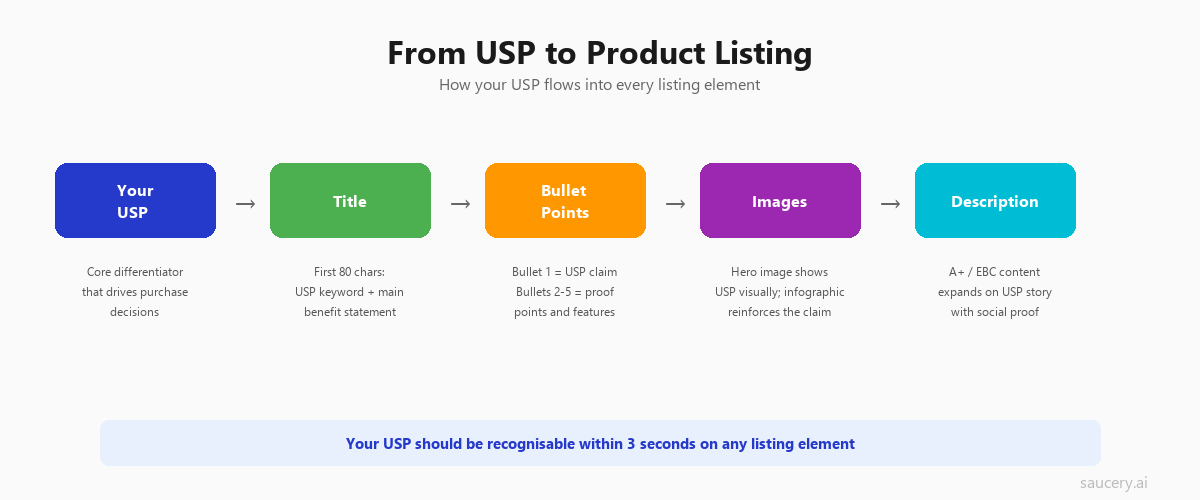
For Amazon listings specifically, your USP needs to work at three speeds:
- Thumbnail speed (1-2 seconds): Your main image and title communicate the USP before a click
- Scan speed (5-10 seconds): Your bullet points reinforce and expand the USP for shoppers who clicked but are deciding quickly
- Deep-dive speed (30+ seconds): Your A+ Content and product description provide the evidence, story, and social proof that converts considered buyers
Every brand in this guide operates at all three speeds. Death Wish Coffee’s “World’s Strongest” works as a title, a bullet point, and a full-page A+ Content story. Mighty Patch’s “shows you it’s working” works as a main image (colour-changing patch), a bullet point (hydrocolloid technology explanation), and a review photo (users showing their used patches).
If your USP only works at one speed, it is not robust enough. Go back to the patterns and find a version that can be expressed visually (image), textually (title/bullets), and narratively (A+ Content).
Your product pricing strategy should also reflect your USP. If your unique proposition is premium (process claims, patented technology, professional endorsement), your price needs to signal premium too. A USP that says “machined from a single block of aluminium” at a budget price point creates cognitive dissonance – the buyer does not believe the quality claim because the price contradicts it.
Frequently Asked Questions
What is a unique selling proposition example?
A unique selling proposition example is a real-world instance of a brand making a specific, differentiated claim that separates their product from competitors. For instance, Death Wish Coffee’s “World’s Strongest Coffee” is a USP example because it makes a superlative claim that no other coffee brand makes, directly addressing what their target buyer (caffeine seekers) cares about most. Good USP examples are specific, measurable, different from competitors, and relevant to the buyer’s decision moment.
How do I write a USP for my e-commerce product?
Start by identifying your buyer’s primary purchase objection – the single biggest reason a qualified buyer would hesitate. Then find your structural advantage (patent, process, certification, format, or ingredient). Choose a pattern that connects your advantage to the objection: specificity (numbers), negative framing (what you exclude), social proof (who endorses you), process claims (how you make it), or outcome claims (what changes for the buyer). Finally, ensure your USP works at thumbnail speed, scan speed, and deep-dive speed across your listing.
What is the difference between a USP and a tagline?
A tagline is a memorable brand phrase (Nike’s “Just Do It”). A USP is a specific product-level claim that differentiates you from competitors and changes purchase behaviour. Taglines build brand awareness; USPs drive conversions. Many of the examples in this guide serve as both – Death Wish Coffee’s “World’s Strongest Coffee” is both memorable enough to be a tagline and specific enough to change a purchase decision. But most products need a USP that is more specific than a typical tagline would allow.
Can I have more than one USP?
You should have one primary USP that leads your messaging, but you can stack supporting claims beneath it. Chomps leads with “Whole30 Approved” (primary USP) then stacks “no sugar, no soy, no gluten” (supporting claims that reinforce the primary). Multiple USPs of equal weight create confusion because buyers cannot hold more than one key differentiator in working memory. Pick the single claim that matters most and let everything else support it.
How do I know if my USP is working?
Measure conversion rate relative to your category average. If your listing converts above the category benchmark, your USP is doing its job. On Amazon, track your unit session percentage before and after implementing a new USP. Also monitor click-through rate from search results – a USP visible in your title and main image should increase CTR from search. If neither metric improves within 2-4 weeks of implementation, your USP is either not differentiated enough or not visible enough in your listing.
Should my USP be different on Amazon versus my own website?
The core proposition should be identical – consistency builds trust across channels. But the format and emphasis may differ. On Amazon, your USP competes directly against 10+ similar products on the same page, so differentiation from those specific competitors matters most. On your own DTC website, the competition is the buyer’s inertia (not buying at all), so the USP might emphasise the outcome more than the competitive difference. Same claim, different framing for different contexts.
How often should I update my USP?
Update your USP when the competitive landscape changes – specifically, when competitors start making the same claim (your USP is no longer unique), when buyer priorities shift (your USP addresses a concern that is no longer primary), or when you develop a new structural advantage worth leading with. Do not change your USP for novelty. If it is working (above-category conversion), keep it. Consistency compounds trust. Most brands change their USP too often, not too rarely.
Your Next Step
You have 50 proven USP examples and five repeatable patterns. The gap between knowing what works and having a USP that works for YOUR product is testing. You can write three strong USP candidates in an afternoon using the framework above. But which of those three will actually change purchase behaviour in your specific market, against your specific competitors, for your specific buyer?
That is not something you can think your way to. You have to test it.
Same product. Better listing. More sales.
Find out which version of your product listing converts best – before you publish.
Saucery tests product decisions using 25 million AI shoppers calibrated to census data across 7 markets. Instead of guessing which USP resonates, you get quantified preference data showing exactly which claim drives purchase intent in your category.
Subscribe for F&B Consumer Insights
Data-driven insights on food & beverage consumer preferences, straight to your inbox.