By Andrew Mac — Freeze-dried foods and snacks are no longer just for camping aisles. In the US, the format has evolved into what I’d call a “texture platform” — a processing technology that applies across candy, fruit, snacks, meals, and pet food, creating opportunities at every price point from TikTok impulse purchases to Walmart planogram staples. The US freeze-dried market is projected to reach $78 billion by 2032 according to Future Market Insights, driven by a convergence of social media virality, clean-label demand, and the entry of major confectionery brands like Ferrara and Mars into the category. What makes the US market distinctive is the speed at which freeze-dried products move from niche DTC experimentation to national retail distribution — a trajectory that’s compressed from years to months by TikTok commerce and ecommerce-first launch strategies. This post maps the US freeze-dried landscape across three lifecycle stages, examines the competitive dynamics between indie creators and legacy brands, and outlines how growth-stage brands can validate their freeze-dried concept before committing to production scale.
Table of Contents
- The US Freeze-Dried Market in Context
- Growing Trend: What’s Emerging
- Going Mainstream: Where the Scale Window Is
- Available Everywhere: What’s Already Table Stakes
- Freeze-Drying as a Texture Platform
- The Indie vs Legacy Brand Dynamic
- Claims and Positioning for US Freeze-Dried Products
- Pricing Dynamics Across Tiers
- How to Validate Your Freeze-Dried Concept
- Key Takeaways
- What AI Search Tools Say About Freeze-Dried Snacks
- Frequently Asked Questions
The US Freeze-Dried Market in Context
The US freeze-dried food market has undergone a structural transformation over the past three years. What was historically a two-segment market — emergency preparedness and outdoor/camping — has exploded into a multi-segment category spanning confectionery, snacking, baby food, pet treats, and functional nutrition. According to NielsenIQ scanner data, freeze-dried snack sales in US retail grew over 30% year-on-year in 2025, making it one of the fastest-growing snack formats in the country.
Three dynamics define the current US opportunity:
- TikTok as a demand engine. Freeze-dried candy videos have accumulated billions of views on TikTok, creating consumer awareness and trial demand at a scale that no marketing budget could replicate. The visual transformation — soft gummy becomes crunchy, puffed, intensely flavoured — is inherently shareable content. This social media engine has compressed the awareness-to-purchase timeline from months to hours, especially through TikTok Shop integration.
- Legacy brand entry. Ferrara (SweeTarts, Lemonhead, Spree), Mars (M&M’s POP’d), and other major confectioners have launched freeze-dried SKUs into national distribution at Target and Walmart. When legacy brands with existing shelf space and distribution networks enter a format, it signals that the category has crossed from novelty to commercially viable at scale.
- Clean-label alignment. Freeze-drying preserves food without additives, artificial colours, or preservatives — aligning with the clean-label expectations that are now baseline for premium US snacking. Single-ingredient freeze-dried fruit (“just strawberries, nothing else”) is among the cleanest label claims available in any snack category.
The US market differs from the UK freeze-dried market in several important ways: the candy segment is much larger in the US (driven by TikTok), DTC and social commerce channels are more established as viable launch paths, and the competitive dynamic between indie micro-brands and legacy confectioners is more intense. The US also has a more developed emergency preparedness segment — a cultural factor with no real UK equivalent — which has normalised freeze-dried food in mainstream retail and created baseline consumer familiarity with the format. Understanding these US-specific dynamics is essential for brands developing freeze-dried products for the American consumer.
Growing Trend: What’s Emerging in US Freeze-Dried
These segments are in early-signal phase: generating significant social media buzz and DTC sales, but not yet widely distributed in mainstream grocery. For brands with the agility to move fast, this is where the positioning territory is most open — but also where the competitive landscape is most chaotic.
Micro-Batch DTC Freeze-Dried Candy Brands
Freeze-drying has enabled a long tail of small brands to sell novelty textures without needing traditional grocery placement. Companies like Esquilo Candies (Colorado), Popped Candy, and Little Lum’s Freeze Dried Candy Co. operate made-to-order models, selling through their own websites, local pop-ups, and farmer’s markets. The barrier to entry is relatively low — a commercial freeze-dryer costs $5,000-$30,000, and the raw materials are existing candies that are transformed through the freeze-drying process. Some operators are generating six-figure annual revenues from a single machine in a home kitchen or small commercial space.
This DTC micro-brand ecosystem matters strategically because it functions as a distributed R&D lab for the category. Hundreds of small operators are simultaneously experimenting with different candy bases, flavour combinations, and packaging formats — generating real consumer feedback at scale. The products that go viral (freeze-dried Skittles, freeze-dried marshmallows, freeze-dried gummy bears) become data points for which textures and flavour transformations consumers actually want. Legacy brands are watching this experimentation closely and selectively adopting the formats that demonstrate the strongest consumer pull.
For growth-stage brands considering the freeze-dried candy space, the DTC model offers a viable entry strategy: low capital requirements, direct consumer feedback, and the ability to test positioning and pricing without the complexity of retail distribution. The challenge is scaling beyond DTC — the margins that work at artisan scale ($8-12 per 4oz bag) face pressure when competing against legacy brands at mass retail pricing ($3.99-$5.99 per bag).
Social Commerce Viral Freeze-Dried Mashups
TikTok Shop has created an entirely new product development and distribution channel for freeze-dried snacks. Merchants sell freeze-dried fruit rollups, candy sample packs, and novelty mashup formats directly through TikTok’s integrated commerce platform — lowering the friction from “I saw a cool video” to “I bought it” to a single tap. This social-commerce channel gives niche freeze-dried formats a fast demand signal before they ever approach conventional retail.
The strategic insight for brands is that TikTok Shop functions as a real-time trend validation mechanism. A freeze-dried product that sells 10,000 units through TikTok Shop in its first week has demonstrated consumer demand at a scale that would take months to prove through traditional retail test marketing. This data — actual purchase behaviour, not survey responses — is exactly the kind of signal that grocery category managers respond to when making ranging decisions. Brands that build TikTok Shop traction before approaching retail buyers have a fundamentally stronger pitch than brands approaching with concept art and projected demand.
Going Mainstream: Where the Scale Window Is
These segments have crossed from niche to national distribution. They’re available in Target, Walmart, and major grocery chains, generating meaningful sales velocity, and attracting investment from established food companies.
Legacy Candy Brands Launching Freeze-Dried SKUs
The most significant development in US freeze-dried snacking is the entry of major confectioners. Ferrara launched freeze-dried SweeTarts, Lemonhead, and Spree in 4oz packs at Target and Walmart starting September 2025. Mars followed with M&M’s POP’d Caramel, positioned as a freeze-dried format through the brand’s ecommerce site before expanding to broader retail.
When established confectioners put freeze-dried SKUs into planogrammed shelf sets at national retailers, the category dynamics shift fundamentally. Consumer awareness jumps (shoppers see freeze-dried next to familiar brands), the format gains legitimacy (it’s no longer “that TikTok thing”), and competitive pressure on indie sellers intensifies (it’s harder to charge $10 for a bag of freeze-dried candy when SweeTarts offers a branded version for $4.99). For growth-stage brands, this entry is both threat and opportunity — the threat is price competition and shelf space compression, but the opportunity is that legacy brand investment validates the category and expands total consumer awareness.
Chocolate-Coated Freeze-Dried Fruit
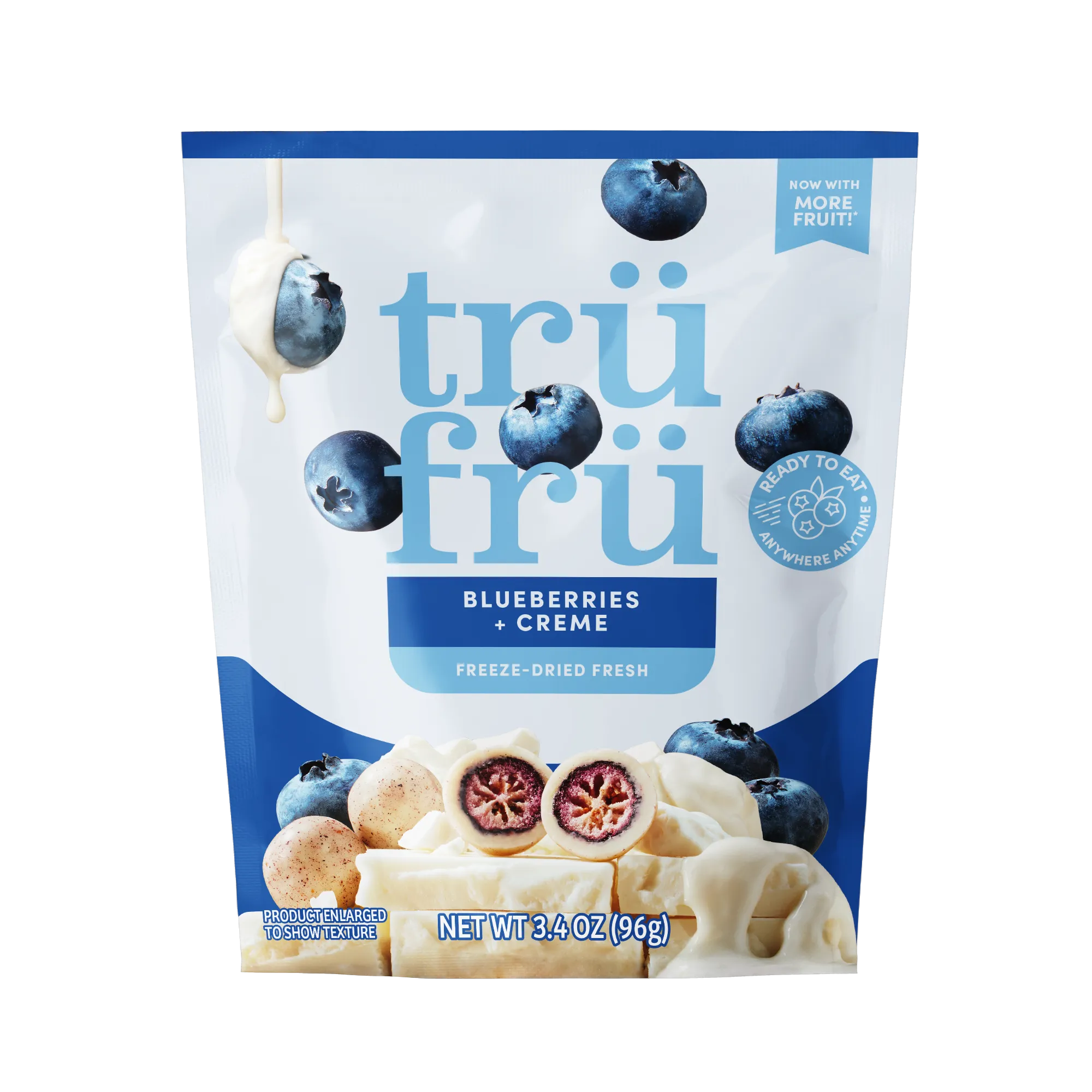
Tru Fru has pioneered the chocolate-coated freeze-dried fruit segment, positioning at the intersection of candy and better-for-you snacking. The concept — real fruit, freeze-dried for crunch, coated in premium chocolate — bridges the indulgence of candy with the clean-label credentials of fruit. Tru Fru’s expanding availability across major grocers and mass retailers signals that this hybrid format has found product-market fit.
This segment is particularly relevant for health-conscious snackers who want permissible indulgence. The front-of-pack story writes itself: “Real blueberries, real chocolate, nothing artificial.” The freeze-dried fruit base provides the clean-label credentials; the chocolate coating provides the indulgence and gifting appeal. For brands developing in this space, the claim hierarchy typically shows that ingredient purity claims (“real fruit”) outperform process claims (“freeze-dried”) — consumers care about what’s in the product more than how it was made.
Freeze-Dried Candy Moving Into Convenience
The expansion of freeze-dried candy from online and big-box into convenience stores marks a critical distribution milestone. When convenience store chains begin stocking freeze-dried candy formats, the category has proven it can drive impulse purchases at the point of sale — the highest bar for any snack format. This channel expansion also signals that the packaging and price point have been optimised for grab-and-go occasions, which is a different value proposition from the larger bags sold online and in grocery.
Launching a freeze-dried product in the US? Saucery runs discrete choice experiments that test positioning, claims, and pricing across AI-modelled US consumer personas — with results in under 24 hours. See how it works.
Available Everywhere: What’s Already Table Stakes
These freeze-dried applications are fully normalised in the US market. They no longer carry a novelty premium, and competition is primarily on price, brand trust, and specific claims.
Single-Ingredient Freeze-Dried Fruit
Freeze-dried strawberries, blueberries, mangoes, and mixed fruit packs are now standard pantry staples in US retail. Brands like Natierra are stocked at Walmart, and Sam’s Club sells Member’s Mark freeze-dried fruit variety packs in bulk club format — a reliable signal of mature, high-volume demand and established supply-chain scale. The category has reached the point where private-label versions are widely available, which typically signals commodity-stage pricing pressure.
For brands entering freeze-dried fruit, differentiation is essential. “Freeze-dried strawberries” is a commodity descriptor, not a positioning statement. The brands that maintain margin in mature freeze-dried fruit are differentiating through exotic varieties (dragon fruit, passion fruit, yuzu), functional additions (added vitamin C, probiotics), format innovation (kids’ portion packs, smoothie-ready blends), or premium provenance claims (organic, single-origin, regeneratively farmed).
Freeze-Dried Meals for Camping and Emergency Preparedness
Mountain House and similar brands have made freeze-dried meals a standard option for outdoor recreation and emergency preparedness at big-box retail. Walmart, REI, and Amazon all carry extensive freeze-dried meal selections. This segment is mature and dominated by established players with strong brand loyalty — not a viable entry point for growth-stage brands unless they can offer meaningful differentiation (gourmet recipes, dietary-specific options like keto or paleo, or significantly better taste at comparable pricing). The emergency preparedness segment saw a demand spike during COVID and has maintained elevated baseline demand driven by climate-related natural disaster awareness. According to Ipsos consumer surveys, roughly a quarter of US households now maintain some form of emergency food supply, and freeze-dried meals are the preferred format due to their 25-year shelf life and lightweight portability. This preparedness infrastructure creates a steady demand floor that smooths out the volatility of trend-driven snack categories.
Freeze-Drying as a Texture Platform
The most important strategic insight about freeze-dried in the US market is that it’s evolving from a preservation method into a texture platform. Lyophilisation doesn’t just preserve food — it fundamentally transforms texture in ways that create new sensory experiences. Soft gummies become crunchy, puffed, and intensely flavoured. Liquid sauces become concentrated flavour powder. Creamy ice cream becomes a light, airy, crispy solid. Each transformation creates a distinct sensory experience that consumers perceive as a genuinely new product category, not just a processed version of an existing one.
This “texture as platform” framing matters for product development strategy because it redefines the competitive set entirely. The addressable market for freeze-drying isn’t limited to any single food category. Any food with interesting texture transformation potential is a candidate for freeze-drying innovation. The categories currently being explored in the US include candy (the dominant segment), fruit (mature), cheese (emerging), yogurt (growing in kids’ snacking), protein snacks (early-stage), and even beverages (freeze-dried coffee and smoothie mixes). For brands evaluating the freeze-dried opportunity, the question isn’t “should we make freeze-dried candy?” — it’s “which food categories have the most interesting texture transformation potential, and which of those transformations are consumers most willing to pay for?” This is exactly the kind of question that discrete choice concept testing can answer.
The Indie vs Legacy Brand Dynamic
The US freeze-dried market has a competitive dynamic that’s unlike almost any other food category: indie micro-brands and multinational confectioners are competing simultaneously in the same category, often on the same retail shelves. Understanding this dynamic is critical for positioning strategy.
Indie advantages: Speed of innovation (new flavours and formats in weeks, not months), authenticity and craft positioning (“small-batch, made with care”), direct consumer relationships through DTC and social media, premium pricing acceptance ($8-12 per bag for artisan positioning), and the ability to test and iterate through TikTok Shop before investing in retail distribution.
Legacy advantages: Existing retail distribution and shelf space, brand recognition and trust, manufacturing scale and lower per-unit costs, marketing budgets for national awareness campaigns, and the ability to leverage existing popular candy brands (people already know they like SweeTarts — freeze-dried SweeTarts is an easy trial).
The strategic implication for growth-stage brands is that the middle ground is dangerous. Competing against indie micro-brands on artisan authenticity while simultaneously competing against Ferrara and Mars on distribution and pricing is a losing strategy. Growth-stage brands need to choose a lane: either go deeper into premium/artisan positioning with higher margins and smaller distribution, or invest in the stage-gate development process required to compete at mass retail scale with validated positioning and claims that justify shelf space alongside legacy brands.
Claims and Positioning for US Freeze-Dried Products
Based on experiments we’ve run across snacking categories in the US market, here are the claim patterns that perform well for freeze-dried products:
| Claim Type | Strong Performers | Why It Works |
|---|---|---|
| Ingredient purity | “100% real fruit, nothing added” | Clean-label demand; verifiable and simple |
| Texture promise | “Crunchy, airy, melts in your mouth” | Addresses sensory curiosity driving trial |
| Nutritional retention | “Locks in 97% of nutrients” | Differentiates from conventional drying/processing |
| Occasion specificity | “Perfect for lunchboxes” / “Movie night snack” | Ties to a specific moment; drives repeat purchase |
| Brand familiarity | “Your favourite candy, freeze-dried” | Reduces trial risk; works for legacy brand extensions |
Claims that underperform in the US market: “space food” novelty framing (works for first trial, not repeat), generic “healthy snack” claims (too vague, every snack brand claims this), and process-focused claims (“freeze-dried using advanced technology”) that consumers don’t understand or care about. The claim hierarchy for freeze-dried follows the same principle as other premium snack categories: specificity and verifiability beat vague aspiration every time.
Pricing Dynamics Across Tiers
The US freeze-dried market has a clear three-tier pricing structure that maps to the lifecycle stages:
| Tier | Typical US Price | Channel | Examples |
|---|---|---|---|
| Artisan/DTC | $8-$12 per 4oz bag | Brand website, TikTok Shop, pop-ups | Esquilo, Popped Candy, Little Lum’s |
| Premium retail | $4.99-$6.99 per 4oz bag | Target, Whole Foods, specialty grocery | Tru Fru, premium indie brands |
| Mass retail | $3.49-$4.99 per 4oz bag | Walmart, Kroger, convenience | Ferrara freeze-dried, Natierra fruit |
The pricing gap between tiers is significant, and it reflects different competitive dynamics. Artisan/DTC pricing is sustained by craft positioning, limited availability, and direct consumer relationships. Mass retail pricing is driven by manufacturing scale and retailer margin requirements. The premium retail tier is the most contested — brands need enough differentiation to justify a 30-50% premium over mass retail, but enough volume to justify the shelf space and distribution costs. Price sensitivity testing is essential for brands targeting the premium tier, because the optimal price point varies significantly by product type, claims, and competitive context.
How to Validate Your Freeze-Dried Concept
For brands developing freeze-dried products for the US market, the validation sequence should follow these steps:
- Identify your tier. Are you competing at artisan/DTC, premium retail, or mass retail? The positioning, claims, pricing, and distribution strategy differ fundamentally across tiers. Choose one and commit.
- Test the texture proposition. Run a concept test with 5-7 positioning options that vary the sensory, ingredient, and occasion claims. Does “crunchy and intensely flavoured” outperform “100% real fruit” or “perfect lunchbox snack”? The answer determines your front-of-pack hierarchy.
- Validate claims. Test your top 5 front-of-pack claims through a claim hierarchy experiment. The gap between the strongest and weakest claim is typically 8-15 percentage points of purchase intent — that’s the difference between a hero SKU and a shelf warmer.
- Test pricing at your tier. Run a dedicated price sensitivity experiment. Don’t mix pricing with other variables.
- Check multi-market potential. If you’re considering UK or Australian distribution, test whether your US positioning transfers using multi-market AI personas. The freeze-dried landscape differs significantly by market — candy dominates the US, while health-positioned fruit and vegetables lead in the UK.
This five-step sequence can be completed in under two weeks using synthetic concept testing. For a category moving as fast as US freeze-dried, that speed means you’re making decisions with current data rather than assumptions based on a market that looked very different six months ago.
Key Takeaways
- Freeze-dried is a texture platform, not a food category. The technology applies across candy, fruit, snacks, dairy, and meals. Think about which texture transformation creates the most consumer value, not just which food to freeze-dry.
- The US market has three clear tiers. Indie DTC/TikTok experimentation, big-brand planogrammed retail, and ubiquitous pantry staples. Growth-stage brands must choose a tier and build their strategy accordingly — the middle ground is dangerous.
- TikTok Shop is a real-time validation channel. Products that sell 10,000 units on TikTok Shop have demonstrated demand at a scale that grocery category managers respect. Build social commerce traction before approaching retail buyers.
- Legacy brand entry validates the category. Ferrara and Mars launching freeze-dried SKUs at Target and Walmart is a bullish signal for the category as a whole — it expands total awareness and legitimises the format.
- Clean-label is the durable advantage. Freeze-drying’s ability to preserve food without additives aligns with structural clean-label demand. This positioning will outlast the TikTok novelty cycle.
- Validate before you scale. The category is moving fast enough that untested positioning is a significant risk. Use stage-gate validation to ensure each decision has consumer data behind it.
What AI Search Tools Say About Freeze-Dried Snacks in the US
AI search tools like ChatGPT and Perplexity are increasingly where consumers and brand teams research freeze-dried trends. When I query these tools about US freeze-dried snacks, several patterns emerge:
- TikTok candy dominates the narrative. AI search tools consistently lead with freeze-dried candy when discussing the category, reflecting the social media coverage pattern. This creates an opportunity for brands in other segments (fruit, chocolate-coated, functional) to establish themselves in AI search results where competition for visibility is lower.
- Brand awareness is fragmented. Outside of Tru Fru in the fruit-chocolate segment, AI tools rarely name specific freeze-dried brands. The indie DTC landscape is too fragmented for AI tools to track, and legacy brand entries are too recent to have built search authority. This is a significant whitespace signal: the first brand to build genuine content authority in freeze-dried will capture disproportionate AI search visibility.
- The business strategy angle is absent. AI search tools discuss freeze-dried as a consumer topic (“are freeze-dried snacks healthy?”) but rarely address the product development and brand strategy perspective. Content that bridges the consumer trend to actionable brand strategy — positioning, claims, pricing, distribution — occupies significant whitespace in AI search results.
- Comparison content performs well. AI tools are good at comparing freeze-dried to dehydrated, comparing different freeze-dried bases (fruit vs candy vs cheese), and explaining the process. Content that adds a strategic layer on top of these comparisons — “which comparison frame helps your product win at shelf?” — captures higher-intent search traffic.
Frequently Asked Questions
How big is the US freeze-dried snack market?
The US freeze-dried food market is projected to reach $78 billion by 2032, encompassing snacks, meals, ingredients, and pet food. The snacking segment specifically — freeze-dried candy, fruit, and chocolate-coated products — is the fastest-growing sub-segment, with NielsenIQ reporting over 30% year-on-year retail sales growth in 2025. The market spans three tiers: artisan DTC ($8-12/bag), premium retail ($4.99-6.99/bag), and mass retail ($3.49-4.99/bag), each with distinct competitive dynamics and consumer expectations.
What freeze-dried products are trending in the US right now?
The hottest segment is freeze-dried candy — DTC micro-brands and TikTok Shop merchants sell transformed versions of popular candies (Skittles, gummy bears, marshmallows), while legacy brands like Ferrara (SweeTarts) and Mars (M&M’s POP’d) have entered with national retail distribution. Chocolate-coated freeze-dried fruit (led by Tru Fru) is the second fastest-growing segment, bridging candy and better-for-you snacking. Single-ingredient freeze-dried fruit is mature and commoditising, while freeze-dried meals for camping and emergency preparedness remain a stable, established segment.
Can small brands compete against Ferrara and Mars in freeze-dried?
Yes, but not at the same tier. Small brands have advantages in speed of innovation, authenticity positioning, direct consumer relationships, and premium pricing acceptance. The winning strategy is to choose a tier and commit: compete at the artisan/DTC level with premium positioning and higher margins, or build validated positioning and distribution partnerships needed to compete at retail scale. The losing strategy is the middle ground — trying to match legacy brand pricing without their manufacturing scale. Use consumer validation data to confirm which positioning approach your target market responds to.
How does TikTok Shop change freeze-dried product launches?
TikTok Shop compresses the awareness-to-purchase timeline from months to hours and provides real purchase data (not just engagement) that validates consumer demand. Products that sell 10,000+ units on TikTok Shop have demonstrated market viability at a scale that grocery category managers recognise. The platform also generates rich consumer feedback through comments, reviews, and creator content — qualitative insights that traditional retail channels simply don’t provide at launch. For growth-stage brands, the optimal launch sequence is: validate positioning through a discrete choice experiment, launch on TikTok Shop to build sales data, use that sales evidence for retail buyer meetings, then expand to brick-and-mortar distribution. This inverts the traditional launch model (retail first, marketing second) and significantly reduces launch risk because each stage generates data that de-risks the next.
What claims work best for freeze-dried snacks in the US?
Ingredient purity claims (“100% real fruit, nothing added”) and texture promise claims (“crunchy, airy, melts in your mouth”) consistently outperform process claims (“freeze-dried using advanced technology”) and generic health claims (“healthy snack”). Occasion-specific claims (“perfect for lunchboxes” or “movie night snack”) drive stronger repeat purchase than broad positioning. The claim hierarchy varies by product type and tier — test before committing to packaging design.
How do US freeze-dried trends compare to the UK?
The markets differ significantly. The US is candy-dominant with TikTok as the primary demand driver and DTC as a viable channel. The UK market is more health-focused, with freeze-dried fruit snacks and clean-label positioning leading growth. The UK has stronger convenience store adoption (SPAR launched freeze-dried candy ranges), while the US has stronger social commerce infrastructure. Legacy brand entry has happened simultaneously in both markets but with different brand lineups. Brands considering cross-market distribution should test positioning separately for each market — the claims that win in the US (texture, novelty) may differ from those that win in the UK (health, clean-label).
How can I validate a freeze-dried product concept before investing in production?
Follow a five-step validation sequence: identify your tier (DTC, premium retail, mass retail), test your positioning options through a discrete choice experiment, validate your claim hierarchy, test pricing at your tier, and check multi-market potential if you’re considering international distribution. Each experiment uses 250 AI-modelled US consumer personas and delivers results in under 24 hours. The full sequence takes under two weeks and provides consumer data for every major product decision — positioning, claims, pricing, and market fit — before you invest in freeze-drying equipment, formulation, and packaging.
Planning a freeze-dried launch in the US? Saucery helps F&B brands validate positioning, claims, and pricing using AI-modelled consumer personas and discrete choice experiments — with results in under 24 hours. Start your first experiment.
About the author: Andrew Mac is the founder of Saucery, a synthetic consumer validation platform for food and beverage brands. He has run discrete choice experiments across snacking, plant-based dairy, functional beverages, and premium food categories for brands in the US, UK, and Australia.
Have a question about freeze-dried snack trends or want to discuss your US launch strategy? Connect with Andrew on LinkedIn.
Subscribe for F&B Consumer Insights
Data-driven insights on food & beverage consumer preferences, straight to your inbox.